
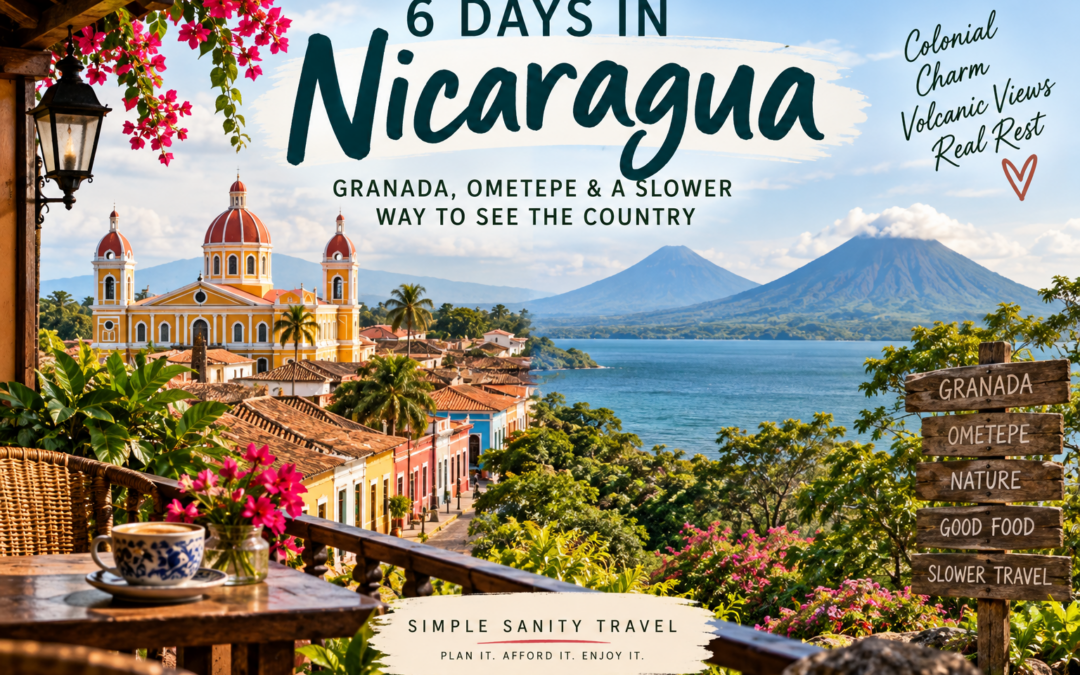
How to Plan a Visit to Nicaragua Without Losing Your Sanity
Nicaragua makes it very easy to build an itinerary around everything you could do.
Volcano hikes. Colonial cities. Surf beaches. Coffee regions. Nature reserves. Lakes. Islands. Waterfalls. Markets. Wildlife.
For a six-day trip, trying to combine all of them usually means spending more time moving than experiencing.
For a first visit, I would keep the itinerary focused on Granada and Isla de Ometepe.
The two destinations give you very different experiences without requiring you to cross the entire country. Granada provides architecture, history, restaurants, markets, and easy access to Lake Nicaragua and nearby natural attractions. Ometepe shifts the pace completely, with volcanic landscapes, rural communities, wildlife, beaches, springs, and a much quieter rhythm.
More importantly, this itinerary asks you to change hotels only once.
For a short trip, that matters.
You are not trying to see all of Nicaragua in six days.
You are choosing two places that offer enough contrast to make the trip interesting without turning it into a transportation schedule.
Affiliate Disclosure: This post may contain affiliate links, which means I may earn a small commission if you make a purchase or booking through one of my links, at no additional cost to you. I only recommend products, services, and travel resources that I believe may be helpful to my readers. I am also a participant in the Amazon Services LLC Associates Program, although not every post includes Amazon affiliate links.
Why Go to Nicaragua?
Nicaragua offers one of the most dramatic combinations of volcanic landscapes, colonial history, lakes, tropical ecosystems, and Pacific coastline in Central America.
Granada and Ometepe show two very different sides of that landscape.
Granada was founded by the Spanish in 1524 and developed along the northwestern shore of Lake Nicaragua. UNESCO describes it as one of the oldest Spanish-founded cities in the Americas that remains in its original location. Its historic architecture reflects centuries of colonial and nineteenth-century development, while its position near Lake Nicaragua connects the city directly to the natural environment surrounding it. Granada and its natural surroundings have been on Nicaragua’s UNESCO World Heritage Tentative List since 2003.
Ometepe feels completely different.
The island rises out of Lake Nicaragua around two volcanoes, Concepción and Maderas, creating one of the country’s most recognizable landscapes.
Ometepe is also internationally recognized for its ecological importance. The island is part of UNESCO’s Man and the Biosphere Programme and is one of Nicaragua’s three recognized biosphere reserves.
Together, Granada and Ometepe give you culture, history, architecture, water, wildlife, volcanic scenery, and rural landscapes without requiring you to build a six-stop itinerary.
PLAN IT
How Many Days Do You Need in Nicaragua?
For this itinerary, I recommend six days and five nights, although adding a seventh night can make the final transfer significantly easier depending on your international flight schedule.
A simple route looks like this:
Day 1: Arrive and settle into Granada.
Day 2: Explore Granada.
Day 3: Choose one excursion from Granada.
Day 4: Travel to Isla de Ometepe.
Day 5: Spend a full day exploring Ometepe.
Day 6: Return to the mainland and continue your journey.
I would divide the nights as three nights in Granada and two nights on Ometepe.
If your flight home requires an early departure or a tight connection from the island, add another mainland night rather than building your airport plan around a ferry crossing and several hours of road transportation.
Day 1: Arrive in Granada
Keep arrival day simple.
Depending on your flight and transportation arrangements, you may already have spent several hours traveling before you reach Granada.
Check into your hotel, walk around the historic center if you have the energy, have dinner, and allow the city to be your introduction to Nicaragua.
Granada is especially well suited to this kind of arrival because much of its appeal does not require a formal sightseeing schedule.
Colorful architecture, churches, plazas, restaurants, cafés, markets, and Lake Nicaragua give you plenty to experience simply by being there.
Day 2: Explore Granada
Use your first full day to experience the city itself.
Granada is one of Nicaragua’s best-known cultural destinations, with a historic center shaped by colonial and neoclassical architecture.
Walk around Parque Central.
Visit some of the city’s churches.
Explore local markets.
Stop for coffee.
Give yourself time for lunch.
The city works particularly well when you allow some space between attractions rather than treating every historic building as another item to complete.
A centrally located hotel is especially useful here because you can walk much of the historic core and easily return to your room or hotel courtyard during the hottest part of the day.
Day 3: Choose One Granada Excursion
Granada makes a convenient base for several nature and adventure experiences.
You could take a boat trip through the Isletas de Granada, explore the lake, visit nearby natural areas, or choose a volcano-focused excursion.
The important word is choose.
You do not need three major experiences in one day.
The Isletas de Granada
The Isletas are a group of small islands near Granada in Lake Nicaragua.
A boat trip offers a completely different view of the region and can include birdlife, lake scenery, and views back toward the surrounding volcanic landscape.
It is also an easier way to experience the natural side of Granada without committing to a physically demanding activity.
What About a Volcano?
Volcanoes are central to Nicaragua’s geography, and many first-time visitors understandably want to include one volcano-related experience.
If that is important to you, this is a reasonable place to build it into the itinerary.
But choose the experience based on your actual interests and fitness level.
You do not need to climb a volcano simply because Nicaragua has several of them.
A guided nature experience, viewpoint, crater visit, or other lower-intensity option may make more sense depending on the traveler.
The goal is not to collect volcanoes.
It is to experience the landscape.
Day 4: Travel to Isla de Ometepe
This is the main transition day of the trip.
Ometepe sits within Lake Nicaragua, so reaching the island requires coordinating ground transportation with a ferry or boat crossing.
The most common route involves traveling toward San Jorge near Rivas and taking the ferry across to Ometepe, often arriving at Moyogalpa.
The lake crossing itself is part of the experience, but the entire journey takes enough time that I would not schedule an important excursion immediately after arrival.
Get to the island.
Reach your hotel.
Unpack.
Have something to eat.
Enjoy the landscape.
That is enough for the day.
Ferry schedules can change, so verify current departure times close to your trip rather than building an itinerary around an old schedule.
Where Should You Stay on Ometepe?
Location matters more on Ometepe than many first-time visitors expect.
The island is larger than it appears on a map, and travel between different areas can take time.
Common bases include Moyogalpa, Altagracia, Santo Domingo, and smaller communities around the island.
Moyogalpa is practical for ferry access and transportation connections.
Santo Domingo and other more rural areas may offer a quieter stay closer to beaches, nature, or specific attractions.
For this itinerary, I would choose the hotel based on the experience you want and the activities you actually plan to do.
A less expensive hotel can quickly become less convenient if every activity requires a long transfer.
Before booking, ask:
How am I getting there from the ferry?
How far is it from the experience I actually want to do?
Can I easily get meals?
Will I enjoy spending downtime at the property?
Those questions are often more useful than simply sorting accommodations by nightly rate.
Day 5: Explore Ometepe
You only have one full day on the island, so choose one primary experience and allow the rest of the day to remain flexible.
Ometepe offers hiking, wildlife, springs, beaches, kayaking, cycling, smaller communities, petroglyphs, and scenic drives.
You are not going to experience all of them in one day.
Nor should you try.
If You Want to Hike
Concepción and Maderas dominate Ometepe’s landscape and attract hikers looking for more physically demanding experiences.
A volcano hike can be a major undertaking.
If hiking is one of the reasons you chose Ometepe, research current trail conditions, guide requirements, weather, and physical demands before booking.
Do not assume that every volcano experience is equivalent.
Conditions can be steep, muddy, humid, and strenuous.
A guided hike can also require much of the day.
Make it your main activity rather than something you attempt to squeeze between several others.
If You Prefer a Less Strenuous Day
You do not need to summit a volcano to experience Ometepe.
Alternatives can include easier walks, kayaking, birding, beaches, local communities, petroglyphs, natural springs, or simply exploring part of the island by vehicle.
That may be a better use of the day for families, travelers with limited mobility, or anyone who prefers nature without a demanding hike.
Leave Time for the Island Itself
Ometepe rewards slower travel.
This is one of those destinations where sitting near the lake, having a long lunch, walking around your hotel grounds, or spending several hours somewhere scenic can be as memorable as another formal attraction.
That is part of why I recommend two nights.
One night turns the island into a transportation exercise.
Two nights gives you a full day where you are actually there.
Day 6: Return to the Mainland
Your final day depends heavily on your flight schedule and what comes next.
If you are continuing elsewhere in Nicaragua, you can leave Ometepe and move on.
If you are flying internationally the same day, be much more cautious.
You are relying on transportation from your hotel, a ferry crossing, road travel, traffic, and airport processing.
That is a lot of moving pieces.
If the flight timing is tight, add another mainland night.
A slower six-day itinerary only works if the final day does not undo all of the pacing you built into the rest of the trip.
Should You Add León or San Juan del Sur?
Not to this six-day itinerary.
León deserves time for its own history, architecture, museums, and surrounding volcanoes.
San Juan del Sur and Nicaragua’s Pacific coast create another completely different type of trip centered more heavily around beaches, surfing, and coastal life.
Both are reasonable additions if you have more time.
Neither needs to be added simply because you found an itinerary online that included them.
For six days, Granada and Ometepe provide enough contrast.
AFFORD IT
How Much Does a Trip to Nicaragua Cost?
Nicaragua can offer very good value for travelers, especially when compared with more developed tourism destinations in the region.
Current traveler-reported spending puts the average at roughly $50 per person per day in Granada and about $44 per person per day on Ometepe, including accommodations, meals, local transportation, and sightseeing.
For this itinerary, however, I would use slightly broader planning ranges because private transfers, more comfortable hotels, ferry logistics, and guided activities can increase costs.
- Budget: $40–$65 per person, per day
Simple guesthouses or hotels, local meals, economical transportation, walking, and mostly inexpensive or free activities. - Comfortable: $75–$130 per person, per day
Comfortable hotels, restaurant variety, convenient transfers, ferry transportation, several paid experiences, and more flexibility. - Upscale: $175–$300+ per person, per day
Boutique or higher-end accommodations, private transportation, private guides, upgraded dining, and premium nature or wellness experiences.
For six days, that gives you a rough on-the-ground budget of:
- Budget: $240–$390 per person
- Comfortable: $450–$780 per person
- Upscale: $1,050–$1,800+ per person
International airfare is separate.
Solo travelers should budget toward the higher end because hotel rooms and private transfers cannot be divided among multiple travelers.
What Should You Budget for Hotels?
Granada has accommodations across a broad range of prices.
Current hotel-rate data puts many budget rooms around $55–$100 per night, midrange properties around $90–$170, and higher-end properties above that, although smaller local guesthouses can be less expensive.
For planning, I would use:
- Budget hotel or guesthouse: $30–$70 per room, per night.
- Comfortable midrange or boutique hotel: $70–$150 per room, per night.
- Upscale or resort-style stay: $175–$350+ per room, per night.
Ometepe can be less expensive overall than Granada. Traveler-reported data currently places the typical double-occupancy room around $26, although actual rates vary widely depending on location and hotel style.
On Ometepe, I would spend less energy chasing the cheapest rate and more time choosing the correct location.
Saving $20 on the room is not especially helpful if you then spend more money and time moving across the island every day.
Spend More on Transportation Where It Removes Friction
Transportation deserves more of the budget on this itinerary than it might appear at first.
Granada itself is very walkable.
Getting between Managua, Granada, San Jorge, the ferry, and your Ometepe hotel requires more coordination.
A shared shuttle or public option may be perfectly reasonable for some travelers.
Families, groups, and travelers who value convenience may find private transportation worth the additional expense.
Compare the total cost per vehicle rather than automatically assuming private transportation is too expensive.
The more people traveling together, the more competitive it can become.
Spend More on One Experience You Really Want
Choose one experience where expertise or access genuinely improves the day.
That might be:
- A guided nature excursion
- A private Isletas boat trip
- A volcano experience
- A guided Ometepe hike
- A wildlife or cultural tour
You do not need a private guide for every hour of the trip.
Spend where the guide changes what you see or understand.
Save by Walking in Granada
Granada is one of the easiest places on this itinerary to enjoy without continuously spending money.
Walk through the historic center.
Visit plazas.
Look at architecture.
Explore the market.
Sit somewhere with coffee.
A city does not have to become a series of paid attractions to be worthwhile.
Save by Eating Locally
Local restaurants can keep food expenses very manageable.
Look for Nicaraguan staples such as gallo pinto, grilled meats, plantains, cheese, rice, beans, fresh juices, and other regional dishes.
Mix casual local restaurants with any higher-end meals you are particularly interested in.
You will generally spend less and experience more than if every meal happens inside an international-style hotel.
Can You Use Points and Miles?
Airline miles or transferable credit-card rewards may be useful for international airfare into Nicaragua or another Central American gateway.
As always, compare award pricing with the cash fare before transferring points.
Hotel rewards are less central to this itinerary.
Granada and Ometepe both have numerous independent and boutique accommodations, and some of the more interesting properties may not belong to major hotel programs.
Use points where they provide good value.
Do not let loyalty status choose your entire itinerary.
Save Strategically and Spend Locally
This itinerary is especially well suited to the same strategy I recommend throughout the series:
Save money where travel rewards or careful planning make sense, then direct more of your remaining budget toward the destination itself.
Hire a local guide.
Use a local boat operator.
Eat at independent restaurants.
Buy from local shops and artisans.
Choose accommodations with ties to the community when they fit your needs.
Making travel affordable does not require making your impact on the destination as small as possible.
ENJOY IT
When Is the Best Time to Visit Nicaragua?
Nicaragua generally has a drier season from approximately November through April and a rainy season from roughly May through November.
The dry season can make road travel, city exploration, ferry connections, and outdoor activities easier.
The wetter months bring greener landscapes, but heavy rain can affect roads, hiking conditions, ferry travel, and outdoor plans.
The U.S. State Department notes that Nicaragua’s rainy season can bring flooding and landslides and that tropical storms and hurricanes are also possible.
If you travel during the wetter season, build additional flexibility into transportation days.
Ometepe in particular is not the place to create a tightly timed itinerary around perfect weather.
What Should You Pack?
For Granada and Ometepe, pack for heat, humidity, walking, water, and variable outdoor conditions.
Useful items include:
- Lightweight breathable clothing
- Comfortable walking shoes
- Sandals
- Sun protection
- Hat
- Insect repellent
- Refillable water bottle
- Light rain jacket during wetter months
- Small day bag
- Swimsuit
- Portable charger
- Quick-drying clothing if you are planning outdoor activities
If you intend to hike either volcano on Ometepe, check the current guide’s recommendations carefully.
The footwear and equipment appropriate for walking around Granada are not necessarily appropriate for a steep volcanic trail.
Is This Nicaragua Itinerary Good for Families?
Yes, particularly if you choose Ometepe activities based on the ages and abilities of your children.
Granada is relatively easy to experience at a slower pace because the historic center can be explored without building the day around strenuous activities.
Boat trips, markets, architecture, and lake experiences can also provide variety.
On Ometepe, the main consideration is transportation and physical activity.
A demanding volcano hike may not make sense for every family.
Easier nature experiences, beaches, springs, wildlife, or scenic exploration may offer a much better day.
The destination is flexible enough that families do not need to experience it in exactly the same way as adventure travelers.
What Should Solo Travelers Consider?
Solo travelers can combine considerable independence with prearranged logistics.
Granada is an easy place to explore independently once you are settled.
The more important planning decisions involve the transfers between destinations and transportation on Ometepe.
Know how you are getting from Granada to the ferry.
Know how you are getting from the port to your hotel.
Know how you are reaching the activity you booked the following day.
Arranging those pieces before arrival reduces uncertainty without turning the trip into an escorted tour.
What Should Travelers With Mobility Concerns Consider?
Granada and Ometepe require different accessibility considerations.
Granada involves walking through historic streets and older buildings where accessibility can vary.
Ometepe’s rural roads, natural attractions, beaches, hiking areas, and smaller hotels can be more challenging.
Before booking, verify:
- Hotel access
- Road conditions
- Distance from the ferry
- Steps and terrain
- Boat boarding requirements
- Bathroom availability
- Walking distances
- Activity-specific physical requirements
The island can still work for travelers with limited mobility, but accommodation location and transportation become especially important.
A Note About Safety and Current Travel Guidance
Nicaragua deserves particularly careful consideration when it comes to current travel guidance.
As of May 14, 2026, the U.S. Department of State lists Nicaragua at Level 3: Reconsider Travel because of crime, health risks, wrongful detention, and arbitrary enforcement of local laws. The advisory specifically states that U.S. nationals face a serious risk of wrongful detention and warns that Nicaraguan authorities may apply laws unpredictably.
The advisory also contains restrictions and cautions that travelers should read in full before deciding whether to visit.
Among other things, it recommends avoiding political commentary or demonstrations, understanding restrictions that may affect photography and other activities, and carefully considering transportation.
U.S. government employees are generally prohibited from driving outside designated areas after dark and from using public transportation because of safety concerns.
This is not a section I would treat as routine fine print.
Read the complete current advisory before booking.
Read it again shortly before departure.
Travel conditions and entry rules can change, and each traveler should decide whether the current risk level fits their own comfort level and circumstances.
Nicaragua’s UNESCO Designations Are Worth Understanding
There is an important distinction here because travelers often see the UNESCO name associated with both Granada and Ometepe.
Ometepe Island is a UNESCO Biosphere Reserve, recognized through UNESCO’s Man and the Biosphere Programme for the relationship between people and the island’s ecosystems.
Granada, meanwhile, is not currently an inscribed UNESCO World Heritage Site. The City of Granada and its natural environment has been on Nicaragua’s World Heritage Tentative List since 2003.
Nicaragua currently has two inscribed World Heritage Sites: León Cathedral and the Ruins of León Viejo.
That does not make Granada less worth visiting.
It simply means the different UNESCO designations should not be treated as interchangeable.
Six Days in Nicaragua Is Enough
A six-day Nicaragua trip does not need to cover the country from end to end.
- Start in Granada.
- Give yourself enough time to experience the city’s architecture, food, streets, and Lake Nicaragua without immediately leaving for another region.
- Choose one larger excursion.
- Then move to Ometepe.
- Stay long enough that the ferry crossing leads somewhere.
- Choose one experience that fits the way you actually travel.
- Hike if you love hiking.
- Choose an easier nature experience if you do not.
- Leave some time where the lake, the volcanoes, and the island itself are the activity.
Granada and Ometepe will not show you all of Nicaragua.
That is not the goal.
They will give you two very different ways to experience the country without requiring six days of constant movement.
Looking for a Done-for-You Nicaragua or Central America Trip?
If Granada and Ometepe appeal to you but coordinating international flights, hotels, private transportation, ferry schedules, island transfers, and activities does not, a curated or customized Nicaragua itinerary may make more sense.
This is also a destination where having the logistics organized before departure can be particularly valuable.
A well-designed customized tripcan coordinate your mainland transportation with the ferry, select an Ometepe hotel based on the experiences you actually want, and leave enough buffer around travel days that the itinerary does not depend on every connection going perfectly.
If you would rather combine Nicaragua with additional destinations in Central America, a multi-country itinerary may also work, but expect a faster pace and more frequent transfers than the six-day route in this guide.
If your priority is depth rather than quantity, use Granada and Ometepe as your starting point.
Travel information can change. Before booking or departure, confirm current government travel advisories, passport and entry requirements, ferry schedules, road and weather conditions, hotel availability, transportation arrangements, volcano and trail conditions, guide requirements, activity restrictions, and operating hours directly with official sources and travel providers.