
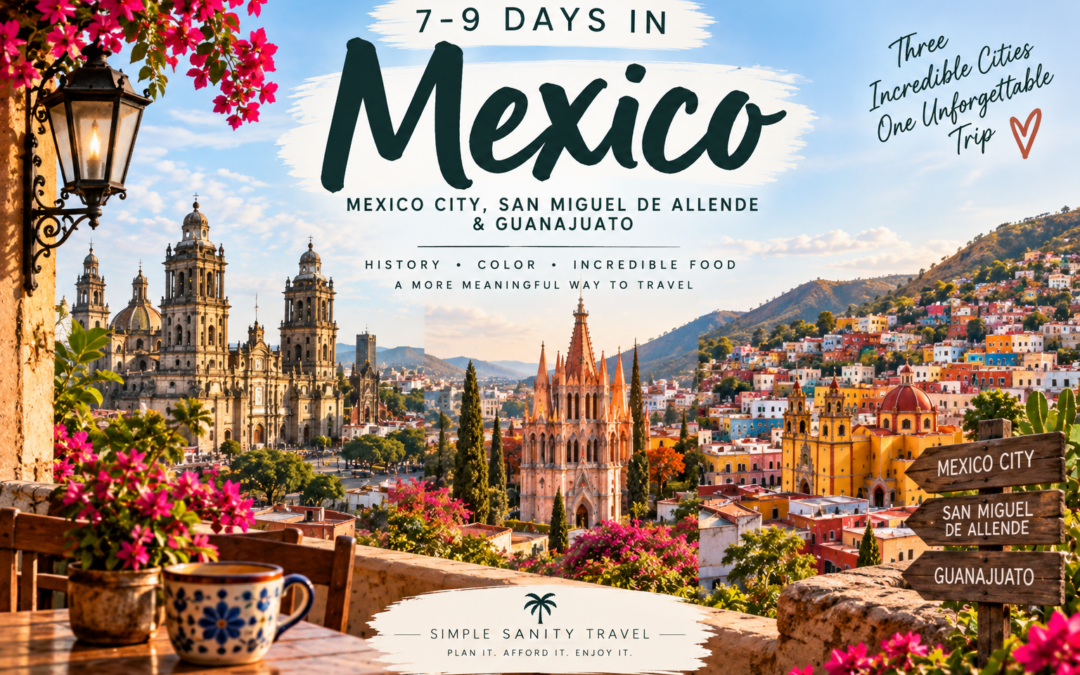
How to Travel to Mexico City, San Miguel de Allende & Guanajuato Without Losing Your Sanity
Mexico City could fill an entire vacation on its own. Add the cobblestone streets and Baroque architecture of San Miguel de Allende and the colorful hills and winding lanes of Guanajuato, and you have a trip that can get very busy, very quickly. This guide shows you how to connect all three in 7 to 9 days, including the best time to go, how long to stay, transportation, realistic budget ranges, where points can help, and how to pace the trip so you actually enjoy it.
This post may contain affiliate links. If you book or purchase through one of these links, I may earn a commission at no additional cost to you. I only share options that I believe are genuinely useful for planning your trip.
Why Go to Mexico City, San Miguel de Allende & Guanajuato?
Mexico is close enough to the United States to make a shorter international trip realistic, but it is far too large and varied to treat as one destination.
For this trip, skip the beach and head inland.
Mexico City brings layers of history, neighborhoods, museums, public art, markets, and a food scene that could keep you occupied for weeks. Its historic center alone has one of the city’s largest concentrations of museums and cultural sites.
San Miguel de Allende changes the pace. Its historic center and nearby Sanctuary of Jesús Nazareno de Atotonilco are a UNESCO World Heritage Site, recognized in part for their architecture and cultural history.
Then there is Guanajuato, with its hills, plazas, colorful buildings, and maze-like streets.
Together, these three cities give you a good introduction to central Mexico without requiring you to spend the entire trip changing hotels.
PLAN IT
How Many Days Do You Need?
Give yourself 7 to 9 days.
I would divide them like this:
Mexico City: 3 nights
San Miguel de Allende: 3 nights
Guanajuato: 1–2 nights
If you have an extra night, give it to Mexico City rather than adding another destination.
Mexico City rewards time. Pick a few things you genuinely care about rather than trying to work through a list of everything you have been told you “have” to see. The city’s official visitor resources cover everything from the Centro Histórico and major museums to neighborhoods such as Roma, Condesa, Coyoacán, and San Ángel.
San Miguel is where I would deliberately leave more blank space. Walk the historic center. Browse galleries and shops. Have a long lunch. Sit in the plaza. You do not need an attraction attached to every hour.
Then finish in Guanajuato for a final change of scenery.
Querétaro, Morelia, Pátzcuaro, Guadalajara, and Tequila are all tempting additions.
Save them for another trip.
Every extra stop means another checkout, another transfer, another check-in, and another round of figuring out where everything is. There is a point where “seeing more of Mexico” turns into seeing more of your suitcase.
When Is the Best Time to Go?
For comfortable sightseeing, roughly November through April is an easy period to consider. San Miguel typically has its driest and sunniest conditions during those months, while its wetter season falls mainly from June through September.
That does not make the rainy months off-limits. It simply means you should plan for afternoon or evening rain and build some flexibility into outdoor plans.
Also check the calendar before booking. Holidays, festivals, and major events can affect both hotel prices and crowds.
And bring layers. Elevation matters in this part of Mexico, and a warm afternoon does not guarantee a warm evening.
How Should You Get Between the Cities?
You do not automatically need a rental car.
Intercity buses make this itinerary fairly straightforward. Current direct service between Mexico City and San Miguel de Allende takes roughly four hours depending on the terminal and traffic. Service between San Miguel de Allende and Guanajuato is also available and takes roughly 1½ hours.
That makes the bus a good place to save money without adding complicated logistics.
Private transfers can still be worthwhile if you are traveling with young kids, older relatives, several suitcases, or a group that can split the cost.
What if you’re traveling solo?
Pay attention to location when choosing your hotel. A central base can make it easier to walk to dinner, return to your room during the day, and reduce how much transportation you need to coordinate alone.
What if you’re traveling with kids?
Cut a city before adding more activities. A family could easily spend three or four nights in Mexico City followed by three nights in San Miguel and call it a very good trip.
It also helps to think about how much structure your kids actually need before the trip instead of filling every open space in the schedule.
What if you’re traveling with parents or grandparents?
Research the hotel entrance as carefully as the hotel room.
Cobblestones, hills, stairs, uneven sidewalks, and older buildings can matter more than the number of stars next to a property’s name. This is especially important in Guanajuato.
When planning a multigenerational vacation with older family members, ask hotels specifically about elevators, stairs, vehicle access, and the actual walk between the property and the historic center.
AFFORD IT
How Much Should You Budget?
For planning purposes, I would start with these per-person, per-day ranges, excluding international airfare:
- Affordable: $60–$100 per day
Think simple accommodations, local meals, intercity buses, walking or public transportation, and selective paid attractions. - Comfortable: $125–$225 per day
This gives you room for a well-located hotel, a mix of casual and nicer meals, rideshares or taxis, intercity transportation, museums, and a few guided experiences. - Upscale: $275+ per day
Think boutique or luxury hotels, private transfers, higher-end dining, private guides, and more flexibility around convenience.
Use those numbers as planning ranges rather than promises. Hotel prices can change substantially by date, neighborhood, events, and room type.
The number of cities also affects your budget. Moving around costs money. Even when the bus itself is reasonable, another transfer can mean taxis to and from terminals, luggage storage, and another short hotel stay.
Can Hotel Points Help?
Yes, especially in Mexico City.
The city has a significant selection of hotels connected to major loyalty programs, including properties in and around Centro Histórico, Reforma, Roma, Condesa, and Polanco. San Miguel de Allende also has some loyalty-program options, although the selection is smaller.
Do not use points simply because you have them.
You might find that points make sense for an expensive Mexico City night while an independent hotel offers better value somewhere else.
Compare the cash rate and the award rate before booking.
Do the same with airfare. If you have transferable credit-card points or airline miles, compare the award price with the cash fare before moving any points. My approach to using credit-card points for family travel without making it another job is intentionally simple: use rewards when they meaningfully reduce the cost of the trip, not because you feel obligated to squeeze maximum theoretical value from every point.
Hotel or Vacation Rental?
Check both.
Vacation rentals can make particular sense for families and groups who need multiple bedrooms, laundry, a kitchen, or somewhere to sit together that is not the edge of somebody’s bed.
But compare the total price, not just the nightly rate.
Include cleaning and service fees, minimum stays, cancellation terms, transportation, and location. In San Miguel and Guanajuato, also look closely at hills and walking access.
A cheaper rental is not much of a bargain if everyone dreads the walk back to it.
Where Should You Spend and Where Should You Save?
Save on the things that do not substantially improve your trip.
Take the bus between cities when it works for your group. Walk when distance and mobility make sense. Use points when the redemption is worthwhile.
Spend where money makes the trip noticeably easier or more meaningful.
That could mean a centrally located hotel, a private transfer on the hardest travel day, a knowledgeable local guide, a meal you are excited about, or something made by a local artisan.
Use the points where useful, save strategically, and be thoughtful about where the rest of your travel dollars go.
ENJOY IT
Stop Collecting Cities
This may be the most important part of the guide.
Central Mexico makes it very easy to say, “Well, we’re already there…”
Then Querétaro appears on the itinerary.
Then Morelia.
Then Guadalajara.
And if you’re going to Guadalajara, shouldn’t you add Tequila?
No.
Protect your peace: three good bases are better than six rushed stops.
Mexico City alone could fill the trip. You are not going to see all of it, so stop trying.
Choose a neighborhood or two. Pick the museum you actually want to visit. Eat something memorable. Leave yourself enough time to notice where you are.
Then let San Miguel slow things down.
You do not need a reservation attached to every hour. Wander. Sit somewhere longer than necessary. Go back to the hotel in the afternoon. Have another coffee.
Guanajuato should feel like a final change of scenery, not one last city you need to conquer before flying home.
The goal is not to return with the longest list of places you saw.
The goal is to remember being there.
Want Someone Else to Handle the Bigger Trip?
If this route sounds good but you would rather see more of central Mexico without personally coordinating all the hotels and city-to-city logistics, one of my travel partners offers a more extensive organized trip through the region.
It covers more ground than the slower Mexico City, San Miguel de Allende, and Guanajuato itinerary in this guide, including additional stops such as Morelia, Pátzcuaro, Guadalajara, Tequila, and Querétaro.
That is a different travel style, and for some travelers, it is exactly the point. You can see more places while handing off many of the decisions involved in getting between them.
Explore the full Mexico itinerary from my travel partner.
Travel information in this guide was accurate at the time of posting. Prices, routes, schedules, hotel and tour availability, entry requirements, and other travel details can change. Always confirm current information directly with the relevant provider or official source before your trip.
Related Blog Posts
- Hotel Points 101: How to Earn Free Nights Without Turning It Into Another Job
- How to Prepare Your Kids for Travel: Start With Yourself
- Five Multigenerational Vacation Ideas for Families Traveling With Elderly Parents or Grandparents
- The Overwhelmed Parent’s Guide to Using Credit Card Points for Family Travel