
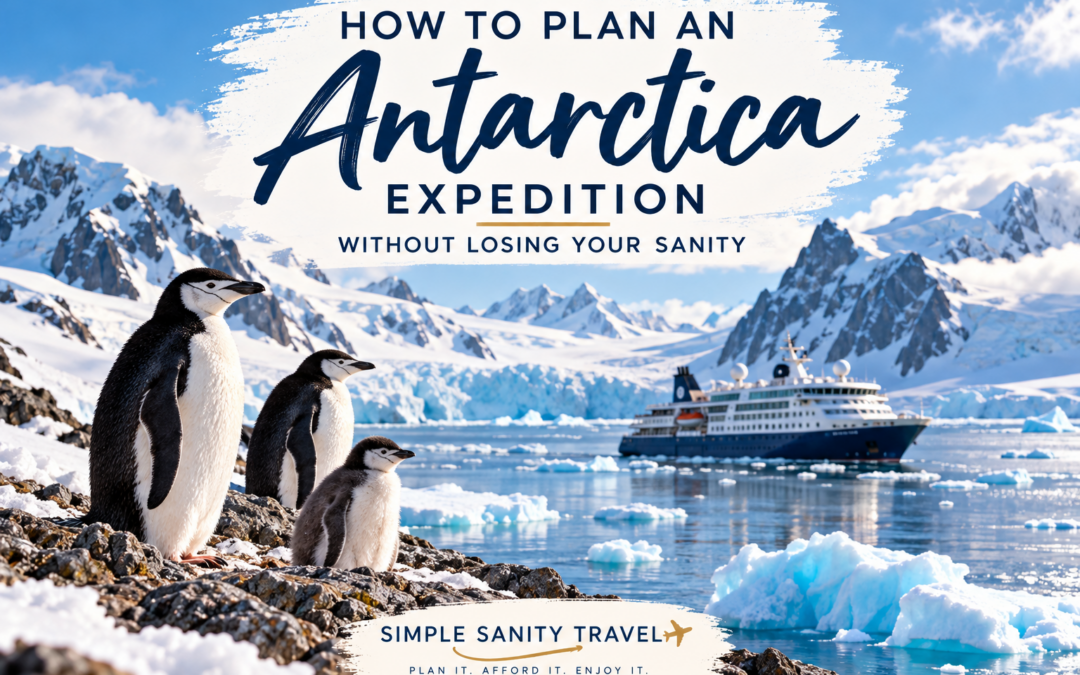
How to Travel to Antarctica Without Losing Your Sanity
Antarctica is not a normal vacation.
There are no neighborhoods to choose between. No restaurant reservations to obsess over. No rental car decision. You are essentially choosing a ship, crossing one of the world’s most famous stretches of ocean, and letting weather, ice, wildlife, and an expedition team decide exactly what happens next.
And that’s part of the appeal.
For most first-time visitors, a classic Antarctic Peninsula expedition takes roughly 10–12 days from Ushuaia, Argentina. The trick is choosing the right expedition, understanding what your fare actually includes, preparing for the Drake Passage, and accepting one important truth before you leave home: you are not going to control Antarctica.
This post may contain affiliate links. If you book or purchase through one of these links, I may earn a commission at no additional cost to you. I only share options that I believe are genuinely useful for planning your trip.
Why Go to Antarctica?
Because there really isn’t another trip quite like it.
You aren’t going for monuments, nightlife, or a carefully scheduled sightseeing route. You’re going for enormous landscapes, ice, penguins, seals, whales, seabirds, science, silence, and the strange experience of standing somewhere that still feels genuinely remote.
And getting there is part of the story.
Ushuaia sits about 1,000 kilometers from the Antarctic Peninsula and is the world’s busiest maritime gateway for Antarctic tourism. Ushuaia’s tourism authority says about 90% of Antarctic tourism passes through the city before heading south.
Then there’s the Drake Passage.
You don’t drive through it.
You don’t schedule around it.
You meet it.
For some travelers, that means calm seas. For others, it means discovering exactly how committed they are to their seasickness medication.
Either way, Antarctica rewards travelers who understand that this is an expedition, not a conventional cruise with a prettier view.
PLAN IT
How Many Days Do You Need for Antarctica?
For a first trip, I would start with the classic Antarctic Peninsula expedition, usually around 10–12 days.
A typical trip looks something like this:
| Expedition Day | General Plan |
|---|---|
| Before embarkation | Arrive in Ushuaia |
| Day 1 | Embark |
| Days 2–3 | Drake Passage |
| Days 4–7 or 8 | Antarctic Peninsula and surrounding islands |
| Days 8–10 | Return across Drake Passage |
| Final day | Disembark in Ushuaia |
The exact sequence varies.
That’s important.
Your operator may show sample landing sites and possible routes, but weather and ice conditions affect where ships can safely go. IAATO specifically notes that Antarctic operators maintain flexible itineraries because conditions change.
If your heart is set on stepping onto one particular beach on one particular day, Antarctica may have some personal growth planned for you.
Should You Start With the Antarctic Peninsula?
For most first-time visitors, yes.
The Antarctic Peninsula is the classic introduction because it’s relatively accessible from southern South America and combines dramatic landscapes with wildlife and opportunities for Zodiac cruising and shore landings.
Longer itineraries may add South Georgia and the Falkland Islands/Islas Malvinas, but those trips commonly require around 20–22 days.
That can be spectacular.
It’s also a very different commitment of time and money.
For your first expedition, don’t assume longer automatically means better.
Choose the trip you can comfortably afford, physically manage, and actually enjoy.
Why Should You Arrive in Ushuaia Early?
Because missing your ship to Antarctica would be a particularly expensive way to learn about flight delays.
I would arrive in Ushuaia at least one or two nights before embarkation, depending on how complicated your flights are.
Many international travelers first fly into Buenos Aires and then connect onward to Ushuaia. Those flights may use different airports, airlines, or tickets.
Do not construct a heroic same-day connection because the computer says it technically works.
Give yourself breathing room.
Ushuaia is also worth seeing. You can explore Tierra del Fuego, walk along the waterfront, eat well, and let your body catch up before boarding.
If you’re already traveling through Argentina, this can pair naturally with a longer trip. My 8 Days in Argentina: Buenos Aires & Mendoza Itinerary is a very different journey, but it can help you think about whether you want additional time in Argentina before or after the expedition.
How Do You Choose an Antarctica Expedition Ship?
This may be the most important decision you make.
Don’t choose based only on cabin photos.
Ask:
How many passengers does the ship carry?
IAATO categorizes vessels carrying 13–200 passengers as Category 1 ships that can make landings. Ships carrying 201–500 passengers can also make landings but face additional restrictions. Ships with more than 500 passengers are cruise-only and cannot make landings in Antarctica.
Even on landing-capable ships, no more than 100 visitors can be ashore at one site at the same time under IAATO operating requirements.
That doesn’t automatically mean the smallest ship is right for everyone.
Larger expedition vessels may offer more amenities, more cabin choices, more public space, stronger accessibility features, or a smoother onboard experience.
Smaller ships may allow a more nimble expedition rhythm.
Your question isn’t:
What’s the best ship?
It’s:
What kind of Antarctica experience do I want?
What Should You Compare Before Booking?
Make yourself a simple comparison chart.
Look at:
- Passenger count
- Landing capability
- Number and type of Zodiacs
- Expedition staff
- Cabin size and configuration
- Solo cabins or solo supplements
- Medical facilities
- Stabilization
- Included gear
- Included hotel nights
- Airport and port transfers
- Meals and beverages
- Wi-Fi
- Gratuities
- Optional activities
- Required insurance
- Cancellation terms
- What happens if weather changes the itinerary
Then look at the total price.
Not the pretty number at the top of the brochure.
The actual number.
Antarctica is not where you want to discover six months later that half the things you assumed were included were apparently just standing nearby when the brochure photo was taken.
When Is the Best Time to Visit Antarctica?
Most Antarctic Peninsula tourism happens during the austral summer, broadly from November through March, although some operations begin in October or stretch into early April.
There isn’t one universally perfect month.
The experience changes as the season progresses.
Earlier in the season, ice and snow can be especially dramatic, while access can be more dependent on ice conditions.
December and January bring long daylight hours and the height of the austral summer wildlife breeding season.
Later in the season, wildlife patterns shift and whale activity can become a major draw. IAATO data also show significant whale presence around the Peninsula and South Shetland Islands during the tourism season.
Instead of asking, “What’s the best month?”
Ask:
What do I most want to experience?
Then choose the season around that, understanding that wildlife never signs a contract.
What Actually Happens During an Antarctica Expedition Day?
This is one reason I think Antarctica works particularly well for travelers who get tired of planning every minute themselves.
The expedition team does most of that.
Depending on conditions, a day might include a morning landing, a Zodiac cruise, wildlife viewing, an afternoon landing somewhere else, onboard lectures, photography sessions, or simply standing outside staring at icebergs because apparently that’s who you are now.
Before landings, visitors receive mandatory briefings covering safe and environmentally responsible behavior.
Your expedition leader evaluates weather, ice, wildlife, landing conditions, and ship scheduling.
You follow instructions.
It is refreshingly simple.
Will You Actually Step on Antarctica?
Possibly, but read your itinerary carefully.
Some voyages include landings on the Antarctic Peninsula itself. Others may land primarily on surrounding islands. Cruise-only vessels carrying more than 500 passengers do not make Antarctic landings.
If physically stepping onto the Antarctic continent matters to you, don’t assume.
Ask before booking.
And remember that even landing-capable expeditions cannot guarantee a specific landing. Weather, ice, wildlife, and safety conditions still get the final vote.
What Is a Zodiac?
It’s the small inflatable boat you’ll probably become very familiar with.
Expedition ships use Zodiacs to move passengers between the ship and shore and to cruise through areas where the ship can’t go.
That means getting into and out of a Zodiac matters more than you might expect.
You may be wearing waterproof pants, boots, layers, gloves, a life jacket, and a camera while stepping from a moving platform onto a small boat.
This is not necessarily difficult.
But it’s something to consider if you have limited mobility, balance issues, or difficulty with stairs.
Is Antarctica Accessible for Travelers With Mobility Limitations?
This depends heavily on the ship and on what you want from the trip.
The onboard portion may be quite manageable on certain vessels, especially those with elevators, accessible cabins, and appropriate public spaces.
Landings are another matter.
Wet landings, uneven snow, rocky beaches, slippery surfaces, Zodiac transfers, and unpredictable conditions can make going ashore more difficult.
Before booking, speak directly with the operator about your specific needs.
Ask about:
- accessible cabin configuration
- elevator access
- gangways and stairs
- Zodiac boarding
- wet versus dry landings
- whether you can remain aboard comfortably during shore activities
- medical facilities
- assistance policies
Do not accept “it should be fine” as the complete accessibility assessment for a trip that costs this much.
What Should Families Know About Antarctica?
Antarctica can be extraordinary for older children and teens who are genuinely interested in wildlife, science, photography, geography, or exploration.
But don’t book it simply because it would look impressive on a family travel résumé.
Check the operator’s minimum age requirements.
Think about seasickness.
Think about long travel days.
Think about cold, Zodiac transfers, safety briefings, and whether your child can follow instructions around wildlife and remote environments.
My guide to preparing your kids for travel is especially relevant here.
For multigenerational families, Antarctica can also be memorable, but matching the ship to everyone’s physical needs matters more than forcing everyone onto the same excursion. My guide to planning multigenerational vacations can help with that conversation before anyone puts down a deposit.
What Travel Documents Do You Need for Antarctica?
Antarctica doesn’t operate like a normal country with a tourist immigration desk waiting to stamp your passport.
Tourism operates under the Antarctic Treaty System and applicable national laws. Visits must comply with authorization and environmental requirements, which commercial expedition operators generally handle as organizers.
But you still need the correct documentation for the countries you travel through.
If you’re departing from Ushuaia, that means checking Argentina’s current entry requirements for your nationality. Visa requirements vary by passport.
You also need to check your expedition operator’s documentation, insurance, health, and medical requirements.
Do this early.
A remote polar expedition is not where you want to discover that a form needed a doctor’s signature six weeks ago.
AFFORD IT
How Much Does a Trip to Antarctica Cost?
This is not the section where I tell you how to visit Antarctica for $83 and a cheerful attitude.
Antarctica is expensive.
For a classic expedition, I would use roughly $10,000–$20,000+ per person for the expedition itself as an initial planning range, understanding that cabin category, ship, departure date, trip length, activities, and operator can move that number significantly in either direction.
For context, published 2026 rates from one established expedition operator show an 11-day Antarctic Peninsula voyage with brochure prices starting around $14,895 per person for a triple suite and rising above $25,000 for some cabin categories.
Luxury expeditions and longer South Georgia combinations can go substantially higher.
And the ship fare isn’t your entire trip.
You may also need to budget for:
- international airfare
- flights within Argentina
- pre-expedition hotel nights
- post-expedition hotel nights
- transfers
- travel insurance
- medical or evacuation coverage
- gear not supplied by the operator
- optional activities
- gratuities
- Wi-Fi or beverages, depending on the ship
- meals before and after the expedition
This is why comparing the total trip cost matters more than comparing two cabin prices.
Where Is It Worth Spending More?
The right ship
This is the big one.
Saving money on a ship that doesn’t deliver the type of expedition you actually want is not strategic saving.
If landings matter, prioritize that.
If accessibility matters, prioritize that.
If seasickness makes you miserable, ship design and stabilization may matter.
If you’re traveling solo, cabin policy may matter more than whether there’s a sauna.
An extra night before departure
Please spend this money.
You are already investing thousands of dollars in Antarctica.
Protect that investment from an overly ambitious flight connection.
Insurance that actually covers your trip
Antarctica is remote.
Read the expedition operator’s requirements carefully and confirm that your policy meets them, including any required emergency medical treatment or evacuation coverage.
Don’t assume the travel insurance attached to a credit card automatically satisfies a polar operator’s requirements.
Read.
Call.
Ask.
Boring travel planning becomes very exciting when you skip it.
Where Can You Save?
Your cabin
You may spend less waking time in it than you expect.
If choosing a simpler cabin lets you take the expedition you actually want, I would seriously consider it.
An iceberg looks exactly the same whether you slept in the owner’s suite or cabin 312.
Pre- and post-trip hotels
This is a good place to use points.
Buenos Aires, in particular, has plenty of major loyalty hotels.
If you’re routing through the city, compare cash and award rates before paying for those buffer nights.
My Hotel Points 101 guide can help you decide when points are actually useful.
Optional extras
Kayaking sounds wonderful.
So does camping.
So does every other activity listed underneath a dramatic photograph.
You don’t need all of them.
The basic expedition already contains Antarctica.
Can You Use Points and Miles for an Antarctica Trip?
For the expedition itself, probably not in the straightforward hotel-points sense.
But points can still remove meaningful costs around it.
Look at using airline miles for your international flights.
Compare points for Buenos Aires hotels.
Consider using transferable credit-card points for flights or lodging before and after the expedition.
And if you’re paying a very large expedition balance by credit card, understand your card’s protections, spending limits, fees, and rewards before doing it.
My guide to using credit card points for family travel covers the broader strategy.
The goal isn’t to make Antarctica “free.”
It’s to use your points where they remove costs that would otherwise come out of your travel budget.
What Should Solo Travelers Know About Antarctica Pricing?
Pay attention to the words solo supplement.
Cruise pricing is often based on two people sharing a cabin, which can make solo travel expensive.
But don’t assume you have to pay double.
Some expedition ships have dedicated single cabins. Some operators offer cabin-share programs. Some departures reduce or waive solo supplements.
Compare the solo price, not the advertised per-person double-occupancy price.
A $1,000 difference in brochure pricing can disappear very quickly when one company charges a large single supplement and another doesn’t.
Should You Wait for a Last-Minute Antarctica Deal?
Last-minute Antarctica deals have long been part of travel lore, particularly in Ushuaia.
I would not build my entire plan around finding one.
If you’re extremely flexible about dates, ship, cabin, itinerary, and the possibility of not going at all, you can monitor late availability.
But if you’re flying internationally, arranging vacation time, traveling with other people, or care about a particular ship or cabin, book the trip you actually want when the price works for you.
Cheap is not useful if it creates a trip you didn’t want.
How Do You Decide Whether Antarctica Is Worth the Money?
Don’t compare Antarctica to a normal vacation.
Ask what you’re buying.
You’re paying for a ship capable of operating in a remote polar environment, trained expedition staff, small-boat operations, food and lodging, navigation, safety infrastructure, environmental compliance, and access to places that cannot simply be reached by booking a rental car.
That doesn’t automatically make every price worthwhile.
It explains why this isn’t a budget beach vacation.
If Antarctica is a major personal travel goal, spending intentionally on the right expedition may make sense.
If you’re considering it mostly because you want to say you’ve been to all seven continents, I would think longer before handing over $15,000.
ENJOY IT
Protect Your Peace: Can You Handle Not Knowing Exactly Where You’re Going?
This may be the most important Antarctica question.
You can book an itinerary.
You cannot book the weather.
Expedition routes change because of ice, wind, sea conditions, wildlife, landing conditions, and other operational factors.
Your expedition leader may announce that tomorrow’s landing has changed.
The beautiful harbor in your brochure may be inaccessible.
A completely different location may turn out to be the best day of the trip.
If you spend thousands of dollars expecting Antarctica to obey your spreadsheet, this trip may test you.
Book the experience, not a checklist of coordinates.
How Bad Is the Drake Passage?
It has a reputation for a reason.
The Drake is a major stretch of open ocean between South America and Antarctica, and conditions can vary dramatically.
Some crossings are relatively calm.
Some are not.
If you’re prone to motion sickness, speak with your healthcare provider before the trip about appropriate prevention or treatment.
And follow your expedition team’s advice.
This is not the moment to discover that you were too proud to take seasickness seriously.
There is no prize for experiencing the full personality of the Drake while standing upright.
What Should You Pack for Antarctica?
Start with your operator’s packing list because included gear varies.
Then think in layers, not one enormous coat.
You’ll typically need a moisture-managing base layer, insulating midlayers, waterproof outer layers, warm socks, gloves, a hat, sun protection, and clothing that works in changing wind and temperatures.
Waterproof footwear matters for landings, although some operators provide or loan boots.
So do waterproof pants.
Your expedition company may also provide a parka.
Confirm before buying half an outdoor store.
And clean your gear carefully before the trip.
IAATO specifically emphasizes biosecurity and preventing non-native species from hitchhiking into Antarctica on clothing and equipment.
Antarctica does not need the seeds from your last hiking trip.
How Close Can You Get to Penguins?
This is not a petting zoo.
Antarctic Treaty and IAATO guidance requires visitors to avoid disturbing wildlife. You should not feed, touch, handle, or approach animals in ways that alter their behavior.
Your expedition guides will explain appropriate distances and behavior.
Sometimes wildlife may approach you.
That does not turn the penguin into your new friend.
Stay still.
Follow instructions.
Take the photo.
Let the penguin continue with its day.
It has places to be.
What Should You Not Over-Plan?
Wildlife.
Landings.
Photography.
The exact number of penguins you expect to see.
The exact species of whale you expect to see.
The weather.
Your daily schedule.
This trip is unusual because less control can create a better experience.
You don’t need to spend the entire landing trying to reproduce the photo you saw online.
Look around.
Put the camera down occasionally.
You are in Antarctica.
Should You Add South Georgia?
Maybe.
But not automatically.
South Georgia is famous for extraordinary wildlife concentrations and is a major destination in its own right.
Adding it can turn a roughly 10–12 day Peninsula trip into something closer to a three-week expedition. Ushuaia’s tourism authority describes Peninsula, Falklands/Islas Malvinas, and South Georgia itineraries at roughly 20–22 days.
If wildlife is your primary reason for traveling and you have the time and money, research it carefully.
If you’re already wondering whether 11 days on a ship is a lot, perhaps don’t begin by doubling it.
Do You Need to Camp, Kayak, or Take a Polar Plunge?
No.
This needs to be said because Antarctica marketing can make ordinary landings look suspiciously insufficient.
You do not need to sleep on the ice.
You do not need to kayak between icebergs.
You do not need to jump into freezing water.
You are allowed to go to Antarctica and remain fully committed to staying warm.
Choose the extras that genuinely excite you.
Skip the rest.
How Do You Travel Responsibly in Antarctica?
Listen to your expedition team.
Follow wildlife rules.
Respect closed areas.
Don’t remove rocks, feathers, bones, plants, or historical artifacts.
Don’t interfere with scientific work.
Follow biosecurity procedures.
Don’t leave anything behind.
IAATO and the Antarctic Treaty System maintain detailed visitor guidance specifically to reduce tourism’s environmental impact and protect wildlife, scientific work, and historic sites.
Choosing an experienced operator that follows these standards matters.
Antarctica isn’t simply scenery.
It’s a protected environment with an international system governing how people interact with it.
Treat being there accordingly.
What’s the Sanity-Saving Take on Antarctica?
Spend more time choosing the expedition and less time trying to plan the expedition’s exact days.
Choose the right ship.
Understand the passenger count.
Know whether you’ll be able to make landings.
Read what’s included.
Understand the solo supplement.
Buy the right insurance.
Arrive early.
Prepare for seasickness.
Pack appropriately.
Then let go.
Because after all the research, money, flights, gear, paperwork, and decisions, the best part may be the one thing you couldn’t schedule:
A whale beside the Zodiac.
A penguin walking past you.
An iceberg that looks completely different when you see it with your own eyes.
Or a morning when the expedition leader changes the plan because Antarctica had another idea.
For once, you don’t need a better itinerary.
You just need to be ready for the one the continent gives you.
Travel information in this guide was accurate at the time of posting. Prices, routes, schedules, expedition availability, entry requirements, insurance requirements, wildlife conditions, and other travel details can change. Always confirm current information directly with your expedition operator, transportation provider, and relevant official authorities before your trip.
Related Blog Posts
8 Days in Argentina: Buenos Aires & Mendoza Itinerary
Hotel Points 101: How to Earn Free Nights Without Turning It Into Another Job
How to Prepare Your Kids for Travel: Start With Yourself
Five Multigenerational Vacation Ideas for Families Traveling With Elderly Parents or Grandparents
The Overwhelmed Parent’s Guide to Using Credit Card Points for Family Travel