
How to Travel to Uruguay Without Losing Your Sanity
Walk the cobblestone streets of a UNESCO-listed colonial town, eat steak straight from the parrilla, sip Tannat wine, bike or stroll along miles of waterfront in Montevideo, then finish beside the beaches of Uruguay’s coast.
That is a lot of variety for one small country.
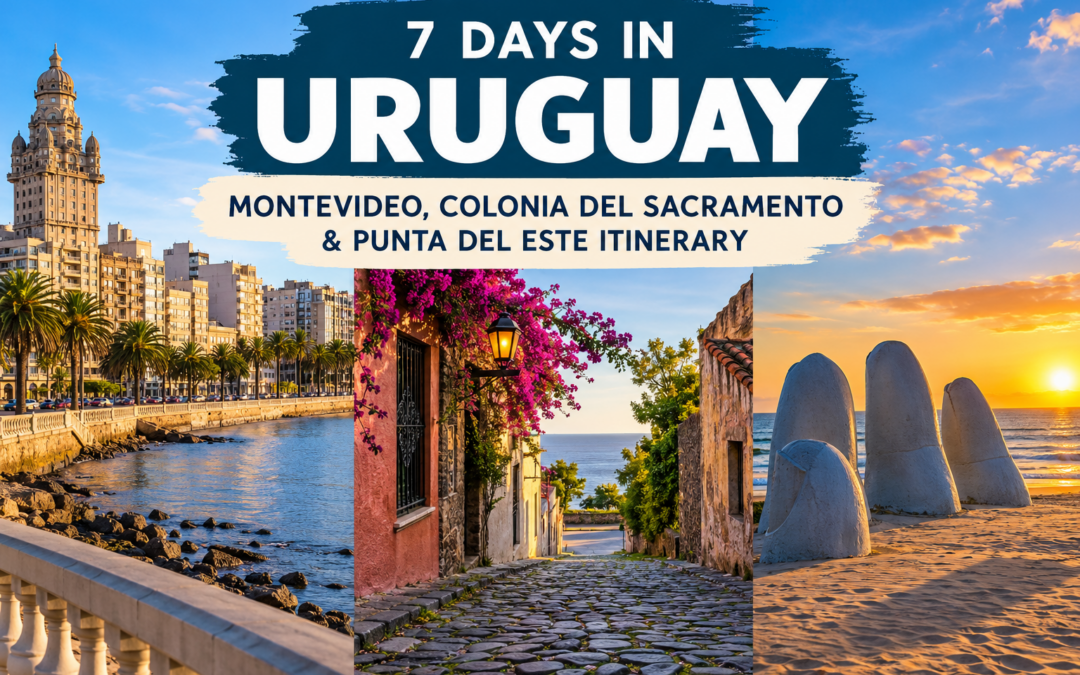
For a first trip, I would spend 7 days between Montevideo, Colonia del Sacramento, and Punta del Este. You get history, food, wine, city life, and the coast without spending half your vacation checking in and out of hotels.
This post may contain affiliate links. If you book or purchase through one of these links, I may earn a commission at no additional cost to you. I only share options that I believe are genuinely useful for planning your trip.
Why Go to Uruguay?
Uruguay is easy to underestimate on a South America itinerary.
Sitting between Argentina and Brazil, it is often treated as an add-on instead of the trip itself. But Uruguay packs several very different experiences into relatively short distances.
Montevideo gives you Ciudad Vieja, parrillas, markets, museums, wine, beaches, and a long waterfront Rambla.
Colonia del Sacramento gives you a UNESCO-listed historic quarter shaped by both Portuguese and Spanish colonial history.
Then Punta del Este changes the mood again with Playa Mansa, Playa Brava, the port, public art, restaurants, and resort-town energy.
The distances are reasonable. Intercity buses make the major routes practical. And you do not need to rent a car just to make the itinerary work.
That is a very good combination for a seven-day trip.
PLAN IT
How Many Days Do You Need in Uruguay?
Seven days gives you enough time for three distinct parts of Uruguay without turning the trip into a race.
Here is how I would divide it:
Day 1: Montevideo
Arrive, check in, and keep the first evening easy. Walk part of the Rambla if you have the energy.
Day 2: Montevideo
Explore Ciudad Vieja, Plaza Independencia, Peatonal Sarandí, Mercado del Puerto, and the historic center.
Day 3: Montevideo
Spend the day around Pocitos, Punta Carretas, the Rambla, museums, or a winery experience.
Day 4: Colonia del Sacramento
Travel to Colonia. Explore the historic quarter on foot and stay overnight so you can enjoy the town after some of the day-trippers leave.
Day 5: Colonia to Punta del Este
Enjoy a slower morning, then travel toward Punta del Este. Settle in and head to the waterfront.
Day 6: Punta del Este
Give yourself a full coastal day for Playa Mansa, Playa Brava, the port, public art, food, and whatever amount of beach time sounds good.
Day 7: Return Toward Montevideo and Depart
Plan your return around your flight time. If you have an early international departure, I would return to Montevideo the night before instead.
Three places in seven days is my limit here.
Uruguay is small.
Your vacation still does not need to become speed dating.
What Should You Do in Montevideo?
Give Montevideo two full days before moving on.
Start with Ciudad Vieja.
Plaza Independencia and the Puerta de la Ciudadela lead naturally toward pedestrian Calle Sarandí, historic buildings, museums, plazas, and eventually Mercado del Puerto.
Mercado del Puerto is worth visiting even if you are not someone who usually gets excited about markets.
The historic iron market dates to the 19th century and today is best known for its restaurants and parrillas. This is a good place to make lunch part of the sightseeing instead of treating food as something you squeeze between attractions.
Then give yourself time for the Rambla.
Montevideo’s waterfront promenade stretches for miles along the Río de la Plata and is part of everyday city life. People walk, run, cycle, fish, drink mate, meet friends, and sit by the water.
That last activity is free.
I recommend it.
Should You Visit a Winery From Montevideo?
If you enjoy wine, yes.
Uruguay is particularly associated with Tannat, its signature red wine, and there are wineries around Montevideo where you can book tastings, tours, and meals.
This is one place where I would consider paying for a proper winery experience instead of trying to squeeze a tasting between unrelated attractions.
If wine is not your thing, skip it.
You do not have to become interested in wine because you crossed an international border.
Use that time for museums, neighborhoods, the Rambla, cafés, or a longer lunch instead.
Where Should You Stay in Montevideo?
For a first visit, I would look at Pocitos, Punta Carretas, or a well-located option closer to Ciudad Vieja, depending on what matters most to you.
Pocitos works well if you want restaurants, waterfront access, and a more residential neighborhood feel.
Punta Carretas also puts you near the Rambla, restaurants, and shopping.
Staying closer to Ciudad Vieja gives you convenient access to the historic center, but compare the immediate surroundings and your evening plans before booking.
Montevideo has enough hotel variety that this is one place where location should win over chasing the absolute lowest room rate.
Why Spend a Night in Colonia del Sacramento?
Because Colonia is different after you stop treating it as a checklist.
Its Barrio Histórico is a UNESCO World Heritage Site shaped by Portuguese and Spanish colonial history. Unlike the rigid grid associated with many Spanish colonial cities in the region, Colonia preserves a different street pattern and architectural mix.
The historic center is compact enough to explore on foot.
Walk the cobblestone streets. See the old city gate and walls. Explore the small museums. Spend time around Plaza Mayor. Walk toward the water. Find somewhere for lunch.
And then do something radical.
Stay after lunch.
Colonia is commonly visited as a day trip, particularly by travelers arriving by ferry from Buenos Aires. Spending a night gives you time to experience the town without structuring the entire day around your return transportation.
Do You Need a Car for This Uruguay Itinerary?
No.
That is one of the reasons I like this route.
Uruguay has intercity buses connecting its major destinations, and Montevideo is the country’s main transportation hub.
A rental car becomes more attractive if you want to explore wineries independently, visit smaller coastal towns, or continue farther east.
But for Montevideo + Colonia + Punta del Este, I would not automatically pay for seven days of rental fees, insurance, fuel, and parking.
Compare current bus schedules before your trip, particularly for the Colonia-to-Punta del Este portion of the route. Depending on the schedule, you may need to connect through Montevideo.
Why Add Punta del Este?
Because it earns the extra hotel change.
Punta del Este gives the itinerary something Montevideo and Colonia cannot: a proper resort-coast experience.
The peninsula sits between Playa Mansa and Playa Brava, giving you two different waterfront personalities. You also have the marina, restaurants, galleries, public art, and the famous La Mano sculpture near Playa Brava.
This does not mean you need to spend the day chasing every famous stop.
Walk.
Go to the beach.
Have lunch.
See the port.
Watch the water.
That is the point of adding the coast.
What About Casapueblo?
If you have time and transportation works for your itinerary, Casapueblo can be a worthwhile addition to the Punta del Este portion of the trip.
The distinctive white complex created by Uruguayan artist Carlos Páez Vilaró sits near Punta Ballena, outside central Punta del Este.
I would treat it as an optional experience rather than something that makes or breaks the trip.
If seeing it means spending your entire beach day coordinating transportation, skip it.
You came to the coast.
You are allowed to actually see the coast.
When Is the Best Time to Visit Uruguay?
It depends heavily on whether the beach matters to you.
December through February is summer in Uruguay and the main beach season. That also means higher demand and potentially much higher prices along the coast.
If you want warm weather and the full Punta del Este summer experience, that makes sense.
If your priorities are Montevideo, Colonia, food, wine, walking, and fewer crowds, spring and fall can be good alternatives.
For this itinerary, I like the shoulder seasons because you can enjoy the coast without necessarily paying peak-summer prices.
But if your mental image of Punta del Este involves actually swimming and spending hours on the beach, choose warmer dates.
What Are the Current Entry Requirements for Uruguay?
For U.S. travelers, entry is currently straightforward.
U.S. citizens currently do not need a tourist visa for visits of 90 days or less. Uruguay is also currently listed at Level 1: Exercise Normal Precautions by the U.S. Department of State.
You still need to check current passport and entry requirements before traveling.
Rules can change, and your passport situation may be different from someone else’s.
Always confirm current requirements directly with the appropriate Uruguayan authorities and the U.S. Department of State before departure.
Is Uruguay Good for Solo, Family, or Multigenerational Travel?
Yes, but I would adjust the pace depending on who is coming.
Solo travelers may appreciate that this itinerary can be done without driving and that the major stops have plenty to do without needing a group tour every day.
For families, Montevideo’s Rambla, beaches, markets, parks, and open spaces give you options beyond museums and formal sightseeing.
For multigenerational trips, the bigger considerations are cobblestones in Colonia, walking distances, luggage during transfers, and changing hotels several times in one week.
If that sounds like too much for your group, make Colonia a day trip from Montevideo and keep only two hotel bases.
My guide to multigenerational vacation planning can help you decide whether the extra hotel change is worth it.
AFFORD IT
How Much Should You Budget for 7 Days in Uruguay?
Here is the first thing I would not do:
Plan Uruguay as if it were a bargain version of South America.
Uruguay can cost more than travelers expect, especially in Montevideo and Punta del Este.
For this itinerary, I would start with these planning ranges:
Affordable: $85–130 per person per day
Comfortable: $175–300 per person per day
Upscale: $400+ per person per day
These ranges assume two people sharing accommodations where applicable and exclude international airfare.
They are planning numbers, not promises. Hotel prices, restaurant costs, transportation fares, and exchange rates can change.
Your biggest variables will be lodging, restaurant choices, winery experiences, and when you visit Punta del Este.
Summer on the coast is a completely different pricing conversation from a quiet weekday outside peak season.
Where Should You Spend More?
I would spend where Uruguay does something particularly well.
That might mean:
• A good parrilla meal
• A winery experience with Tannat
• A well-located Montevideo hotel
• One night inside or near Colonia’s historic quarter
• A coastal hotel that lets you walk instead of constantly arranging transportation
• A special dinner in Punta del Este
Uruguay is not the destination where I would spend $40 on transportation to save $15 on a hotel.
Location matters.
Where Can You Save?
Transportation is one of the easiest places to be strategic.
You do not need a rental car for the entire trip.
Intercity buses can handle major portions of this itinerary, and Montevideo itself gives you public transportation, taxis, and ride-hailing options.
You also have plenty of inexpensive experiences.
Walking Ciudad Vieja costs nothing.
The Rambla costs nothing.
The beach costs nothing.
Watching the sunset remains stubbornly resistant to dynamic pricing.
Take advantage of that.
Can You Use Hotel Points in Uruguay?
Montevideo is the best place to try.
Major hotel loyalty programs currently have options in the city, including properties connected to Hilton Honors, World of Hyatt, Marriott Bonvoy, and IHG One Rewards.
That makes Montevideo a good place to compare:
Cash rate vs. points rate vs. location.
Do not redeem a pile of points just because the button lets you.
If the room is reasonably priced in cash, save the points for somewhere they solve a more expensive problem.
My Hotel Points 101 guide can help if you are still figuring out when a redemption is actually worth it.
Colonia and Punta del Este are where I would be more open to independent properties if the location and price make sense.
Use the points where useful, save strategically, and be thoughtful about where the rest of your travel dollars go.
Can Flight Points Help You Get to Uruguay?
Yes.
Montevideo’s Carrasco International Airport is your primary international gateway, but depending on your U.S. departure city, you may need a connection.
Search both cash fares and award availability.
I would also compare flights into Montevideo with broader South America routing options if you are combining Uruguay with Argentina.
Just be careful about building elaborate separate-ticket combinations to save a relatively small number of points.
A complicated itinerary has a cost too.
My guide to using credit card points for family travel explains why the best redemption is often the one that makes the trip easier, not the one that wins an imaginary points competition.
Should You Use Airbnb or Vrbo in Uruguay?
This is one destination where vacation rentals may be worth comparing carefully, particularly in Punta del Este.
For families and groups, an apartment near the beach can provide more space and a kitchen.
But compare the total cost.
Look at:
• Cleaning and service fees
• Parking if you have a car
• Exact distance from the beach
• Air conditioning
• Cancellation terms
• Whether linens and basic supplies are included
• Hotel breakfast or other benefits you would be giving up
In Montevideo, hotel points and competitive hotel options may tilt the calculation toward a hotel.
In Punta del Este, particularly for a group, the math may go the other way.
How Can You Spend More of Your Money Locally?
Use international hotel points where they genuinely save you money.
Then spend elsewhere.
Eat at independent restaurants and parrillas.
Book a locally operated winery visit.
Buy from local makers.
Stay at an independent property in Colonia or on the coast.
Stop for coffee somewhere that does not have a loyalty app asking for your birthday.
Travel spending does not have to be all-local or all-points.
A mix is often more realistic.
ENJOY IT
How Do You Protect Your Peace in Uruguay?
Do not confuse a small country with an invitation to see all of it.
Yes, Uruguay is relatively compact.
No, that does not mean you need Montevideo, Colonia, Punta del Este, José Ignacio, Cabo Polonio, Punta del Diablo, Rocha, three wineries, and a ferry to Buenos Aires in seven days.
The distances may fit on Google Maps.
Your energy still has opinions.
Three destinations are enough.
Is Punta del Este Worth It if You Don’t Care About Nightlife?
Yes.
Punta del Este has a reputation for summer nightlife and upscale tourism, but you do not have to participate in either.
The coast itself is the reason I included it.
Walk around the peninsula.
Choose Playa Mansa or Playa Brava.
Visit the port.
See La Mano.
Eat seafood.
Watch the sunset.
Go to bed.
Punta del Este will recover from your refusal to go clubbing.
Should You Add José Ignacio?
Not on this seven-day itinerary unless it is a priority.
José Ignacio can be a lovely coastal addition, but every addition creates another transportation decision.
If you have nine or ten days, I would start looking farther along the coast.
With seven, give Punta del Este enough time to actually feel like the beach portion of the trip.
What Should You Skip in Montevideo?
Do not turn Ciudad Vieja into an architectural scavenger hunt.
Pick the museums and historic sites that genuinely interest you.
Spend time at Mercado del Puerto.
Walk the Rambla.
Have a proper meal.
Sit somewhere.
Montevideo rewards travelers who understand that observing a city is also an activity.
How Much Should You Plan in Colonia?
Very little after the essentials.
This is exactly why I like spending the night.
Explore the historic quarter.
Learn some of the Portuguese and Spanish history behind what you are seeing.
Walk along the water.
Climb whatever you have decided is worth climbing.
Then stop.
Colonia is compact enough that trying to create a 14-item sightseeing list mostly guarantees you will walk past the same corner six times.
What Is the Sanity-Saving Take?
Uruguay works because you can get three different trips without crossing another border.
Montevideo gives you culture, parrillas, Tannat, neighborhoods, beaches, and one very long waterfront.
Colonia gives you cobblestones, colonial history, and a UNESCO-listed historic quarter.
Punta del Este gives you the coast, beach time, public art, and a completely different pace.
Seven days. Three stops. No rental car required.
That is enough.
You do not need to turn Uruguay into a race simply because the country looks small on the map.
Sometimes the better deal is not seeing more places.
It is getting more out of the ones you chose.
Travel information in this guide was accurate at the time of posting. Prices, routes, schedules, hotel and vacation-rental availability, entry requirements, attraction hours, and other travel details can change. Always confirm current information directly with the relevant provider or official source before your trip.
Related Blog Posts
Hotel Points 101: How to Earn Free Nights Without Turning It Into Another Job
The Overwhelmed Parent’s Guide to Using Credit Card Points for Family Travel
Five Multigenerational Vacation Ideas for Families Traveling With Elderly Parents or Grandparents