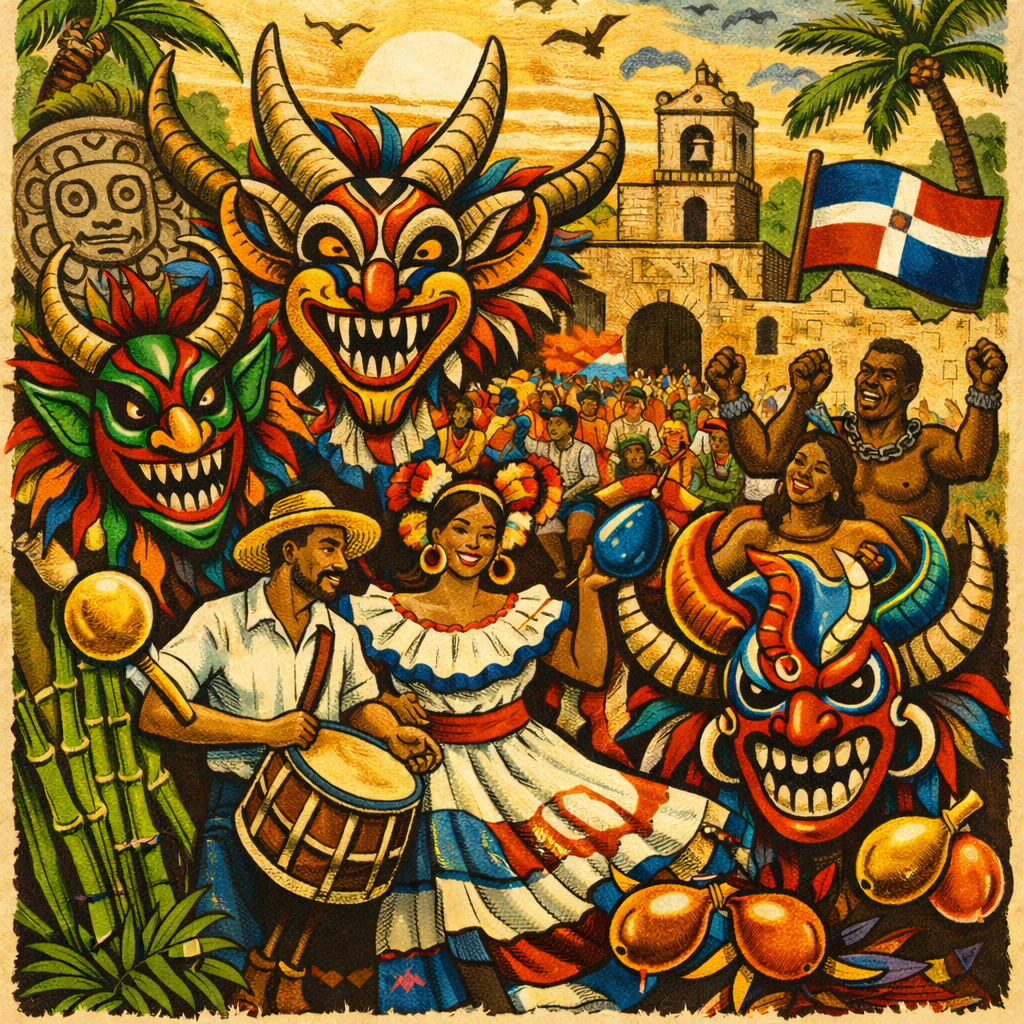
If you’ve ever seen photos of Dominican Carnival, you probably noticed the masks first—bold colors, towering horns, faces that look part-devil, part-ancestor, part inside joke you haven’t learned yet.
That reaction is exactly right. Dominican Carnival isn’t meant to be immediately legible. It’s layered, irreverent, joyful, and political all at once. It follows a Catholic calendar, moves to African rhythms, carries Indigenous symbolism, and expresses a distinctly Dominican sense of humor and resistance.
This guide is for travelers who want to experience Carnival with context, not just confetti.
1. What Dominican Carnival Is & Why It Matters
Dominican Carnival (Carnaval Dominicano) is a month-long cultural tradition celebrated every February, with major events on Sundays leading up to Independence Day (February 27).
While it may look like a street party, Carnival functions as something deeper: a public ritual of memory, satire, and survival. Through costume, performance, and sound, communities express:
-
Collective resilience under colonial rule
-
Mockery of political, religious, and social authority
-
The right to take up space through humor and excess
Carnival is one of the few moments where social order is intentionally inverted. Laughter becomes critique. Noise becomes power.
2. Roots: Indigenous, African, and Ancestral Lineages
Carnival arrived on the island through Spanish Catholic traditions tied to the pre-Lenten calendar—but what survives today is not a European copy.
Dominican Carnival is a creolized practice shaped by overlapping lineages:
-
African descendants, who used masking, drumming, and performance as coded resistance
-
Taíno worldviews, especially ideas of transformation, symbolism, and spirit embodiment
-
Colonial satire, where enslaved and marginalized people could parody elites—briefly and collectively
Over centuries, Carnival adapted to local histories, regional identities, and political realities. What emerged is a living cultural language: loud, symbolic, irreverent, and unmistakably Dominican.
3. The Diablos Cojuelos: The Face of Carnival
The most recognizable figures of Dominican Carnival are the Diablos Cojuelos (“Limping Devils”).
Despite the name, these figures are not villains. They are tricksters.
What They Represent
-
Satire of colonial authority and imposed morality
-
The chaos that interrupts rigid order
-
A reminder that power is never permanent
The Masks
Diablo Cojuelo masks are:
-
Oversized and horned
-
Hand-painted and highly individualized
-
Often crafted by local artisans or passed down through families
Each mask reflects regional style, family identity, and personal creativity.
The Whips (Vejigas)
Traditionally made from dried animal bladders, vejigas are used to lightly strike spectators. This gesture is symbolic, not violent—a reminder that Carnival dissolves the boundary between performer and audience.
Participation, even momentary discomfort, is part of the ritual.
4. Where Carnival Is Celebrated (And How It Differs)
Carnival is celebrated nationwide, but each city brings its own character and emphasis.
La Vega
-
Considered the oldest Carnival in the country
-
Highly organized comparsas (performance groups)
-
Intense, theatrical, and very crowded
Santo Domingo
-
More overtly political and satirical
-
Large parades near the Malecón
-
Easier access and orientation for first-time visitors
Santiago
-
More family-oriented
-
Strong regional pride
-
Emphasis on music and local participation
For first-time visitors, Santo Domingo often offers the best balance of scale, access, and cultural context.
5. How to Experience This Respectfully (Heritage Travel Lens)
Carnival is not a passive event. Even standing still places you inside the ritual.
What to Expect
-
Extremely loud music (merengue, bachata, palos, salve)
-
Heat, crowds, and close physical proximity
-
Masks entering your personal space
-
Full participation across generations
Cultural Etiquette
-
Ask before touching masks or costumes
-
Avoid treating performers as photo props
-
Dress comfortably and modestly—this is a family tradition
-
Learn about the whip tradition before reacting
-
Follow local guidance; attend with residents when possible
Carnival is not a costume party for visitors. It is a living, community-held tradition.
6. Practical Notes for Planning a Trip Around Carnival
-
Book accommodations early—February fills quickly
-
Expect road closures and traffic delays on Sundays
-
Wear clothes you don’t mind getting dusty or splashed
-
Bring ear protection if traveling with children
-
Schedule non-Carnival excursions on weekdays when possible
Plan with flexibility. Carnival moves on its own terms.
7. Learn More: Books, Media, and Cultural Resources
Books & Writing
-
The Dominican People
A foundational text on Dominican history and national identity, written by one of the country’s most respected historians. -
Silencing the Past
A broader Caribbean framework for understanding how history, power, and memory shape public traditions.
Museums & Cultural Centers
-
Museo del Hombre Dominicano
Offers grounding context on Indigenous, African, and mestizo cultural lineages in the Dominican Republic.
Music as Education
Listening to palos and salve is essential. Carnival does not exist without Afro-Dominican rhythms—sound is historical memory in motion.
8. How to Give Back While You’re There
Carnival sustains entire creative economies—mask-makers, musicians, food vendors, costume designers, and organizers.
Ways to support responsibly:
-
Purchase masks or crafts directly from artisans
-
Eat from local vendors rather than international chains
-
Attend community-led events, not only tourist parades
-
Ask guides and hosts who benefits from your attendance
Giving back is not about charity—it’s about circulating respect and resources within the community.
Final Thoughts
Dominican Carnival isn’t meant to be fully explained. It’s meant to be felt—through sound, movement, satire, and shared space. Arrive with curiosity rather than control, and respect rather than consumption. Carnival will meet you where you are and it will stay with you long after February ends.