
How to Travel to Paraguay Without Losing Your Sanity
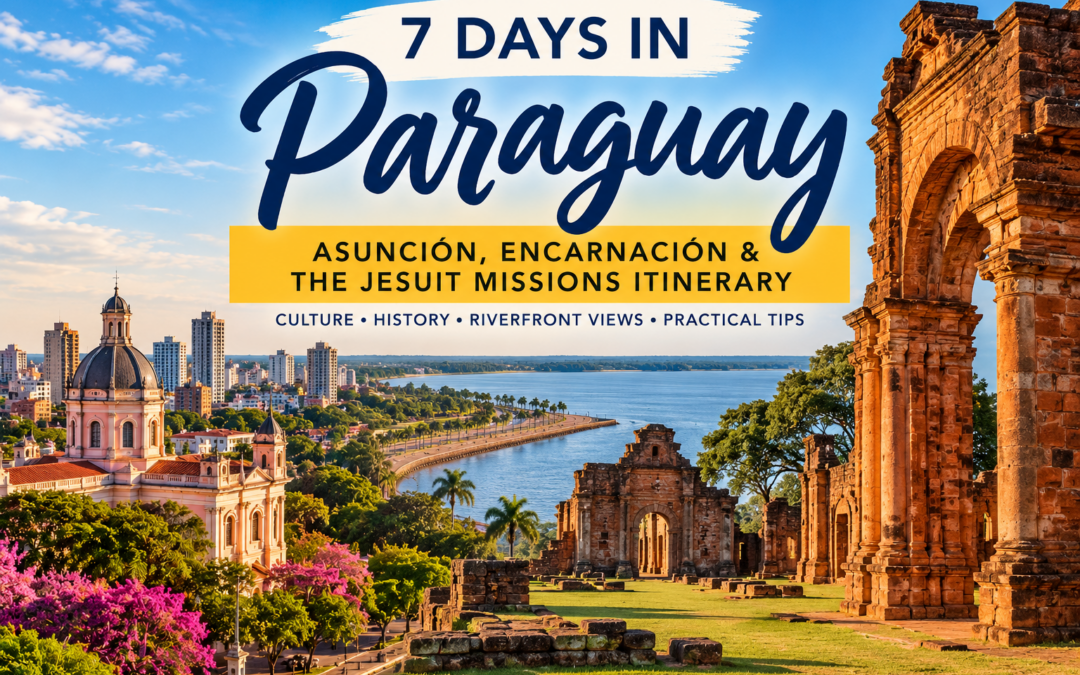
Walk through one of South America’s oldest capitals, eat chipa while hearing Spanish and Guaraní around you, then head south to explore centuries-old Jesuit mission ruins before ending the day beside the Paraná River.
Paraguay rarely gets the attention of its neighbors. That may be exactly what makes it interesting. For a first trip, I would spend 7 days between Asunción and Encarnación, using Encarnación as a base for the Jesuit Missions. Two bases. One manageable overland trip. And no need to turn the entire country into a checklist.
This post may contain affiliate links. If you book or purchase through one of these links, I may earn a commission at no additional cost to you. I only share options that I believe are genuinely useful for planning your trip.
Why Go to Paraguay?
Paraguay gives you something increasingly difficult to find in travel: a place that does not seem designed entirely around international tourism.
Asunción is one of South America’s oldest cities and remains Paraguay’s political, economic, and cultural center. You can explore historic buildings, museums, parks, restaurants, and contemporary city life without needing a complicated sightseeing schedule.
Then there is southern Paraguay.
Encarnación sits along the Paraná River, with a waterfront, beaches, restaurants, and easy access to La Santísima Trinidad de Paraná and Jesús de Tavarangue, Paraguay’s UNESCO World Heritage Site.
This is not the South America trip for someone trying to collect the continent’s biggest landmarks in seven days.
It is better for travelers who enjoy history, food, everyday culture, slower cities, and places that require a little curiosity.
PLAN IT
How Many Days Do You Need in Paraguay?
Seven days works well for Asunción, Encarnación, and the Jesuit Missions.
Here is how I would plan it:
Day 1: Asunción
Arrive, settle in, and keep the first evening easy.
Day 2: Asunción
Explore the historic center, museums, architecture, and Paraguayan food.
Day 3: Asunción
Use your second full day for neighborhoods, markets, cultural sites, and anything you did not get to the day before.
Day 4: Asunción to Encarnación
Travel south, check in, and spend the evening along the Costanera and Paraná River.
Day 5: Jesuit Missions
Visit La Santísima Trinidad de Paraná and Jesús de Tavarangue.
Day 6: Encarnación
Slow down. Explore the waterfront, eat well, visit another local attraction, or simply leave some room in the day.
Day 7: Departure or Return to Asunción
Build this around your international flight arrangements.
The important part is not trying to add Ciudad del Este, Itaipú, the Chaco, and three other places simply because you found them on a map.
Seven days goes quickly.
What Should You Do in Asunción?
Give Asunción two full days.
Start with the historic center and use the city as an introduction to Paraguay rather than treating it as the place where your international flight happened to land.
Asunción sits on the Paraguay River and mixes historic architecture with modern neighborhoods, museums, cultural spaces, parks, restaurants, and shopping areas.
This is also a good place to start paying attention to something that makes Paraguay culturally distinctive: Spanish and Guaraní are both official languages, and Guaraní remains part of everyday life.
You do not need to build a minute-by-minute sightseeing itinerary here.
Pick a few cultural and historical priorities, leave time for food, and actually look around.
Where Should You Stay in Asunción?
Your choice depends on what you want from the city.
If history and sightseeing are the priority, staying closer to the historic center can make exploring easier.
If you prefer newer hotels, restaurants, shopping, and a more contemporary base, look around areas such as Villa Morra and the Avenida Aviadores del Chaco corridor.
Asunción also has several international hotel brands, which can be useful if you have hotel points.
The goal is not to find the theoretically perfect neighborhood.
Choose the location that reduces the transportation you will personally need.
How Do You Get From Asunción to Encarnación?
For this itinerary, the long-distance bus is the straightforward option.
Asunción and Encarnación are roughly 370 kilometers apart. Plan on approximately five to six hours for the overland journey, depending on the service and road conditions.
That takes a significant chunk of Day 4, but it is manageable.
You could also rent a car, particularly if you want more flexibility around the Jesuit Missions. But I would not rent one automatically for the entire week just because road trips sound romantic.
A five-hour drive is still a five-hour drive.
Someone has to do it.
Compare the cost of a rental car, fuel, parking, insurance, and tolls against using a comfortable long-distance bus and arranging local transportation once you reach Encarnación.
Why Stay in Encarnación?
Because Encarnación does more than give you somewhere to sleep before visiting the missions.
The city sits along the Paraná River opposite Posadas, Argentina. Its waterfront includes the Costanera and several river beaches, giving the second half of the trip a completely different pace.
Asunción is your city and culture base.
Encarnación gives you riverfront time and access to the historic sites of Itapúa.
You do not need a third hotel.
Why Visit the Jesuit Missions?
This is where the trip gets especially interesting.
The Jesuit Missions of La Santísima Trinidad de Paraná and Jesús de Tavarangue are Paraguay’s UNESCO World Heritage Site. They are surviving parts of a larger network of Jesuit missions established across the Río de la Plata region during the 17th and 18th centuries.
But there is more to understand here than old stone buildings.
The missions were part of a colonial project centered on Christianizing Indigenous Guaraní communities. They also developed within the complicated realities of colonial labor systems, settlement, religion, and cultural exchange.
Indigenous traditions persisted, and the architecture reflects both European Christian influences and Guaraní artistic traditions.
That history deserves more than a quick photo stop.
At Trinidad, you can still see the layout of the former settlement, including the central plaza, church structures, workshops, school areas, cemetery, and former residences.
Jesús de Tavarangue has a different character, including an unfinished church.
The two sites are close enough to make visiting both in one dedicated day practical.
How Do You Visit the Jesuit Missions From Encarnación?
Use Encarnación as your base and make this a dedicated day trip.
Trinidad is roughly 30 kilometers from central Encarnación.
For the simplest day, arrange a driver, local tour, or rental car that allows you to visit both Trinidad and Jesús de Tavarangue without piecing together several transportation connections.
If you are comfortable navigating local transportation and have plenty of time, you can research public options.
But this is one place where paying for transportation can buy back a lot of mental energy.
There is typically an admission fee for the mission sites, and ticket structures can cover multiple locations. Check the current fee, opening hours, and ticket rules before your visit.
When Is the Best Time to Visit Paraguay?
There is no single perfect month, but heat should be part of your decision.
Paraguay can get very hot, particularly during the Southern Hemisphere summer. If your priority is walking through Asunción and spending time outdoors at the missions, the cooler part of the year can be easier for sightseeing.
Encarnación becomes especially lively during summer. Its river beaches attract domestic travelers, and the city is also known for its Carnival celebrations.
That means the “best” time depends on what you want.
Want easier sightseeing? Favor milder weather.
Want the livelier summer atmosphere in Encarnación? Accept more heat and plan your days accordingly.
Either way, check major holidays, festivals, weather, and accommodation prices for your actual dates before booking.
What Are the Current Entry Requirements for Paraguay?
For U.S. travelers, Paraguay is currently relatively straightforward.
U.S. citizens can currently visit Paraguay for short tourist stays without obtaining a tourist visa in advance.
You will still need a valid passport and should check current entry requirements before departure.
Families traveling with minors should pay particular attention to documentation, especially when only one parent or legal guardian is traveling with a child.
Before booking, check the latest requirements directly with Paraguayan authorities and review current travel information from the U.S. Department of State.
Entry rules and travel guidance can change.
A blog post you saved months ago is not immigration control.
Is Paraguay Good for Solo, Family, or Multigenerational Travel?
This itinerary can work for all three, with a few adjustments.
Solo travelers may appreciate that the route has only two bases and can be done without renting a car for the entire trip.
Families can keep Asunción flexible and make the missions the main structured sightseeing day. Kids who are old enough to engage with history may get much more from the sites if you give them some context before arriving.
If you are traveling with grandparents or someone with limited mobility, pay closer attention to heat, walking surfaces at historic sites, long overland transportation days, and how you plan to reach the missions.
My guide to multigenerational vacation planning can help you think through those tradeoffs.
AFFORD IT
How Much Should You Budget for 7 Days in Paraguay?
Paraguay can be relatively affordable once you arrive, particularly for food, local transportation, and mid-range lodging.
For this itinerary, I would start with these planning ranges:
Affordable: $60–95 per person per day
Comfortable: $110–190 per person per day
Upscale: $250+ per person per day
These ranges assume two people sharing lodging where applicable and exclude international airfare.
They are planning numbers, not promises. Hotel rates, transportation costs, exchange rates, and other expenses can change.
Paraguay can be inexpensive, but I would not build the entire trip around proving how little money you can spend.
That is not the point of AFFORD IT.
Where Should You Spend More?
Spend on the pieces that make the route easier.
For this itinerary, that might mean:
• A comfortable hotel in a convenient Asunción neighborhood
• A better long-distance bus seat
• Private transportation or a local guide for the Jesuit Missions
• A well-located Encarnación hotel
• Good travel insurance
• Experiences that help you understand Paraguayan history and culture rather than simply look at it
The Jesuit Missions are one place where I would happily spend more for good context.
You can look at old walls in plenty of places.
Understanding what happened there is more interesting.
Where Can You Save?
Food and everyday transportation give you plenty of room.
This is a good destination for eating locally rather than defaulting to international hotel restaurants.
Look for Paraguayan staples such as chipa, sopa paraguaya, mbejú, and other regional dishes as you encounter them.
Local transportation can also help keep the budget manageable.
And remember that saving strategically does not mean selecting the cheapest possible option every time.
A comfortable five-hour bus seat is allowed.
Can You Use Hotel Points in Paraguay?
Yes, especially in Asunción.
This is one of the more useful surprises in the itinerary.
Major hotel loyalty programs have properties in Asunción, including options connected to Marriott Bonvoy, Hilton Honors, and IHG One Rewards.
That gives travelers with points several options to compare.
But do the math before redeeming.
If an Asunción hotel has a reasonable cash rate and requires a large number of points, paying cash may be smarter. Save those points for the $400 hotel on another trip.
Encarnación is where I would be more open to an independent hotel and spending directly with a local property.
If you are still figuring out when points are actually useful, my Hotel Points 101 guide walks through the basics.
Use the points where useful, save strategically, and be thoughtful about where the rest of your travel dollars go.
Can Flight Points Help You Get to Paraguay?
Potentially.
International airfare may be one of the larger expenses of a Paraguay trip because Asunción does not have the same volume of U.S. service as some of South America’s larger gateways.
Search both cash and award options.
Depending on your departure city, your itinerary may involve a connection elsewhere in Latin America.
Also compare one-ticket itineraries against separate positioning flights.
A clever points redemption becomes considerably less clever when a delayed first flight causes you to miss an unrelated international ticket.
If you are new to this, my guide to using credit card points for family travel explains why I would rather have a useful redemption than a mathematically perfect one.
Should You Use Airbnb or Vrbo in Paraguay?
They can make sense, particularly for groups or longer stays in Asunción.
Compare the total price against hotels rather than looking only at the nightly rate.
Add cleaning fees, service fees, transportation from the location, cancellation terms, and anything you would otherwise receive from a hotel.
For a seven-day trip with only a few nights in each city, I would not choose a vacation rental unless it offers a clear advantage.
A kitchen you use once is not a travel strategy.
How Can Your Travel Dollars Stay in the Local Economy?
This is a particularly good destination for being intentional about it.
Stay at an independent property for part of the trip.
Eat at locally owned restaurants.
Buy food from markets and small vendors.
Use a Paraguayan guide or driver for the missions.
Buy locally produced crafts directly from makers or reputable sellers when possible.
You do not have to avoid every international hotel brand to support the local economy.
Use points where they genuinely save you money, then spend some of what you saved on local food, guides, transportation, and businesses.
That balance makes more sense to me.
ENJOY IT
How Do You Protect Your Peace in Paraguay?
Stop trying to make Paraguay compete with Argentina and Brazil.
It does not need to.
You do not need the biggest waterfall, most famous city, or most photographed landmark every day for a trip to be worthwhile.
Paraguay works better when you let it be Paraguay.
Give Asunción time.
Take the bus south.
Spend a full day understanding the missions.
Walk along the river in Encarnación.
Eat something you have never ordered before.
That is enough.
Should You Add Ciudad del Este and Itaipú?
Not automatically.
Itaipú is fascinating, and Ciudad del Este can absolutely be part of a broader Paraguay itinerary.
But adding them to this seven-day route means another significant transfer and another hotel decision.
If you have nine or ten days, then we can have that conversation.
With seven, I would choose depth over geography.
What About the Paraguayan Chaco?
Save it for another trip unless it is specifically why you are going to Paraguay.
The Chaco is enormous, remote, environmentally distinct, and worthy of much more planning than “maybe we can squeeze it in Thursday.”
That is not squeezing.
That is a separate trip wearing a fake mustache.
How Much Should You Schedule in Encarnación?
Less than you think.
Give one day to the Jesuit Missions.
Then protect the other.
Walk the Costanera. Spend time by the Paraná River. Have a long lunch. Explore without requiring every hour to produce an attraction.
Encarnación is not merely your hotel near Trinidad.
Let it be part of the trip.
What Should You Know About the Heat?
Respect it.
If temperatures are high, do outdoor sightseeing earlier and later in the day.
Carry water.
Use shade.
Take the midday break.
This matters particularly at archaeological sites where you may spend significant time walking outside.
You do not receive bonus points for sightseeing at 2 p.m. because the itinerary said so.
Move the itinerary.
What Is the Sanity-Saving Take?
Paraguay does not need an overloaded itinerary to justify the trip.
For a first visit, I would keep it simple:
Three nights in Asunción. Three nights in Encarnación. One dedicated day for the Jesuit Missions. Seven days total.
You get one of South America’s oldest capitals, Paraguayan food and everyday culture, the Paraná River, a second city with a completely different pace, and one of the country’s most important historical sites.
You also get something that can disappear when every trip becomes a greatest-hits compilation:
Room to be curious.
Paraguay may not be the country everyone else is posting about.
That might be part of the reason to go.
Travel information in this guide was accurate at the time of posting. Prices, routes, schedules, hotel availability, attraction fees, entry requirements, travel advisories, and other travel details can change. Always confirm current information directly with the relevant provider or official source before your trip.
Related Blog Posts
Hotel Points 101: How to Earn Free Nights Without Turning It Into Another Job
The Overwhelmed Parent’s Guide to Using Credit Card Points for Family Travel
Five Multigenerational Vacation Ideas for Families Traveling With Elderly Parents or Grandparents