
How to Travel to the Dominican Republic Without Losing Your Sanity
I was born in Santo Domingo and lived in the Dominican Republic until I was 19. So when I tell you the Dominican Republic is more than an all-inclusive resort, I’m not suggesting you skip the beach. I’m telling you there’s a whole country beyond it.
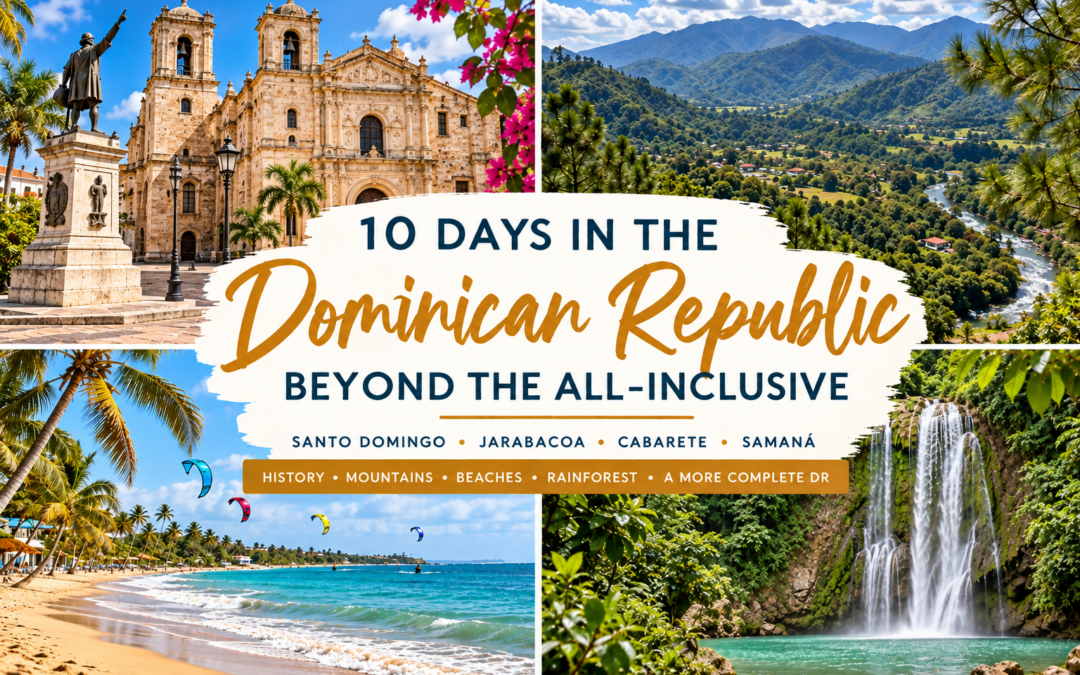
You can walk through centuries of history in Santo Domingo, wake up to cool mountain air in Jarabacoa, spend a few easy days on the beach in Cabarete, and find rainforest, waterfalls, dramatic coastline, and seasonal whale watching around Samaná.
This 10-day Dominican Republic itinerary will help you experience several sides of the country without turning your vacation into an endurance event.
This post may contain affiliate links. If you book or purchase through one of these links, I may earn a commission at no additional cost to you. I only share options that I believe are genuinely useful for planning your trip.
Why Go to the Dominican Republic?
For many travelers, the Dominican Republic means Punta Cana.
There’s a reason for that. The beaches are beautiful. The resorts make vacation easy. Sometimes you want to check into a hotel, find a chair near the water, and let somebody else worry about lunch.
I fully support this.
But that’s one kind of Dominican Republic vacation.
The country gives you mountains, waterfalls, tropical forests, historic cities, small coastal communities, and beaches far beyond the major resort areas. You can also choose from affordable locally run hotels and vacation rentals to boutique properties, familiar hotel brands, villas, and serious luxury.
The question isn’t whether you should go to a resort or avoid one.
It’s which Dominican Republic experience you actually want.
| If You Want… | Consider… |
|---|---|
| History, architecture, and city life | Santo Domingo |
| Mountains and cooler weather | Jarabacoa |
| Beach town without making the resort the whole vacation | Cabarete |
| Rainforest, waterfalls, and dramatic beaches | Samaná |
| Seasonal whale watching | Samaná |
| Windsports | Cabarete |
| Outdoor adventure | Jarabacoa |
| A traditional resort vacation | Punta Cana and other resort areas |
| A little of everything | Keep reading |
PLAN IT
How Many Days Do You Need in the Dominican Republic?
You could spend a week at one beach and have a perfectly good vacation.
But if the goal is to understand how different the country can feel from one region to another, I’d give it about 10 days.
Here’s the route I recommend:
Days 1–3: Santo Domingo
History, architecture, food, culture, and city life.
Days 4–5: Jarabacoa
Mountains, cooler temperatures, waterfalls, and outdoor experiences.
Days 6–7: Cabarete
Beach time with less agenda.
Days 8–10: Samaná Peninsula
Rainforest, waterfalls, beaches, and nature.
Four stops in 10 days is about as busy as I would make this.
You are visiting a country, not completing a scavenger hunt.
Why Should You Start in Santo Domingo?
Because Santo Domingo isn’t simply where you land before going somewhere else.
It’s my hometown, and it’s also one of the best places to begin understanding the Dominican Republic.
Give it two full days rather than rushing through the Colonial City on your way to the beach.
Spend part of that time in the Ciudad Colonial, but don’t make that the only Santo Domingo you see.
The capital is also restaurants, neighborhoods, museums, parks, nightlife, shopping, the Malecón, modern architecture, and daily Dominican life.
That distinction matters to me.
Santo Domingo has a remarkable history.
But Santo Domingo is not a historical exhibit. It’s a living city.
What’s So Important About Santo Domingo’s Colonial City?
This is one place where saying “historic” almost undersells it.
The Colonial City is a UNESCO World Heritage Site, and UNESCO identifies Santo Domingo as the site of the first cathedral, hospital, customs house, and university in the Americas. Its early grid layout also influenced the planning of cities established later throughout the Americas.
Then there’s Calle Las Damas, the first stone street in the Americas.
This part of the Colonial City is personal for me, too. Nearby is Iglesia de Las Mercedes, the church where I was baptized.
That’s one of the reasons I don’t want you to race through Santo Domingo checking monuments off a list.
Walk the streets. See the Catedral Primada de América. Explore the plazas. Look at the architecture. Sit somewhere for a while. Have something to eat.
And learn what you’re looking at.
You don’t need a history degree for your vacation, but anywhere you travel, I think it’s important to understand why a place is significant to that destination and its culture.
Santo Domingo’s Colonial City isn’t simply a collection of beautiful old buildings. Its history is also tied to European colonization and conquest. Understanding that context gives you a much better sense of the city you’re walking through.
Why Go to Jarabacoa?
This is the part that surprises people.
Yes, you can go to the Dominican Republic and want a light sweater.
Jarabacoa sits in the mountains of the Cordillera Central, giving you a completely different environment from the Caribbean coast.
Instead of palm trees and resort pools, think green mountains, rivers, waterfalls, coffee, hiking, rafting, and cooler mornings.
You can visit waterfalls such as Salto de Baiguate, go rafting, hike, ride horses, or simply use Jarabacoa as an excuse to slow down somewhere green.
You don’t need to do all of those things.
Pick one major activity.
The mountains will still be there if you don’t conquer them before lunch.
Why Cabarete Instead of Punta Cana?
Because for this particular itinerary, I want you to experience a Dominican beach town rather than immediately entering a large resort complex.
Cabarete is particularly well known for kitesurfing and windsurfing, but you do not have to attach yourself to a kite to justify going there.
The beach area also has restaurants, bars, shops, hotels, guesthouses, and condos, which makes it easier to build an independent beach stay.
That’s exactly what I want these two days to accomplish.
Go to the beach.
Eat.
Walk around.
Watch people do athletic things while you remain peacefully committed to your chair.
Cabarete also shows you that a Dominican beach vacation doesn’t have to mean choosing between a bare-bones stay and a massive all-inclusive. There are different accommodation styles and spending levels along the north coast.
This is a beach vacation.
It just doesn’t have to be the only part of the vacation.
Why Finish in Samaná?
Because Samaná shows you yet another version of tropical Dominican Republic.
Here, lush mountains and tropical forest meet the coast. The peninsula has waterfalls, beaches, mangroves, caves, protected areas, and small coastal communities.
Two places you’ll hear about frequently are El Limón and Los Haitises, and they offer very different experiences.
What Is El Limón?
Salto El Limón is a tall waterfall tucked into the green interior of the Samaná Peninsula.
Getting there is part of the experience. You’ll travel through tropical vegetation and hilly countryside before reaching the waterfall, either hiking or using one of the locally offered horseback-riding options.
It’s the better choice if what you’re picturing is waterfall + tropical landscape + active outing.
Wear shoes that can handle mud and uneven terrain.
This is not the day for the cute sandals.
What Is Los Haitises National Park?
Los Haitises National Park is a large protected landscape of mangrove forests, tropical vegetation, caves, waterways, small islands, and distinctive limestone formations that rise dramatically from the water.
It’s also culturally significant. Caves within the park contain Indigenous Taíno pictographs and petroglyphs.
Much of the park is explored by boat or kayak, making the experience completely different from hiking to El Limón.
Think mangroves + caves + wildlife + geology + Taíno history.
If you’re trying to choose between the two, I’d think about what interests you more.
Choose El Limón if the waterfall and journey to reach it sound exciting.
Choose Los Haitises if you’re more interested in ecosystems, caves, wildlife, and history.
You can certainly do both if you have the time.
You don’t have to.
For this itinerary, I’d choose one major nature experience and leave plenty of room for the coast.
Can You See Whales in Samaná?
Yes, but this is seasonal.
Samaná Bay is an important winter gathering area for humpback whales, and whale-watching excursions operate during the regulated season.
If your trip falls during whale season, this could easily become your major Samaná experience.
If you’re traveling another time of year, don’t treat Samaná as second best.
The beaches, tropical landscapes, waterfalls, and national parks are still there.
What’s the Best Time to Visit the Dominican Republic?
There isn’t one perfect month for every version of this trip.
If whale watching is important to you, you’ll need to plan around Samaná’s whale season.
If you’re primarily interested in cities, mountains, and beaches, you have considerably more flexibility.
The bigger issue is weather. The Dominican Republic has a tropical climate, while the elevation around Jarabacoa creates noticeably cooler conditions.
If you’re traveling during the wetter part of the year or Atlantic hurricane season, build flexibility into your plans and pay attention to forecasts and cancellation policies.
And pack for the itinerary you actually booked.
Beach clothes alone make considerably less sense when you’ve decided to spend two nights in the mountains.
Do You Need a Rental Car?
Not necessarily.
And this is one decision I would think about carefully.
Santo Domingo is a tough place to drive.
The traffic can be insane, driving styles may be very different from what you’re used to, and navigating a busy capital isn’t necessarily how you want to begin your vacation.
I grew up there.
I’m not going to pretend the traffic is relaxing.
Once you’re traveling between regions, a rental car does give you more independence. But for this particular itinerary, you have three reasonable choices:
Rent a car: More independence and flexibility, but you’re responsible for driving, navigation, parking, and dealing with Santo Domingo traffic.
Arrange transfers: More expensive, but considerably less mental work.
Book an organized trip: Someone else handles most of the transportation logistics, but you give up some flexibility.
If you do rent a car, I would keep longer road trips to daylight hours.
I would not rent automatically just because the destinations are connected by roads.
Think about how comfortable you are driving somewhere unfamiliar and how much transportation you actually want to manage on vacation.
What Are the Current Dominican Republic Entry Requirements?
For foreign tourists, Dominican authorities currently list requirements that include a valid passport, return or onward transportation, a local address, and sufficient funds. Visa requirements depend on nationality.
There is currently a temporary passport-validity exception for nationals of several countries, including the United States, Canada, the United Kingdom, EU countries, Brazil, Chile, Argentina, Colombia, and Ecuador. That exception is currently scheduled through December 31, 2026, so travelers planning later trips should not assume the same rule will still apply.
Commercial airline passengers also need to complete the Dominican Republic’s free electronic E-Ticket for entry and departure.
Because entry rules can change, check the current requirements for your nationality directly with Dominican authorities before traveling.
And use the official E-Ticket system.
A government form that is free does not become better because a random website offers to charge you for it.
Is This Route Good for Solo, Family, or Multigenerational Travel?
It can be, but I’d adjust the activities rather than assuming everyone wants the same trip.
Solo travelers: Santo Domingo gives you plenty to explore, while organized activities can make Jarabacoa and Samaná easier to navigate without arranging everything yourself.
With kids: History, beaches, waterfalls, and wildlife give you variety. Just check age, swimming ability, and physical requirements before booking rafting, canyoning, horseback riding, or longer hikes.
If you’re traveling with children, my guide to preparing your kids for travel can help you think through the trip before you start filling everyone’s calendar.
Multigenerational groups: Jarabacoa doesn’t have to mean strenuous adventure. Some people can hike or raft while others enjoy the scenery, cafés, and cooler weather. Samaná can work the same way.
If you’re trying to balance different ages, interests, and energy levels, these multigenerational vacation ideas can help you think through the bigger planning decisions. The best group trip isn’t necessarily the one where everyone does everything together.
AFFORD IT
How Much Should You Budget for 10 Days in the Dominican Republic?
The Dominican Republic can work across a surprisingly broad range of budgets.
For planning purposes, I would start around these per-person daily ranges, excluding international airfare:
| Travel Style | Approximate Daily Budget |
|---|---|
| Affordable | $75–$125 |
| Comfortable | $150–$275 |
| Upscale | $350+ |
These are planning ranges, not promises.
Your actual costs will depend heavily on lodging, transportation between regions, private tours, meals, and how much luxury you want at the beach.
And luxury here can go well beyond $350 per person per day.
The Dominican Republic is not simply a “cheap Caribbean destination.”
You can find straightforward locally run accommodations, vacation rentals, comfortable hotels, beautiful boutique properties, private villas, and high-end luxury resorts.
That’s useful because you can mix categories.
You don’t have to travel at the same spending level for all 10 days.
Where Is It Worth Spending More?
Transportation between regions.
If paying for a reliable transfer saves you from renting a car you don’t want to drive, that’s money solving a real problem.
A knowledgeable Santo Domingo guide.
You can absolutely explore the Colonial City independently. But if the history matters to you, a good guide can give context to what you’re seeing rather than leaving you with a camera roll full of attractive old buildings.
One major nature experience.
Raft in Jarabacoa. Explore Los Haitises. Go whale watching in season.
Choose the experience that matters to you and spend there.
The hotel when the hotel itself is part of the vacation.
This is especially useful at the end of the trip. After moving around the country, spending more for a beautiful final stay can be worth it.
Where Can You Save?
Save on the days that don’t need an itinerary.
A Cabarete beach day doesn’t need three paid excursions.
Walking around Santo Domingo doesn’t require a tour every hour.
And one of the pleasures of Samaná is simply being somewhere beautiful.
Don’t confuse doing more with getting more value.
Can You Use Hotel Points in the Dominican Republic?
Yes, but don’t force them into every stop.
Santo Domingo is the easiest place on this itinerary to make a conventional hotel-loyalty strategy work. Major programs have a presence in the capital, which makes it worth comparing the cash rate with the points rate.
Once you get into Jarabacoa, Cabarete, and parts of Samaná, independent properties can become much more interesting.
Don’t move the entire trip around to stay loyal to a hotel logo.
Use the points where they’re useful. Pay cash when the independent hotel is the experience you actually want.
If you’re new to loyalty programs, start with my Hotel Points 101 guide. You don’t need to turn earning a free night into another job.
What About Airline Miles and Credit Card Points?
The Dominican Republic has multiple international gateways, which can give you more options than destinations served by one major airport.
Compare the cash fare and award fare, including taxes, fees, and positioning costs, before automatically transferring points.
If you’re traveling as a family, that math matters even more. Four mediocre redemptions can burn through a points balance very quickly.
My guide to using credit card points for family travel walks through the basics without requiring you to make points and miles your newest personality trait.
Points should make the trip easier or less expensive.
They are not a second vacation hobby you have to master before you’re allowed to leave home.
Should You Book a Hotel, Airbnb, or Vrbo?
All three can make sense.
Vacation rentals can be particularly useful for families, groups, and travelers who want separate bedrooms, kitchens, or longer stays.
Compare the total price rather than the nightly rate.
Look at cleaning and service fees, air conditioning, backup power, security, exact location, cancellation terms, kitchen facilities, parking, and transportation.
A rental that saves $40 a night but requires a car for every meal may not actually be the bargain it appeared to be.
Where Should Your Travel Dollars Go?
This matters to me with the Dominican Republic.
Stay at the luxury hotel if that’s what you want.
Use points.
Book the resort.
Enjoy it.
But get outside sometimes too.
Eat at local restaurants. Hire Dominican guides. Buy from local businesses and artisans. Stop at cafés. Spend money in the communities you’re visiting.
You don’t have to prove anything by avoiding comfort.
The goal is simply to make deliberate choices about where your travel dollars go.
Use the points where useful, save strategically, and be thoughtful about where the rest of your travel dollars go.
ENJOY IT
Protect Your Peace: Do You Really Need to Visit All Four Places?
No.
I like this 10-day route because it demonstrates how varied the Dominican Republic can be.
That doesn’t mean you have to copy it exactly.
If you have five or six days, combine Santo Domingo with Jarabacoa or Samaná.
If you have seven or eight days, choose three environments.
If you have 10 days, the fuller route becomes much more reasonable.
And if you’re already tired just reading the destination names?
Pick two.
You will still have visited the Dominican Republic.
What If You Mostly Want a Beach Vacation?
Then have one.
This article isn’t an intervention.
If you want several days with a book, a pool, and absolutely no interest in what time lunch ends because lunch apparently never ends, I understand the appeal.
The point is that Punta Cana isn’t your only choice.
Cabarete gives you an independent beach-town atmosphere and watersports.
Samaná gives you lush landscapes and beaches surrounded by dramatic nature.
And there are still more coastal destinations around the country that could support completely different vacations.
If Punta Cana is exactly what you want?
Go.
Just don’t leave thinking you’ve seen the entire country.
What Should You Not Over-Plan?
Beach days.
Evenings.
Meals.
And Jarabacoa.
The temptation with a destination that offers rafting, waterfalls, hiking, horseback riding, and other outdoor activities is to start collecting experiences.
Choose one.
Leave some room for the weather, your energy level, and the possibility that you find somewhere you simply want to stay longer.
The same goes for Samaná.
One major nature experience plus time near the water is enough.
Your vacation does not require supporting documentation proving that you maximized every hour.
How Do You Make a Four-Stop Trip Feel Like a Vacation?
Treat travel days like travel days.
Don’t schedule a major morning excursion, a long transfer, hotel check-in, and an elaborate evening plan because technically the calendar has enough squares.
Move.
Check in.
Eat something.
Look around.
Go to bed if you want.
That isn’t wasting a day.
That’s how you keep the other days enjoyable.
What Does “Beyond the All-Inclusive” Actually Mean?
It doesn’t mean rejecting resorts.
It doesn’t mean backpacking.
It doesn’t mean luxury is somehow less authentic.
And it definitely doesn’t mean you need to make your vacation harder to prove that you experienced the country properly.
The Dominican Republic has accessible places to stay and exceptional luxury. It has cities and small towns. Mountains and beaches. Rainforest and resorts. History and modern life.
I was born in Santo Domingo and spent the first 19 years of my life in the Dominican Republic.
So yes, I want you to see the beaches.
I also want you to know there are cool mountain mornings in Jarabacoa.
That Samaná can give you rainforest, waterfalls, mangroves, caves, and a coastline that feels completely different from Punta Cana.
That you can spend a few uncomplicated beach days in Cabarete.
And that Santo Domingo deserves more than being the place you flew over on your way somewhere else.
The Dominican Republic can absolutely give you the Caribbean vacation you’re picturing.
It can also give you a trip you weren’t picturing at all.
Want Someone Else to Handle the Bigger Trip?
If the idea of combining Santo Domingo, the mountains, and the coast sounds great but the transportation between them is the part making you reconsider everything, this is one destination where an organized option can make a lot of sense.
One of my travel partners offers an 11-day Dominican Republic trip through Santo Domingo, Jarabacoa, Cabarete, Las Terrenas, and Samaná, finishing with an all-inclusive beach stay.
It’s a busier route than I would recommend for every independent traveler, but it handles one of the hardest parts of a multi-stop Dominican Republic trip: getting from place to place.
Explore the Dominican Republic trip from my travel partner
Travel information in this guide was accurate at the time of posting. Prices, routes, schedules, hotel and tour availability, entry requirements, and other travel details can change. Always confirm current information directly with the relevant provider or official source before your trip.
Related Blog Posts
Hotel Points 101: How to Earn Free Nights Without Turning It Into Another Job
How to Prepare Your Kids for Travel: Start With Yourself
Five Multigenerational Vacation Ideas for Families Traveling With Elderly Parents or Grandparents
The Overwhelmed Parent’s Guide to Using Credit Card Points for Family Travel