
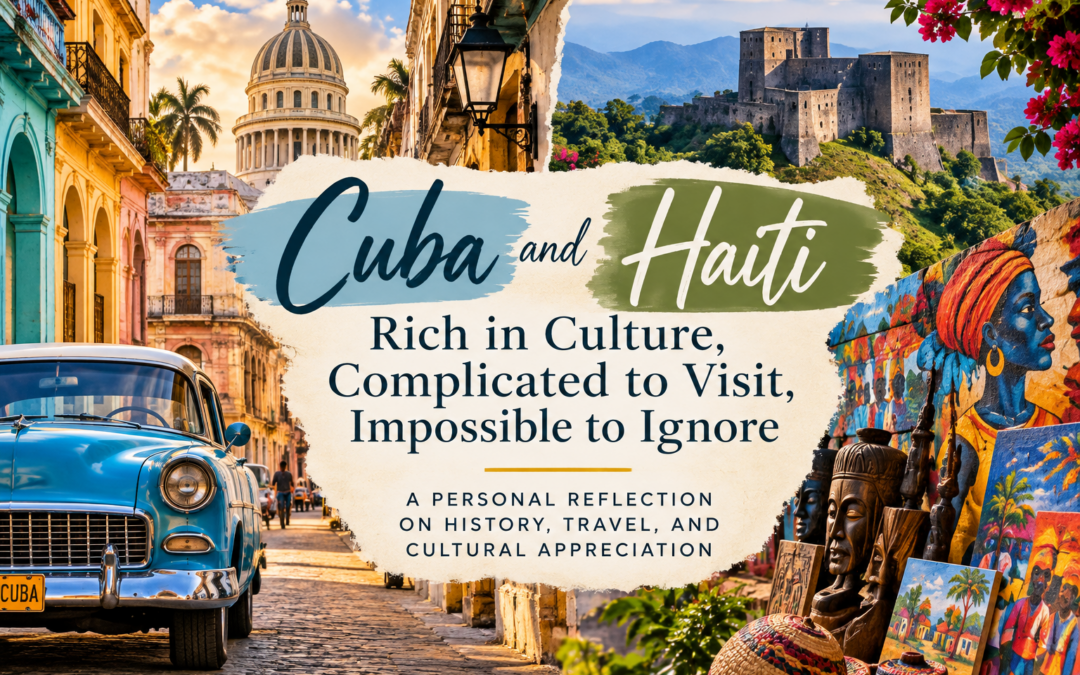
Why I’m Not Publishing Travel Itineraries for Cuba and Haiti Right Now
I believe travel is one of the most meaningful ways to understand the world.
It’s how we experience different cultures, hear stories we might never encounter at home, and discover how much we have in common with people whose lives look different from ours.
But I also believe there’s a responsibility that comes with recommending a destination.
When I publish a travel guide on Simple Sanity Travel, I’m not just sharing beautiful places. I’m helping someone make decisions about their time, money, safety, and peace of mind.
And sometimes, the responsible decision is not to recommend a trip.
That’s where I find myself with Cuba and Haiti.
Both countries have extraordinary histories, vibrant cultures, and contributions to the Caribbean and the wider world that deserve recognition.
Both also face circumstances that make travel complicated, though for very different reasons.
I’ve never visited Cuba. I have, however, crossed into Haiti during a high school excursion while I was living in the Dominican Republic. That experience gave me an early opportunity to think about the relationship between geography, economics, and the two countries that share Hispaniola.
Today, as a Dominican American, I think about both countries differently than I did growing up.
There was a time when I took for granted that, as a Dominican citizen, I had the freedom to consider visiting both neighboring Haiti and nearby Cuba. I didn’t always think about how citizenship, political relationships, and government restrictions could shape someone else’s ability to make the same trip.
That freedom wasn’t universal, and it wasn’t necessarily guaranteed under every circumstance. But it was something I rarely questioned.
Now I do.
I’ve decided not to publish conventional vacation itineraries for Cuba or Haiti under current conditions.
But I don’t want to leave either country out of the conversation.
Because a country doesn’t become less culturally significant simply because visiting it is difficult.
Why Are Cuba and Haiti So Often Described as Forbidden Destinations?
The word forbidden can make a destination sound mysterious or intriguing.
But behind that word are real people, political decisions, economic challenges, and difficult circumstances.
Cuba and Haiti are not interchangeable, and neither country should be reduced to a headline.
For people subject to U.S. jurisdiction, Cuba is complicated by longstanding travel-related sanctions and restrictions, alongside practical challenges within the country.
Haiti faces a severe security and humanitarian crisis that makes leisure travel an entirely different concern.
Those distinctions matter.
So does recognizing that a travel restriction or safety advisory tells us something about the circumstances of visiting a place—not everything about the people who live there.
As someone whose life has been shaped by both the Dominican Republic and the United States, I also recognize that the way we learn about Cuba and Haiti is influenced by the histories and political relationships of the countries telling the stories.
That makes curiosity important.
But it also makes humility necessary.
Cuba: More Than Vintage Cars and Colorful Streets
When people imagine Cuba, they often picture classic cars driving through Havana, colorful buildings, salsa music, and a slower pace of life.
Those images are familiar, but they tell only part of the story.
Cuba’s cultural identity reflects centuries of interaction among Indigenous history, Spanish colonization, the forced migration of enslaved Africans, immigration, political change, and the creativity of Cuban communities.
Its music alone has influenced artists around the world.
Son cubano, rumba, mambo, danzón, and other Cuban musical traditions have shaped the sounds we hear across Latin America and beyond.
Cuban food tells its own story through dishes such as ropa vieja, moros y cristianos, yuca con mojo, and tostones.
And Cuba’s literary, visual, and performing arts traditions offer far more to explore than the familiar images associated with tourism.
What Makes Havana Culturally Significant?
Old Havana and its Fortification System is a UNESCO World Heritage Site.
Its streets, plazas, courtyards, and historic buildings reflect the city’s long history as a major Caribbean port.
But historic architecture isn’t simply beautiful scenery.
It also reflects colonization, commerce, slavery, wealth, inequality, and the many communities that shaped the city over time.
Understanding Havana means looking beyond the colorful facades and appreciating the complicated history behind them.
And Cuba is much more than Havana.
From Santiago de Cuba’s musical and Afro-Cuban traditions to the agricultural landscapes of Viñales, the country contains distinct regional histories and identities that deserve attention.
Why Is Travel to Cuba Complicated for Americans?
U.S. rules prohibit travel-related transactions for ordinary tourism in Cuba by people subject to U.S. jurisdiction.
Certain categories of travel are authorized, but travelers must meet specific requirements.
One commonly discussed category, support for the Cuban people, requires qualifying activities and meaningful engagement. It isn’t simply a vacation that includes a few locally owned restaurants.
Travelers also need to understand restrictions involving certain businesses and accommodations.
These rules can change, and they don’t apply identically to every traveler in the world.
I find myself thinking about how different this feels from the way I understood regional travel when I was younger.
Growing up in the Dominican Republic, I didn’t think of Cuba as a place I was categorically prohibited from visiting. It was another Caribbean nation whose culture, music, and history were connected to the region I called home.
Now, as a U.S. citizen, I have to consider a different legal framework.
That contrast reminds me that our passports and citizenships can shape how we experience the same world.
Rather than publish a seven-day sightseeing itinerary that could give readers the wrong impression about what’s permitted, I’d rather be transparent about why I’m holding off.
That decision doesn’t diminish my interest in Cuba.
It reinforces my belief that understanding a destination should come before promoting it.
Haiti: A History the World Should Know Better
Haiti’s story is one of the most consequential in the history of the Americas.
In 1804, Haiti declared independence after a revolution that overthrew French colonial rule and slavery.
It became the first independent Black republic and the first modern state established through a successful revolt by enslaved people.
That achievement changed history.
Yet Haiti is too often introduced through conversations about disasters, political instability, and poverty, without giving equal attention to its intellectual, artistic, and cultural contributions.
Haiti is not defined by its crises.
My First Experience Crossing Into Haiti
I visited the Haitian side of the Dominican–Haitian border during my senior year of high school, while I was still living in the Dominican Republic.
It was a school excursion designed to teach us about the geology of the region and how it influenced the economies of both countries.
That educational purpose has stayed with me.
We weren’t crossing the border for a beach vacation or a typical sightseeing trip. We were learning about the land itself and how geography could shape the opportunities, resources, and economic experiences of two neighboring nations.
Haiti and the Dominican Republic share the island of Hispaniola, but they have distinct histories, languages, political systems, and cultural identities.
They also share an interconnected history that cannot be understood entirely from one side of the border.
Looking back, I appreciate that the excursion gave me an opportunity to cross into Haiti and learn about the region in a way that went beyond a classroom.
I also recognize how limited one border visit is.
It didn’t give me a complete understanding of Haiti, and I wouldn’t present it as though it did.
But it did give me a reason to keep asking questions about the relationship between our countries.
And as I’ve grown older, those questions have become more complicated.
What Makes Haitian Culture So Distinctive?
Haitian culture reflects African heritage, Indigenous influences, French colonial history, and generations of creativity and adaptation.
Haitian Creole, or Kreyòl Ayisyen, is central to national identity, alongside French, the country’s other official language.
Music is another powerful expression of Haitian culture.
Traditions such as rara and konpa reflect different histories, instruments, and community experiences.
Haitian visual art, literature, dance, and religious traditions are equally significant.
Haitian Vodou, for example, is a complex religious tradition with deep historical and cultural roots. It deserves to be understood respectfully, rather than through the stereotypes that often appear in popular entertainment.
And Haitian food offers its own window into the country’s identity.
Dishes such as griot, diri kole ak pwa, soup joumou, and pikliz reflect ingredients, techniques, and traditions passed across generations.
Soup joumou carries particular historical meaning because of its association with Haitian independence and freedom.
These aren’t simply interesting cultural details.
They’re parts of a living national identity.
Why Does Haiti’s Citadelle Laferrière Matter?
In northern Haiti, the Citadelle Laferrière stands as one of the country’s most important historic landmarks.
Along with Sans-Souci Palace and the Ramiers site, it forms a UNESCO World Heritage Site.
The fortress was constructed in the years following independence as part of efforts to defend the new nation.
It represents a remarkable chapter in the history of freedom, military engineering, and nation-building.
It’s the kind of place I would ordinarily want to include in a cultural travel guide.
But appreciating its significance and recommending a visit are two different things.
Why Am I Not Recommending Travel to Haiti?
Haiti’s security situation is serious.
The U.S. State Department advises Americans not to travel to Haiti because of risks including kidnapping, crime, terrorism, unrest, and limited access to medical care.
These concerns affect much more than tourism. They have profound consequences for Haitians themselves.
I don’t believe it would be responsible to publish a leisure itinerary suggesting that readers should simply book a flight, arrange a driver, and explore.
And I don’t want to present Haiti’s difficulties as something adventurous travelers should try to overcome for the sake of an unusual vacation.
The people living through these circumstances deserve more respect than that.
Choosing not to promote tourism right now isn’t a rejection of Haiti. It’s a recognition that the conditions for responsible leisure travel matter.
Can We Appreciate a Country Without Traveling There?
Absolutely.
Travel is one way to experience culture, but it isn’t the only way.
You can begin learning about Cuba and Haiti without boarding a plane.
And in some circumstances, that may be the more thoughtful choice.
Start With the Stories People Tell About Themselves
Read books by Cuban and Haitian writers.
Seek out films and documentaries created by people with direct connections to the cultures being represented.
Listen to musicians from different generations.
Pay attention to how artists describe their own countries rather than relying exclusively on outside interpretations.
If you’re looking for a place to begin, here are a few authors and books worth exploring.
Cuban and Cuban American authors:
- Cristina García — Dreaming in Cuban. A novel exploring family, memory, identity, and the ways political divisions affect generations of Cuban women.
- Leonardo Padura — Havana Blue. The first Mario Conde detective novel offers a literary window into Cuban society through crime fiction.
- Alejo Carpentier — The Kingdom of This World. A Cuban writer’s influential historical novel set during the Haitian Revolution. It’s especially interesting for this conversation because it connects the literary traditions and histories of both countries.
Haitian and Haitian American authors:
- Edwidge Danticat — Breath, Eyes, Memory. A novel exploring family, womanhood, migration, and the relationship between Haiti and the Haitian diaspora.
- Jacques Roumain — Masters of the Dew. A landmark Haitian novel about rural life, community, environmental hardship, and collective responsibility.
- Edwidge Danticat — Create Dangerously: The Immigrant Artist at Work. Essays examining art, exile, political violence, and the responsibility of telling stories.
These books aren’t substitutes for the full range of Cuban and Haitian perspectives. Some are novels, some are essays, and each reflects the author’s particular experiences, historical context, and artistic choices.
But they’re meaningful starting points.
One of the most useful questions we can ask is:
Whose perspective am I learning from?
This is a question I’ve had to ask myself often as a Dominican American.
Both countries where I hold citizenship—the Dominican Republic and the United States—have histories of political conflict with Haiti and Cuba.
In different ways, they’ve often occupied positions of greater political or economic power in those relationships. It’s tempting to think of them as the “winners” of certain conflicts.
But history is rarely that simple.
The Dominican Republic’s relationship with Haiti includes shared geography, economic interdependence, migration, cooperation, conflict, and painful histories of anti-Haitian discrimination.
The United States’ relationships with Cuba and Haiti include intervention, political pressure, economic policies, and decisions whose consequences have extended far beyond American borders.
I grew up learning about the region from a Dominican perspective. As an American, I also encounter the world through narratives shaped by U.S. history and politics.
Neither perspective is neutral.
And neither should be the only one I rely on.
That doesn’t mean rejecting everything I’ve learned. It means being willing to question it, look for missing voices, and recognize when someone else’s experience challenges the story I’m familiar with.
I want to hear how Cubans and Haitians tell their own histories, including the differences and disagreements within their communities.
Curiosity isn’t only about discovering unfamiliar places. Sometimes it’s about reconsidering what we thought we already knew.
Explore the Food With Curiosity
Food is often one of the most accessible ways to begin understanding a culture.
If you live near a Cuban or Haitian restaurant, consider visiting and learning about the dishes on the menu.
Try a dish you haven’t had before.
Learn why particular ingredients or preparations matter.
If you cook at home, look for recipes shared by Cuban and Haitian cooks who explain their family traditions.
And remember that no single restaurant or recipe represents an entire country.
Food traditions vary across regions, households, and generations.
Support Artists and Businesses Thoughtfully
Look for opportunities to purchase books, music, art, and other work directly from Cuban and Haitian creators or reputable sellers.
Support diaspora-owned restaurants and businesses in your own community.
If you want to contribute to humanitarian work, research established organizations, their local partnerships, and how they use donations.
Not every opportunity will be appropriate for every person.
The goal isn’t to turn cultural appreciation into another shopping list.
It’s to be intentional about whose work and expertise you’re supporting.
What Does PLAN IT. AFFORD IT. ENJOY IT. Mean When Travel Isn’t the Right Choice?
At Simple Sanity Travel, I usually use these three principles to help readers organize meaningful trips without unnecessary stress.
But they also apply when the best decision is to wait.
PLAN IT: Understand Before You Go
Planning isn’t only about hotels, flights, and itineraries.
It’s about understanding where you’re going, why you want to go, and whether the trip makes sense under current circumstances.
For Cuba, that means understanding the legal rules that apply to your travel.
For Haiti, it means taking security conditions and official travel advisories seriously.
For both, it means learning about the people, culture, and history without assuming that every destination is ready to be packaged into a vacation.
AFFORD IT: Consider Where Your Money Goes
Intentional spending matters even when you’re not traveling.
You can support cultural creators, independent businesses, and reputable organizations without booking a trip.
And if travel becomes appropriate in the future, the same principle will apply: consider who benefits from your spending.
A low price isn’t automatically good value.
Neither is a vacation worth taking simply because you can afford the airfare.
ENJOY IT: Protect Your Peace Without Looking Away
Protecting your peace doesn’t mean ignoring difficult realities.
It means making informed decisions and recognizing when an experience isn’t right for you.
You can be curious about a place without putting it on your immediate travel calendar.
You can admire a country’s heritage while acknowledging its current challenges.
And you can leave space for the possibility of visiting someday without making promises about when that day will come.
Why I Believe Travel Writers Have a Responsibility to Say Not Right Now
Travel content can make almost anywhere look inviting.
A beautiful photograph, a carefully chosen hotel, and a list of must-see attractions can turn a complicated destination into something that appears easy to book.
But readers deserve more than inspiration.
They deserve context.
When I recommend a destination, I want readers to feel that I’ve considered not only what makes it interesting, but also what it takes to visit responsibly.
That doesn’t mean every trip needs to be effortless or that travel should be limited to familiar places.
It means there are times when the right recommendation is to wait.
For Cuba and Haiti, that’s where I stand today.
I haven’t visited Cuba, and my experience in Haiti was a brief educational excursion to the border region—not a comprehensive journey through the country.
I’m not going to pretend otherwise.
I’m also not going to publish an itinerary simply to fill a space in a destination series.
Their stories are worth sharing without turning them into vacations I’m not comfortable recommending.
Cuba and Haiti Deserve More Than a Travel Advisory or a Headline
I hope there comes a time when I can responsibly share detailed travel itineraries for both countries.
I’d love to write about exploring Cuba’s neighborhoods, music, food, and regional traditions with the depth they deserve.
I’d love to create a Haiti guide that introduces readers to its historical landmarks, artistic communities, culinary traditions, and regional identities.
But until that makes sense, I can still make room for both countries here.
Not as forbidden destinations to chase.
Not as places defined only by hardship.
And not as entries on a checklist.
As countries with histories worth learning, cultures worth appreciating, and people whose lives and contributions deserve to be seen beyond the headlines.
My own connection to this conversation comes from being Dominican American, from growing up on the island Haiti and the Dominican Republic share, and from recognizing how much our understanding of neighboring countries can depend on which side of a border—or political conflict—we stand.
I don’t have all the answers.
But I can keep learning, asking better questions, and making room for perspectives beyond my own.
Sometimes responsible travel planning begins with knowing where to go.
And sometimes, it begins with knowing when not to.
That’s part of protecting your peace, too.
Travel restrictions, security conditions, and official advisories can change. This article is a cultural and editorial reflection, not a recommendation to travel to Cuba or Haiti. Before considering either destination, review current government guidance and any legal requirements that apply to you.