
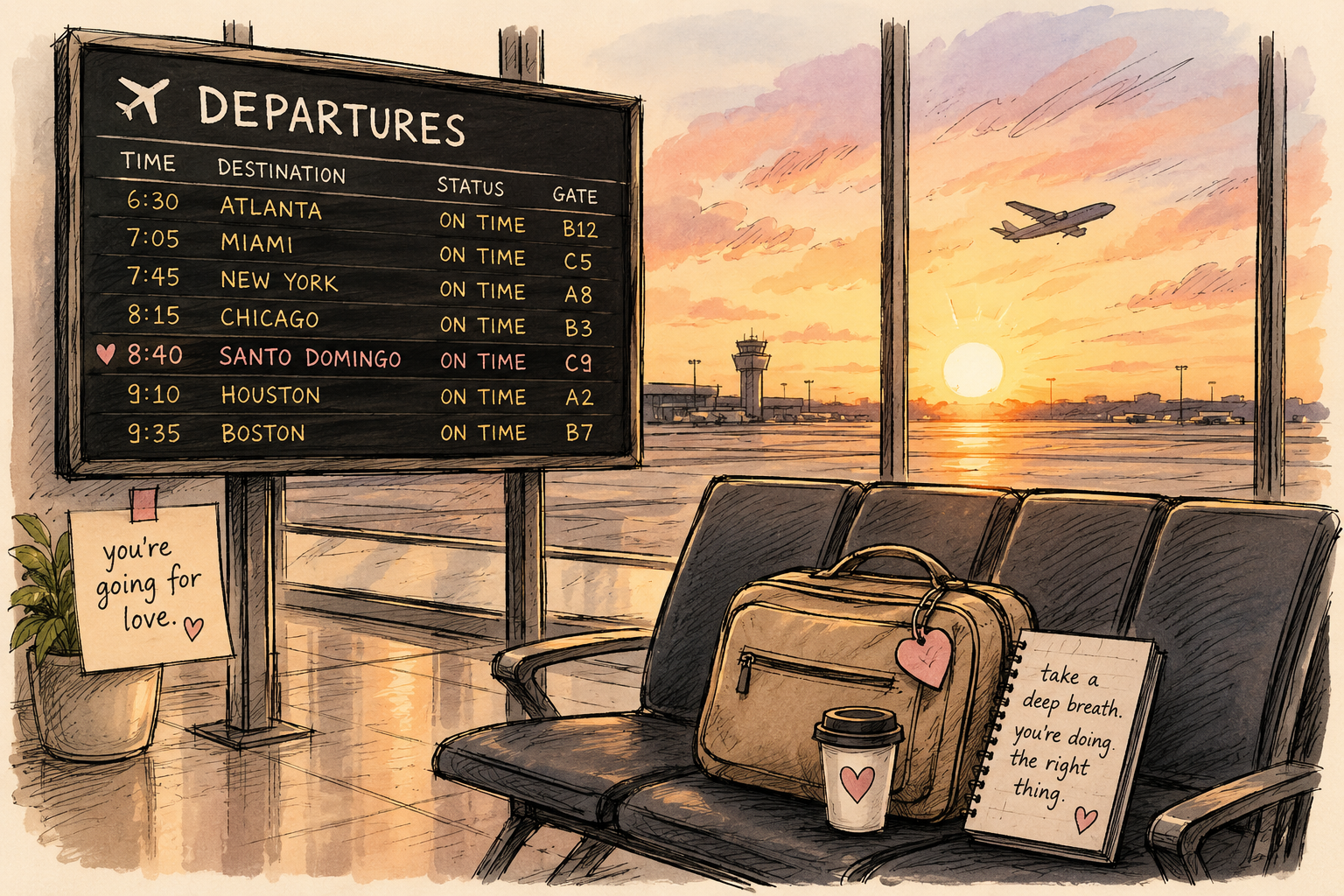
A practical guide for when grief and logistics collide
Written by a travel advisor who has also had to drop everything and book a last-minute flight through grief.
Most travel starts with anticipation.
You’ve got a Pinterest board. A countdown. Maybe a group chat that’s been buzzing for months.
But sometimes the phone rings at an hour it shouldn’t.
And suddenly, you’re not planning a trip. You’re surviving one.
When my grandmother passed away, I had to book last-minute flights to the Dominican Republic while my mind was still catching up to what had just happened. As someone who plans travel for a living — who knows the policies, the routing tricks, the fastest way to get from point A to point B — I still sat there staring at my screen feeling completely frozen.
Grief doesn’t care about your expertise.
So I’m writing this for the version of you who might get that phone call. Not because I can make this easy. But because I know what it feels like when nothing feels manageable, and I want to hand you something that helps.
Why Emergency Travel Feels So Overwhelming (And Why That’s Normal)
When you’re in shock, your nervous system goes into a kind of protective fog.
Everything slows down. Even decisions that normally take two seconds can feel like too much.
Which flight? Do I need my passport? Who watches the kids? What do I even pack? When am I coming home?
You don’t need more pressure to get it right. You need fewer things to figure out.
That’s the whole goal of this guide — to take as many decisions off your plate as possible, so you can save your energy for what actually matters: being present for the people you love.
What to Do Before You Leave: A Quick 15-Minute Checklist
You probably won’t have the luxury of a calm, organized departure. That’s okay. But if you have even a few minutes, these small things will make coming home much easier:
- Move perishables to the freezer
- Take out the trash
- Grab snacks — you’re not hungry now, but you will be
- Charge your devices and pack a power bank with multiple cables
- Withdraw some cash (tips, taxis, unexpected moments)
- Put on something comfortable and shoes you can walk in for hours
- Pack your medications first, before anything else
- Give yourself full permission to forget everything else
That last one isn’t an afterthought. It’s the most important thing on that list.
Build Your Emergency Contact List Before You Ever Need It
One of the most underrated things you can do right now, before any emergency happens, is save a simple list of contacts somewhere easy to find.
When emotions are running high, you don’t want to be scrolling through your phone trying to remember your neighbor’s last name.
Your emergency contact list for travel should include:
- A workplace contact who can cover for you
- A neighbor with a spare key
- Your pet sitter or a friend who can step in
- Your babysitter
- Close family members who need to be looped in
- Your travel advisor
- Your travel insurance provider
This isn’t morbid. This is the kind of quiet preparation that takes five minutes now and saves you real anguish later.
How to Pack for Emergency Travel (When You Don’t Know How Long You’ll Be Gone)
Here’s what I’ve learned: people almost always pack for the trip they planned, not the one that actually happens.
Emergency travel is unpredictable. You might arrive thinking you’ll be home in two days, and end up staying for a week. Pack for that possibility.
A carry-on with the basics is enough:
- A few changes of clothes
- Toiletries
- All prescription medications (bring more than you think you need)
- Chargers
- A sweater or light layer
- Important documents
- Something that grounds you — a comfort item, a journal, headphones, whatever helps
If your stay gets extended, you’ll be so grateful you thought ahead. And if it doesn’t, unpacking an extra outfit is a very small price to pay for peace of mind.
Travel Documents to Have Ready for a Family Emergency
For domestic travel: Have your ID somewhere accessible — not buried at the bottom of your bag.
For international travel: Confirm right now that your passport is valid and know exactly where it is. If your passport has expired and you need to travel internationally within two weeks due to a family emergency, you may qualify for an expedited emergency appointment through the U.S. State Department.
This isn’t a small thing when you’re rushing out the door in a fog. Make it one less thing to scramble for.
Should You Ask About Bereavement Fares?
It’s worth knowing that some airlines still offer bereavement fares — discounted or flexible tickets for travelers dealing with a death in the family. As of 2026, Delta and Alaska Airlines are the primary U.S. carriers with formal bereavement policies. Both require you to call directly (not book online) and provide documentation.
That said, bereavement fares don’t always save money. The discount often applies to full-price fares that may already cost more than a last-minute deal you’d find elsewhere. What they can offer is more flexibility on your return date — which, when you don’t know when you’re coming home, is often worth more than a price reduction.
If points or miles are available to you, that’s frequently the smartest play for last-minute emergency travel. No advance purchase required, no blackout date issues if you have enough points, and no sting at checkout when you’re already overwhelmed.
What a Travel Advisor Actually Does During a Family Emergency
When you call me during a family emergency, my job isn’t just to find you a flight.
It’s to think for you when thinking feels impossible.
I’m looking at:
- The fastest routing vs. the most practical one (those aren’t always the same)
- How urgent your arrival actually is — and whether an overnight option makes more sense
- How to balance speed with what your budget can handle right now
- Which seats will be easiest on your nervous system during a hard travel day
- How to coordinate last-minute travel for multiple family members without making you the one holding all the information
- How to pull all your confirmation numbers and itinerary details into one document you can actually find
- How to keep your family informed so you’re not the one repeating the same update over and over
Sometimes the most valuable thing I can offer you isn’t a deal.
It’s one less thing for you to carry.
Frequently Asked Questions About Emergency Family Travel
What do I do first when I need to travel for a family emergency? Before you book anything, take a breath. Then: confirm your travel documents are valid, identify the fastest route to your destination (not always the cheapest), and reach out to a travel advisor or airline directly if you need same-day or next-day travel. If you have a travel advisor, call them before you start clicking around — they can do the comparison work while you focus on everything else.
Do airlines give discounts for family emergencies or deaths? A small number of airlines still offer bereavement fares, including Delta and Alaska Airlines in the U.S. These fares require calling the airline directly and providing documentation. However, they don’t always result in the lowest price — their main value is flexibility on return travel when you’re uncertain how long you’ll be away.
What should I pack for an emergency trip? Pack for longer than you expect to stay. A carry-on with a few changes of clothes, all medications, chargers, important documents, and one item that grounds you (headphones, a journal, a soft layer) covers most situations. Don’t stress the rest — you can buy almost anything you forget.
What if my passport is expired and I need to travel internationally for a family emergency? Contact the U.S. State Department immediately. You may qualify for an emergency passport appointment if you need to travel internationally within two weeks due to the death or serious illness of an immediate family member. Appointments fill quickly — call as soon as you know travel is needed.
How can a travel advisor help during a family emergency? A travel advisor handles the logistics so you don’t have to: researching routes, comparing costs, managing itinerary changes, coordinating travel for multiple family members, and keeping everyone informed. When your mental bandwidth is fully taken up by grief, having someone who can think clearly about the details is one of the most valuable forms of support available.
You Don’t Have to Do This Perfectly
Emergency travel is not going to be graceful. It’s not supposed to be.
You might forget something important.
You might wear the same sweatshirt for three days straight.
You might cry in the middle of a crowded terminal, and that is completely okay.
You may not know when you’re coming home, and that uncertainty is one of the hardest parts.
Let people help you. Let someone take the dog. Let someone handle your mail. Let someone water the plants. You are not failing by accepting that you cannot do everything right now.
This trip isn’t the one you planned. It’s the one love is asking you to take.
One Last Thing
No one wants to need this post.
I didn’t want to need to write it.
But if you’re reading this because you just got the call — I want you to know that you don’t have to get this right. You just have to get there.
The laundry can wait. The perfectly curated packing list can wait. The tiny details that would normally stress you out can wait.
Your presence is what matters.
And if having this resource makes even one impossible day feel 5% more manageable, then sharing this piece of my own story will have been worth it.
Navigating a last-minute trip and need someone to think through the logistics with you? Book a free Travel Sanity Consult.