
Why go to Guatemala?
Guatemala sits in Central America, just south of Mexico. That makes it relatively close to the United States while offering a trip that feels worlds away. Think volcanoes rising behind colonial-era streets, Lake Atitlán surrounded by mountains and Maya communities, archaeological sites, colorful markets, excellent coffee, and food traditions worth slowing down for.
It is also a destination where your money can stretch across different travel styles. You can keep things relatively affordable with simple hotels, shared transportation, and local restaurants. Or you can spend more on boutique properties, private transfers, and lakefront stays.
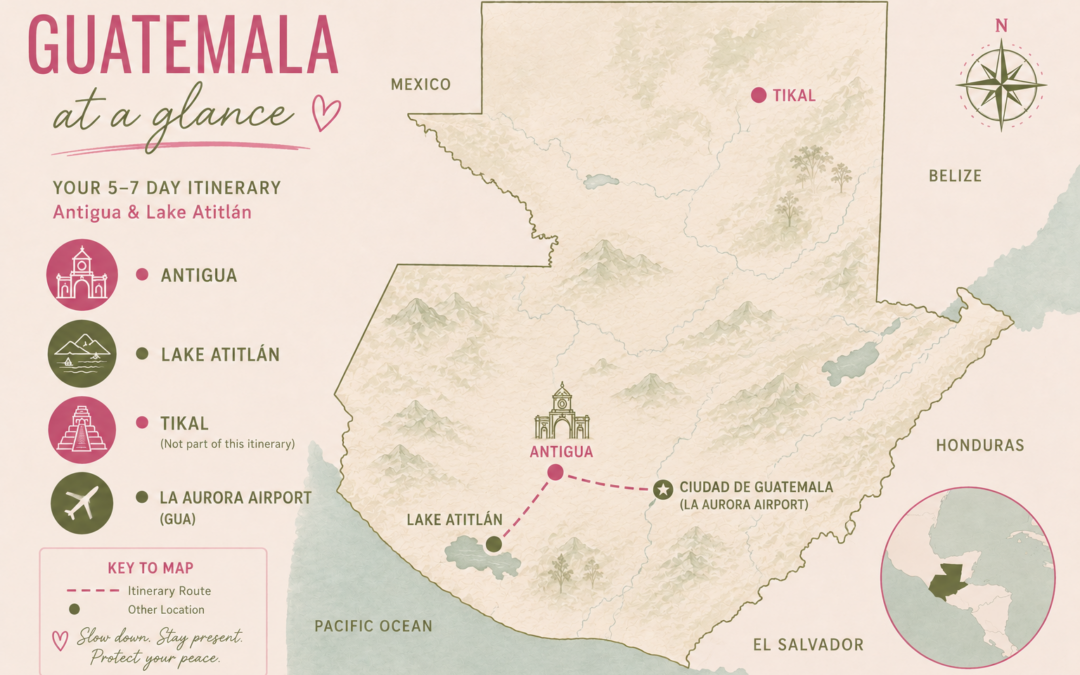
For a first trip, though, I would not try to see the entire country. My pick is Antigua Guatemala and Lake Atitlán for five to seven days. That is enough variety to feel like a substantial trip without spending your vacation constantly packing and moving.
PLAN IT
Where should you go, and how long do you need?
Start with three nights in Antigua, then spend two or three nights at Lake Atitlán.
Antigua is a UNESCO World Heritage Site with a compact historic center, cobblestone streets, churches, ruins, cafés, restaurants, and volcano views. Give yourself at least one full day without a major excursion, so the city does not become nothing more than your launching point for another activity.
Then head to Lake Atitlán. For first-time visitors, Panajachel is my practical default base, because of its road access, restaurants, services, and boat connections. San Juan La Laguna is worth visiting for locally led art, textile, and cultural experiences. San Pedro tends to attract more budget- and nightlife-oriented travelers. San Marcos may appeal if you want a quieter, wellness-focused stay.
Whatever you choose, pick one lake base. You can use boats to explore without moving your luggage every night.
Most travelers will not need a rental car. Fly into La Aurora International Airport (GUA) in Guatemala City, arrange a transfer to Antigua, then use a shared shuttle or private transfer to Lake Atitlán.
What about Tikal and the volcanoes?
Tikal is one of Guatemala’s great archaeological destinations, but adding it to Antigua and Lake Atitlán substantially increases your travel time. If Tikal is one of the main reasons you are visiting Guatemala, extend your trip and include it properly. Otherwise, save it for another visit.
The same principle applies to volcano hiking. Guatemala’s volcanic landscape is a huge part of its appeal, but you do not need to schedule a strenuous hike automatically. If you do want one, choose a reputable operator and check current volcanic and trail conditions immediately before your trip.
What changes depending on who you are traveling with?
Going solo? I would choose centrally located accommodations and reputable shared shuttles or transfers to make logistics easier. Panajachel is especially practical when you do not want to coordinate every lake movement alone.
Traveling with kids? Slow down. Prioritize a comfortable hotel, fewer scheduled activities, and private transfers when the price difference is reasonable. Three nights in Antigua plus three at the lake gives families more breathing room.
Taking a multigenerational trip? Pay close attention to mobility. Antigua’s cobblestones and Lake Atitlán’s boats, docks, stairs, and steep streets can be hard on older relatives or anyone with limited mobility. Hotel access may matter more than getting the prettiest view.
AFFORD IT
How much should you budget for Guatemala?
For an Antigua and Lake Atitlán trip, here are the per-person, per-day planning ranges I would use.
Affordable, $40 to $70. Simple accommodations, casual meals, shared shuttles, public lake boats, walking, and selective paid activities.
Comfortable, $80 to $150. Comfortable lodging, restaurant meals, shared or occasional private transportation, and a mix of free and paid experiences.
Upscale, $175 to $300 and up. Boutique hotels or resorts, private transfers and boats, higher-end dining, and private tours.
These are planning ranges rather than fixed prices, and airfare to Guatemala is not included. Guatemala City has service from major U.S. gateways, including Miami, New York, Los Angeles, and Dallas, though nonstop availability depends on the airline, route, and travel dates.
Before paying cash, check your airline miles. Programs such as American AAdvantage can sometimes reduce your airfare cost, but always compare the award price with the cash fare instead of assuming points are the better deal.
Can you use hotel points?
Possibly, and Guatemala City is where points are most useful.
The major international loyalty brands, including Marriott Bonvoy, Hilton Honors, and World of Hyatt, tend to have their Guatemala presence concentrated in and around Guatemala City. They have much less presence around Lake Atitlán.
So a useful strategy may be this: redeem points for a Guatemala City arrival or departure night, and pay cash for an independent property at the lake. Before you count on any specific hotel, confirm it is still listed with your program, because portfolios change.
What about Airbnb and Vrbo?
Vacation rentals are another option, particularly for families and groups. Both Airbnb and Vrbo tend to show a large inventory in Antigua, along with rentals around Lake Atitlán, including family-friendly homes.
Compare the total cost, including fees, with a hotel. At Lake Atitlán, also check exactly how you will reach the property. A gorgeous, inexpensive rental becomes less appealing if your family has to haul luggage up steep stairs after every boat ride.
Use the points, and spend locally too
Using airline miles or hotel points does not have to mean directing your entire travel budget toward multinational companies.
Think of rewards as a way to create room in the budget. Maybe miles cover your flight, or hotel points cover your final night in Guatemala City. Then spend some of what you saved at a locally owned restaurant, an independent hotel, a neighborhood café, an artisan shop, a community-led experience, or with a local guide.
That is the AFFORD IT approach. Save strategically, then be intentional about where the rest of your money goes.
ENJOY IT
When is the best time to visit Guatemala?
There is no single month that works best for every traveler. Guatemala broadly has two seasons, and each one asks something a little different of you.
The drier season runs roughly from November through April. Days tend to be clearer, mountain roads and volcano trails are generally easier, and lake mornings are more likely to be calm. The tradeoff is that this is also the busier, higher-demand stretch, so accommodations and popular experiences can cost more and book up sooner.
The rainier season runs roughly from May through October. Rain often arrives in the afternoon rather than lasting all day, so many mornings are still usable, and the landscape is greener. The tradeoff is more variability. Rain can affect mountain roads, volcano excursions, lake conditions, visibility, and transfer times, so you want more flexibility built into the plan.
Here is what I would take from that. If easier outdoor logistics matter most to you and you can travel outside the busiest holiday weeks, the drier season is the simpler choice. If you are comfortable planning your bigger activities for the morning and keeping some margin in your days, the rainier season can be quieter and less expensive. Either way, do not bet the whole itinerary on perfect skies. Build in a flexible day, and check weather and volcanic conditions close to your trip rather than relying on a saved forecast.
How do you keep Guatemala from becoming an exhausting trip?
Start by accepting that you do not need to see everything.
Antigua. Lake Atitlán. Tikal. Semuc Champey. Chichicastenango. Volcano hikes. Guatemala City.
They do not all need to fit into one week.
Protect your peace: choose fewer regions and experience them better.
Give Antigua time without a reservation attached to every hour. Walk. Have coffee. Linger over lunch.
At Lake Atitlán, unpack once. Visit one or two communities intentionally rather than racing around the shoreline. If you are prone to motion sickness, remember that lake boats can be bumpy. If someone in your group has mobility concerns, research docks, stairs, paths, and hotel access before booking.
And about those volcano hikes.
You do not have to climb one just because social media says it is a Guatemala must-do.
Volcano hikes can mean altitude, steep terrain, cold temperatures, very early starts, and changing volcanic conditions. If that sounds exciting, prepare properly and go with a reputable operator. If it sounds miserable, skip it. Your Guatemala trip does not become less meaningful because you stayed at ground level.
Finally, protect your departure day. If you have an early international flight, do not create a tight Lake Atitlán-to-airport connection with no margin for boat, weather, road, or traffic delays.
Guatemala rewards curiosity, but it does not require speed. See enough to make you want to return.
Check out my recommended tour of this location.
This is an itinerary you can book today. You can customize it and add different things to fit the needs of you and your family: Antigua Guatemala & Lake Atitlan Escape Guatemala in 8 Days, 6 Nights in Destination
And if you have questions or would like a little more human support, you can message me through there so we can connect and figure it out together.
Note: Information in this post is accurate to the best of our knowledge at the time of publication. Travel details can change, including entry requirements, airline routes and schedules, hotel availability, transportation options, operating hours, prices, and tour availability. Please confirm the latest details directly with airlines, hotels, tour providers, and official government sources before booking or traveling.