
How to Travel to Mexico City, Puebla & Oaxaca Without Losing Your Sanity
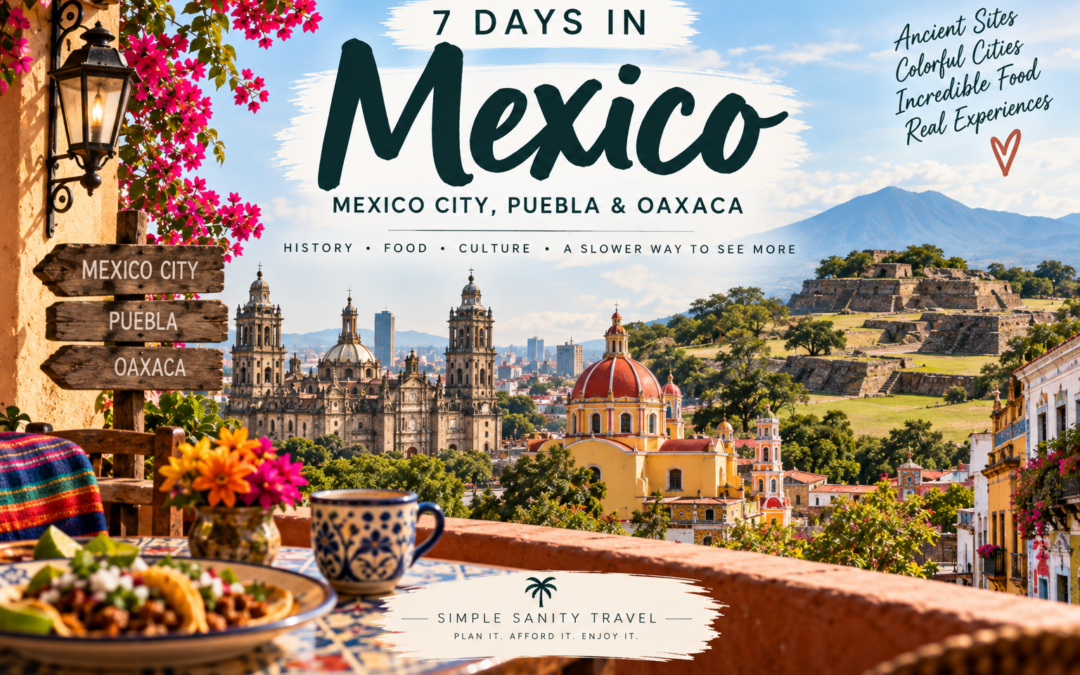
Mexico City brings mariachi, tacos, museums, and enough neighborhoods to fill a trip by itself. Puebla adds tiled architecture and serious food history, while Oaxaca pairs markets and distinctive regional cooking with Monte Albán, one of Mexico’s most important archaeological sites. This 7-day Mexico itinerary connects the three while covering the decisions that actually matter: when to go, how long to stay, transportation, budget, points, pacing, and what deserves your limited vacation time.
This post may contain affiliate links. If you book or purchase through one of these links, I may earn a commission at no additional cost to you. I only share options that I believe are genuinely useful for planning your trip.
Why Go to Mexico City, Puebla & Oaxaca?
This route works especially well if food and history are two of the main reasons you travel.
Mexico City gives you the enormous, energetic capital. About 30 years ago, I visited and still remember dancing to mariachi music, eating some very good tacos, and feeling a little dizzy from the altitude. I would not use a three-decade-old trip as your guide to Mexico City today, but those memories have certainly lasted.
Teotihuacan adds an entirely different historical layer. Located about 50 kilometers northeast of Mexico City, the ancient city developed into one of the largest urban centers in the Americas and became an influential cultural center in Mesoamerica.
Then you travel south through Puebla, whose UNESCO-listed historic center is known for architecture incorporating colorful tilework, before reaching Oaxaca. There, the historic city and nearby Monte Albán give you another opportunity to understand Mexico beyond a generic “ancient ruins” label. Monte Albán was shaped over centuries by different peoples and became a major Zapotec center.
It is a lot of history for seven days.
Which is exactly why we are not adding six more places.
PLAN IT
How Many Days Do You Need?
For a 7-day Mexico City, Puebla, and Oaxaca itinerary, I would think of the trip as two main bases rather than three equal stays.
Give Mexico City about three nights and Oaxaca about three nights, using Puebla and nearby Cholula as your transition south rather than packing and unpacking for another full hotel stay.
That keeps the trip moving without making it feel like a relay race.
In Mexico City, give one day to the city itself and another to Teotihuacan if the archaeological site is high on your list. UNESCO dates Teotihuacan’s major development to roughly the first through seventh centuries and notes the scale of landmarks such as the Pyramids of the Sun and Moon and the Temple of Quetzalcoatl.
Your remaining Mexico City time should be selective.
You do not need the historic center, National Museum of Anthropology, Chapultepec, Coyoacán, Xochimilco, Frida Kahlo Museum, Roma, Condesa, Polanco, Teotihuacan, and every taco you’ve bookmarked squeezed into 72 hours.
Pick your priorities.
Then travel toward Oaxaca, stopping in the Puebla area. Puebla’s historic center has been on UNESCO’s World Heritage List since 1987, with architecture reflecting a mix of European and American influences.
Cholula can add another archaeological stop, but remember that you still have Oaxaca ahead.
Once you reach Oaxaca, stay put.
Give the city itself time for markets, food, architecture, museums, and wandering. Then dedicate part of a day to Monte Albán.
When Is the Best Time to Go?
Mexico City can be visited year-round, but its official tourism site points to spring and fall as particularly pleasant, with warm afternoons and cooler evenings. Summer is wetter, and heavy rain can contribute to traffic delays. Winter mornings and evenings can be quite cool.
For this particular itinerary, late fall through spring is an easy starting point if your priority is comfortable walking and archaeological sites.
That does not mean summer is a bad time to go. It means you should build some weather flexibility into your day rather than scheduling every outdoor activity back-to-back.
Also check for festivals and major events before booking. Oaxaca in particular has cultural celebrations that can dramatically change both the experience and the cost of a visit.
Give Yourself an Easier First Day
This is one trip where I would resist landing and immediately launching into a full sightseeing schedule.
Mexico City sits at high elevation, and I distinctly remember feeling it during my visit.
Give yourself some room on arrival day. Check in. Eat. Walk around your immediate neighborhood. Drink water. See how you feel.
There will still be tacos tomorrow.
And if Teotihuacan is part of your trip, I would not automatically put it first thing the morning after a late arrival. It is a substantial archaeological site, and UNESCO notes that the ancient city extended well beyond its monumental ceremonial core.
How Should You Get Around?
For a trip like this, you do not need to automatically rent a car.
Within Mexico City, public transportation and rideshare or taxi options can reduce the need to drive in a very large city. For the longer journey south, bus transportation is a practical part of the route.
The important planning decision is whether you want Puebla to be a stop or a stay.
With only seven days, I favor the stop.
If you have nine or ten days, an overnight in Puebla becomes much easier to justify. You can slow down, eat properly, explore the historic center, and potentially give Cholula more time instead of treating both as boxes to check before continuing to Oaxaca.
Traveling solo?
Stay somewhere that makes your daily logistics easier, even if the room costs a little more. Central locations can reduce transportation decisions and make it easier to return to your hotel when you are ready to be done.
Traveling with kids?
Do not assume children need more activities to stay interested. They may need fewer.
You can also think about preparing your kids for the rhythm of the trip before you leave. A long archaeological-site day followed by a long museum day followed by another historic-center walking day is a lot, even for adults who supposedly chose this itinerary voluntarily.
Traveling with parents or grandparents?
Pay attention to walking surfaces, heat, stairs, altitude, and the amount of time spent standing at archaeological sites.
When planning a trip with older parents or grandparents, a private transfer or guide on your hardest sightseeing day may be a better place to spend than adding another attraction.
AFFORD IT
How Much Should You Budget?
For planning, I would start with these per-person, per-day ranges, excluding international airfare:
- Affordable: $65–$110 per day. Think simple accommodations, local meals, buses, public transportation, walking, and carefully chosen paid attractions.
- Comfortable: $130–$225 per day. This gives you more room for centrally located hotels, a mix of casual and nicer restaurants, rideshares, intercity transportation, admission fees, and some guided experiences.
- Upscale: $275+ per day. Think boutique or luxury hotels, private transportation, higher-end dining, private guides, and paying more for convenience.
Treat these as planning ranges, not fixed prices. Your dates and hotel choices matter enormously, particularly around popular festivals and holidays.
Food is also one category where “budget” does not have to mean boring. Mexico City, Puebla, and Oaxaca give you plenty of reasons to eat locally without making every meal an expensive reservation.
Can You Use Hotel Points?
Mexico City is the easiest place on this itinerary to start looking.
Major hotel loyalty programs have a substantial presence there. Puebla also has Marriott Bonvoy options, while Oaxaca has at least some opportunities within the major loyalty ecosystem, including a current Marriott property.
That does not mean you should force a points redemption into every city.
You may find that hotel points make sense for a pricier Mexico City stay while an independent hotel in Oaxaca gives you a location or experience you prefer.
Compare both.
The same applies to airfare. This itinerary is particularly interesting because you do not necessarily have to fly round-trip through Mexico City. Depending on your home airport, fares, and available awards, compare a multi-city ticket that flies into Mexico City and home from Oaxaca with the cost and inconvenience of returning to Mexico City just to catch your flight.
If you’re using rewards, keep the points strategy simple enough that it actually saves you work.
What About Airbnb or Vrbo?
Compare vacation rentals with hotels in both Mexico City and Oaxaca, especially if you are traveling as a family or group.
A rental can be useful when you need multiple bedrooms, a kitchen, laundry, or more shared space. But it is not automatically the cheaper option.
Compare the final cost after fees. Then compare location, cancellation terms, minimum stays, stairs, building access, and how you will get around.
A cheap apartment that adds two transportation decisions to every day may not save you much in the end.
Where Should You Spend and Where Should You Save?
Save on transportation when a comfortable bus does the job. Use points when the redemption is genuinely useful. Choose inexpensive meals because you want the tacos, tlayudas, or market food, not because you think every travel dollar needs to be squeezed.
Spend on experiences that add context.
A good guide at Teotihuacan or Monte Albán can help you understand what you are looking at rather than simply walking through a collection of impressive structures.
Spend locally, too. Independent restaurants, markets, artisans, locally owned accommodations, and local guides give you plenty of ways to put part of your travel budget into the places you came to experience.
Use the points where useful, save strategically, and be thoughtful about where the rest of your travel dollars go.
ENJOY IT
Do Not Turn This Into Seven Days of Field Trips
The danger with this itinerary is not necessarily adding more cities.
It is adding too many important things.
Teotihuacan is important. Puebla is important. Monte Albán is important. Oaxaca’s historic center is important.
Your vacation does not need to become a final exam.
At Monte Albán, for example, you are visiting a place with roughly 1,500 years of occupation connected to Olmec, Zapotec, and Mixtec peoples. UNESCO describes it as the most important archaeological site in the Valley of Oaxaca and a major Zapotec capital.
Give places like that enough attention to mean something.
Then go eat lunch.
Protect Your Peace: Alternate Heavy Days With Lighter Ones
A ten-hour sightseeing day should not be followed by another ten-hour sightseeing day simply because you are technically capable of doing it.
After Teotihuacan, make the next day easier.
After the transfer through Puebla to Oaxaca, do not arrive and immediately attempt to “see Oaxaca.”
Check in. Walk. Eat dinner.
After Monte Albán, leave room for something that requires less concentration. Browse a market. Sit in the Zócalo. Have coffee. Wander without trying to learn another 1,500 years of history before bedtime.
That breathing room is not wasted vacation time.
It is part of the trip.
Want Someone Else to Handle the Planning?
If Mexico City, Puebla, Oaxaca, Teotihuacan, and Monte Albán sound like your kind of trip but coordinating the transportation, hotels, and major sightseeing does not, one of my travel partners offers a 7-day organized version of this route.
The current itinerary includes Mexico City and Teotihuacan, a journey south through Cholula and Puebla, and several nights in Oaxaca with visits to Monte Albán and the city itself. Flights, accommodations, transfers, several activities, and some meals are included in the package, although the exact inclusions and available departures can change.
This is a good route to compare rather than assuming independent planning is automatically the better fit. The tradeoff is straightforward: an organized trip gives you less control over the daily schedule, but it removes a substantial amount of logistical work.
Explore the 7-day Mexico itinerary from my travel partner
Looking for a slower Mexico itinerary focused on colorful historic cities, great food, and more time to wander? Check out Mexico City, San Miguel de Allende & Guanajuato: A 7–9 Day Mexico Itinerary for another way to explore central Mexico without trying to see everything at once.
Travel information in this guide was accurate at the time of posting. Prices, routes, schedules, hotel and tour availability, entry requirements, and other travel details can change. Always confirm current information directly with the relevant provider or official source before your trip.
Related Blog Posts
- Hotel Points 101: How to Earn Free Nights Without Turning It Into Another Job
- How to Prepare Your Kids for Travel: Start With Yourself
- Five Multigenerational Vacation Ideas for Families Traveling With Elderly Parents or Grandparents
- The Overwhelmed Parent’s Guide to Using Credit Card Points for Family Travel
- Mexico City, San Miguel de Allende & Guanajuato: A 7–9 Day Mexico Itinerary