
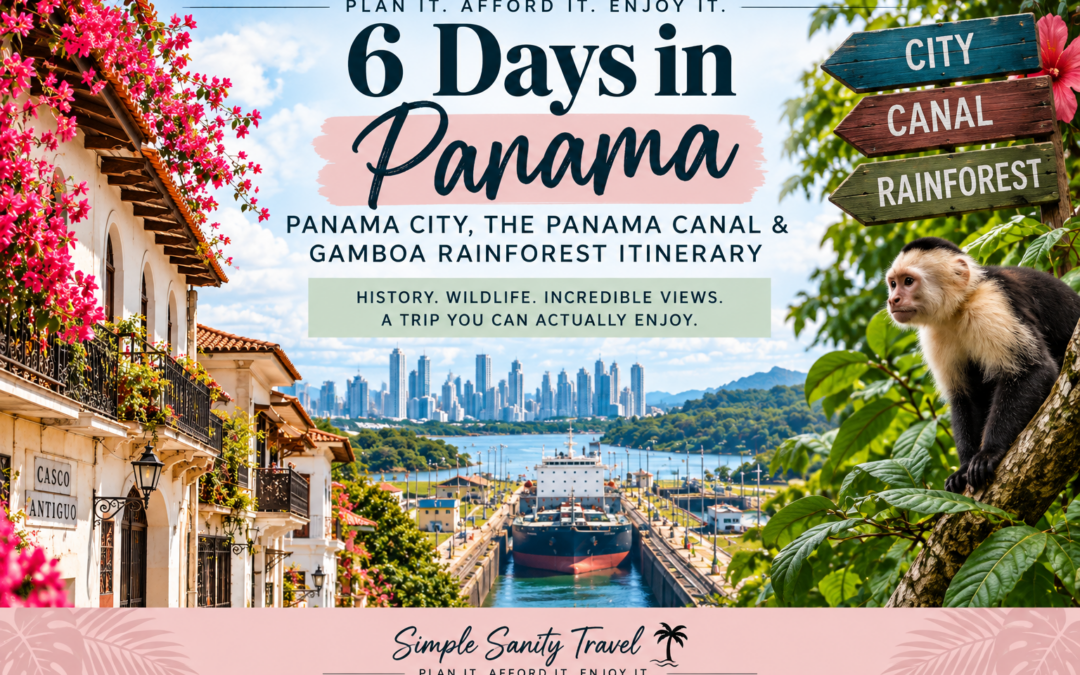
How to Travel to Panama Without Losing Your Sanity
Panama gives you a modern capital, centuries of history, one of the world’s most important waterways, and tropical rainforest without requiring you to spend half your vacation moving between destinations. Spend a few days exploring Panama City and the Panama Canal, then trade the skyline for the rainforest around Gamboa. This 6-day Panama itinerary covers when to go, what deserves your time, transportation, realistic budget ranges, points, and how to choose between rainforest and beach without trying to squeeze the entire country into one trip.
This post may contain affiliate links. If you book or purchase through one of these links, I may earn a commission at no additional cost to you. I only share options that I believe are genuinely useful for planning your trip.
Why Go to Panama?
If your mental picture of Panama begins and ends with the Panama Canal, you’re missing quite a bit.
Panama City gives you a striking combination of modern skyline and historic neighborhoods. Casco Antiguo tells part of the story of a city shaped by its location between oceans, while the Panama Canal shows you just how important that location became to global transportation and trade.
Then, not far from the city, the scenery changes.
Rainforest, Gatún Lake, birds, monkeys, and other wildlife give you a completely different experience without requiring another flight across the country.
For a first visit, I would keep things simple:
Panama City + Gamboa Rainforest.
And if you’d rather end the trip with a beach chair instead of binoculars?
We’ll talk about that too.
PLAN IT
How Many Days Do You Need in Panama?
Six days works well for this particular first-time route.
I would structure it roughly like this:
Days 1–3: Panama City
Settle in, explore Casco Antiguo, visit the Panama Canal, and leave some room for food and wandering.
Day 4: Panama City to Gamboa
Move into the rainforest and let the pace change.
Day 5: Gamboa
Choose one substantial nature or wildlife experience.
Day 6: Departure
If you have seven days, great.
Give the extra night to Panama City or Gamboa based on your interests rather than automatically adding another destination.
Panama is one of those places where a map can convince you that you should be able to fit in just one more stop.
Resist.
Why Start in Panama City?
Because Panama City isn’t simply where your plane lands.
It’s an important part of the trip.
You can explore historic architecture and plazas in Casco Antiguo, see the contrast between old and modern Panama City, learn about the country’s history, eat very well, and visit the Panama Canal without immediately packing your suitcase again.
Three nights gives you enough time to experience the city without making every day a sightseeing marathon.
Is Casco Antiguo Worth Visiting?
Yes.
Casco Antiguo, also called Casco Viejo, is the historic district established after the destruction of the original Panama City settlement in the 17th century.
But this is not a neighborhood I would approach with a checklist.
A good walking tour can give you the historical context first. Then put the itinerary away for a while.
Walk the plazas. Look at the architecture. Stop for coffee. Have lunch. Find somewhere interesting for dinner.
Historic neighborhoods are much more enjoyable when you’re allowed to notice them.
Is the Panama Canal Worth Visiting?
Yes, especially on a first trip.
The Panama Canal is not famous simply because large ships pass through it. Understanding why the Canal exists, how the locks work, and how Panama’s geography made the waterway possible adds context to much of what you’ll see during the rest of the trip.
The Miraflores Visitor Center is the most convenient option from Panama City. The Panama Canal Authority offers online ticket purchasing for its visitor centers. (Autoridad del Canal de Panamá)
There is one current planning detail worth knowing: the Panama Canal Authority is modernizing the Miraflores Visitor Center through the end of 2026. The center remains part of the visitor experience, but the authority warns that entry waits can be longer than normal, particularly during high-demand periods. (Autoridad del Canal de Panamá)
So this is one place where I would check the official Canal information shortly before your visit rather than relying on a schedule you saved months ago.
And don’t obsess over finding the perfect minute to see a ship.
Give yourself enough time to understand what you’re looking at.
Otherwise the experience becomes:
Big ship. Locks. Photo. Next.
You came all this way. Give it a minute.
Should You Visit Panamá Viejo Too?
Maybe.
Panamá Viejo is the archaeological site of the original city founded in 1519, while Casco Antiguo represents the later settlement.
If you’re particularly interested in history, seeing both helps connect the pieces.
But if three historic hours are plenty for you, you don’t need to visit another site simply because someone else’s itinerary says you should.
Casco Antiguo plus the Canal may give you enough historical context for this particular trip.
Know what actually interests you.
Why Stay in Gamboa?
Because it lets you change the entire feeling of the trip without creating complicated logistics.
After several days of city streets, restaurants, architecture, and the Canal, you move into a tropical rainforest environment near the Canal watershed and Gatún Lake.
This is where I would choose one substantial nature experience.
That could mean a wildlife-focused boat trip, rainforest trails, birding, or another guided nature experience that fits your interests and physical comfort level.
You do not need four rainforest tours because there are four rainforest tours available.
Should You Choose Gamboa or Playa Blanca?
This is probably the most important decision in this itinerary.
Choose Gamboa if you want nature and wildlife.
Rainforest, birds, monkeys, Gatún Lake, and the landscape surrounding the Canal become the second half of the trip.
Choose Playa Blanca if you want to stop making decisions.
A Pacific beach stay gives you a completely different ending. You can trade rainforest activities for a resort, pool, beach, and a much shorter daily agenda.
Neither is the “right” choice.
They are two different vacations.
For this itinerary, I’m choosing Gamboa because the city + rainforest combination gives first-time visitors two very different sides of Panama.
But if you’ve spent the last six months dreaming about sitting somewhere while another person brings you a drink, I am not going to argue with you.
Do You Need to Visit San Blas on Your First Panama Trip?
No.
The Guna Yala archipelago, often called the San Blas Islands in travel marketing, deserves thoughtful planning and appropriate cultural context.
It should not become a last-minute addition because you saw turquoise water on Instagram.
Some excursions from Panama City can turn into very long days once transportation is included.
For a six-day first trip, I would choose Panama City + Gamboa or Panama City + a beach stay rather than trying to wedge another major destination between them.
If Guna Yala is one of the main reasons you’re going to Panama, that’s different.
Build the trip around it instead of treating it as an extra.
When Is the Best Time to Visit Panama?
If drier weather is your priority, roughly mid-December through April is a practical place to start looking.
That also tends to be a popular time to visit.
Travel during Panama’s greener, wetter months can still work well, particularly if lower prices or fewer visitors matter more to you than having the best odds of dry weather.
Rainy season also doesn’t necessarily mean it rains from breakfast until bedtime every day.
Look at the tradeoff rather than chasing the idea of perfect weather.
How Do You Get Around Panama?
For this route, you don’t automatically need a rental car.
In Panama City, taxis, rideshare services, organized tours, and private transfers can cover most visitor needs.
For the move to Gamboa, arrange a transfer or use transportation associated with your accommodation or tour provider.
If you’re traveling with children, older relatives, or several people, this is one of those situations where paying for a private transfer may be worth more than finding the absolute cheapest option.
Less complicated counts as value too.
What Are the Current Entry Requirements for Panama?
This is one part of trip planning where you should always go directly to the official authorities before traveling.
Panama’s National Immigration Service currently says tourists should carry an original passport or travel document with at least three months of validity, proof of sufficient funds for the trip, and confirmed transportation out of Panama within the permitted period. Its current guidance lists proof of economic solvency of at least B/.500. Visa requirements depend on nationality. (Migración Panamá)
Those requirements can change.
Before you travel, check Panama’s National Immigration Service and any applicable requirements for your nationality rather than assuming a blog post you bookmarked months ago is still current.
What If You’re Traveling Solo?
This route works well for solo travelers because Panama City gives you plenty to explore independently while Canal and rainforest tours offer structured activities when you want them.
Choose accommodations with a location that makes your daily plans easier and use established transportation providers for longer transfers.
You don’t need to join a group tour for the entire vacation just because you’re traveling alone.
What If You’re Traveling With Kids?
Panama has a nice combination for families.
Ships moving through enormous locks are very different from looking for monkeys in a rainforest.
That variety can work in your favor.
But don’t try to combine a long historic walking tour, the Canal, a wildlife excursion, and a nice dinner into one heroic family day.
Before booking activities, think about what your particular kids need to feel ready for the trip, including heat tolerance, walking stamina, boat comfort, and how much sightseeing they can reasonably handle.
What If You’re Traveling With Parents or Grandparents?
Panama City + Gamboa can also work well for a multigenerational trip because you can reduce transportation friction with private transfers and choose activities based on the people actually traveling.
Pay attention to walking distances, heat, boat access, stairs, and the physical requirements of rainforest activities.
And remember that everyone doesn’t have to do everything.
If you’re planning with older parents or grandparents, build around what everyone will enjoy rather than making the itinerary a test of endurance.
AFFORD IT
How Much Does a Trip to Panama Cost?
Panama can be more expensive than travelers expect if they’re comparing it with some of its Central American neighbors.
Upscale Panama City hotels, private transfers, cocktails, restaurants, and organized nature experiences can move the budget quickly.
For planning purposes, I would start around these per-person, per-day ranges, excluding international airfare:
- Affordable: $70–$120 per day: Think simpler accommodations, local meals, selective paid activities, and shared or lower-cost transportation.
- Comfortable: $140–$250 per day: This gives you room for a well-located hotel, good restaurants, convenient transportation, and a couple of meaningful paid experiences.
- Upscale: $300+ per day: Think higher-end hotels or resorts, private transfers, premium experiences, and more upscale dining.
These are planning ranges, not fixed trip prices.
Where you stay and how many tours you book will make a significant difference.
Where Should You Spend and Where Should You Save?
Spend on the Canal if understanding it matters to you.
This is one of Panama’s defining experiences.
Spend on a good historical walking tour.
If history interests you, a knowledgeable guide can make Casco Antiguo much more meaningful.
Spend on one quality rainforest experience.
Choose the wildlife, boat, or nature experience you actually care about.
Then save elsewhere.
Save by wandering.
Casco Antiguo does not require a paid activity every hour.
Save by using the hotel pool.
You already paid for it.
There is no rule saying that relaxing for three hours must be followed by an excursion to make the day count.
Save by not collecting wildlife tours.
You do not need a second rainforest excursion just because there are still monkeys you haven’t personally met.
Can You Use Hotel Points in Panama?
Yes, and Panama City is a destination where checking your hotel loyalty accounts is genuinely worthwhile.
Major hotel groups have a meaningful presence in the city, so compare options through programs such as Marriott Bonvoy, Hilton Honors, World of Hyatt, and IHG One Rewards if you already collect those points.
But compare the points rate with the cash rate.
Sometimes using hotel points for an expensive night makes perfect sense.
Sometimes the hotel is reasonably priced and you’d be better off paying cash and saving the points for another trip.
Points are useful when they solve an expensive problem.
They do not need to be used simply because they exist.
The same applies to airfare. If you’re using transferable rewards, keep your points strategy manageable enough that planning the vacation doesn’t become a second job.
Should You Book a Hotel, Airbnb, or Vrbo?
For a short first trip to Panama City, I lean toward a well-located hotel.
Vacation rentals can make sense for families, groups, or longer stays, especially when you need multiple bedrooms or a kitchen.
But compare the full price and the actual convenience.
Look at fees, air conditioning, cancellation terms, building access, location, and transportation.
A cheaper apartment that adds extra transportation to every day may not save you much.
And convenience has value when you’re only in the city for three nights.
Where Is It Worth Spending Locally?
Restaurants, cafés, markets, independent guides, locally operated experiences, and artisans are easy places to make more intentional choices.
If you book an experience involving an Indigenous community, look carefully at who operates it and how the community participates and benefits.
Culture is not scenery.
That doesn’t mean you should avoid cultural experiences. It means you should choose them thoughtfully.
The same rule we’ve used throughout this series applies here:
Use the points where useful, save strategically, and be thoughtful about where the rest of your travel dollars go.
ENJOY IT
Protect Your Peace: How Do You Keep a Panama Trip From Getting Too Busy?
By accepting that you are not going to see all of Panama.
This is where perfectly reasonable itineraries start going sideways.
Panama City.
The Canal.
Gamboa.
San Blas.
Playa Blanca.
Boquete.
Bocas del Toro.
El Valle.
Suddenly you need a vacation from planning your vacation.
For this trip, choose Panama City + one second environment.
That’s enough.
Should You Choose the Rainforest or the Beach?
Ask yourself what you want the second half of the trip to feel like.
If you want wildlife, forest, birds, boats, and more active nature experiences, choose Gamboa.
If you want a resort, beach, pool, and fewer decisions, choose Playa Blanca.
Do not choose based on which one you think you’re supposed to see.
Choose based on the vacation you actually need.
What Should You Not Over-Plan?
Casco Antiguo.
Give yourself enough structure to understand the neighborhood, then leave some space.
The rainforest.
One meaningful nature experience is enough for a short stay.
And especially your evenings.
If you’ve spent the day walking through Panama City in tropical heat or looking for wildlife in the rainforest, dinner can be the evening activity.
There does not need to be an evening activity after dinner.
Can a Travel Day Just Be a Travel Day?
Yes.
When you move from Panama City to Gamboa, let that be the transition.
You don’t have to leave the city at sunrise, squeeze in three attractions, arrive at the hotel, drop your bags, and immediately head into the rainforest.
Check in.
Look around.
Have something to eat.
Use the pool.
Tomorrow exists.
Want Someone Else to Handle the Planning?
If Panama sounds good but you’d rather not coordinate hotels, transfers, and the bigger pieces yourself, I have two travel-partner options depending on what kind of trip you want.
Want the Rainforest?
If the Panama City + Gamboa route in this guide sounds like your trip, one of my travel partners offers a shorter organized version combining Panama City, the Canal area, and Gamboa Rainforest.
It’s a good fit if you want the city-and-nature combination but would rather have much of the transportation and planning handled for you.
Explore the Panama City + Gamboa Rainforest trip from my travel partner
Want the Beach Instead?
If you’ve reached this point thinking, The rainforest sounds lovely, but what I actually want is a beach chair, there is another option.
My travel partner also offers a Panama City + Playa Blanca itinerary that combines time in the capital with an all-inclusive beach stay.
This is the better fit if you want some Panama City history and sightseeing followed by several days where the hardest decision might be pool or beach.
Explore the Panama City + all-inclusive Playa Blanca trip from my travel partner
Neither version is the correct way to see Panama.
One gives you city + rainforest.
The other gives you city + beach.
Choose the trip you’ll actually enjoy instead of the one with the longest list of things you managed to see.
Travel information in this guide was accurate at the time of posting. Prices, routes, schedules, hotel and tour availability, entry requirements, and other travel details can change. Always confirm current information directly with the relevant provider or official source before your trip.
Related Blog Posts
- Hotel Points 101: How to Earn Free Nights Without Turning It Into Another Job
- How to Prepare Your Kids for Travel: Start With Yourself
- Five Multigenerational Vacation Ideas for Families Traveling With Elderly Parents or Grandparents
- The Overwhelmed Parent’s Guide to Using Credit Card Points for Family Travel