
How to Travel to Ecuador Without Losing Your Sanity
Ecuador looks wonderfully manageable on a map. Then you start researching and discover colonial cities, volcanoes, cloud forests, the Amazon, waterfalls, Pacific beaches, and the Galápagos Islands all competing for your vacation days.
You do not need to see all of them on your first trip.
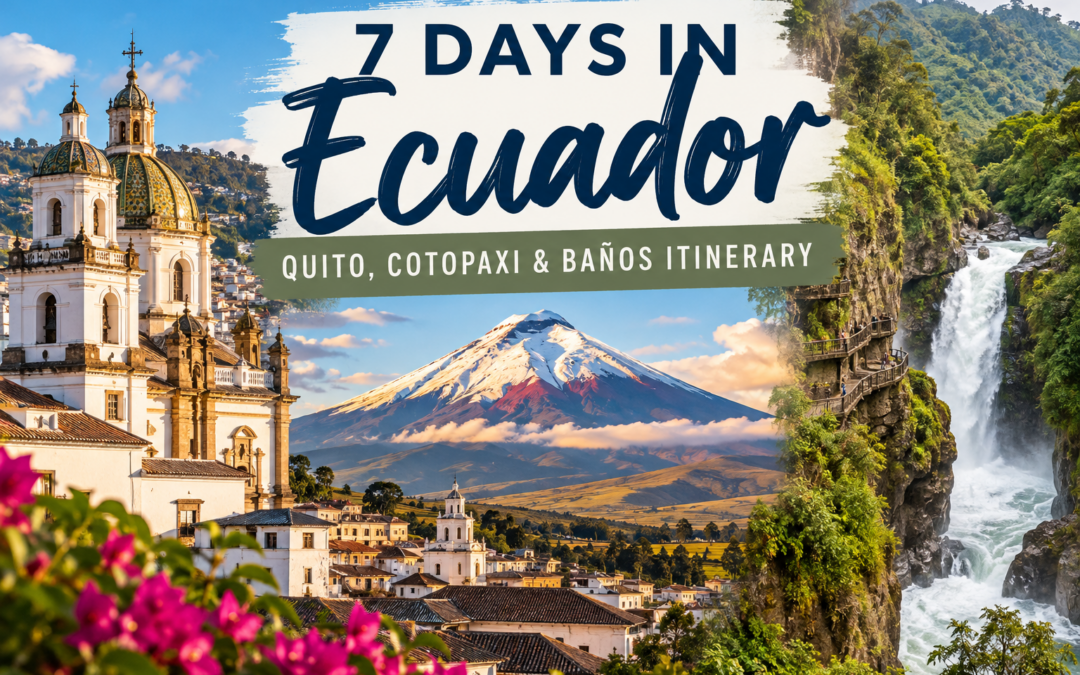
For seven days, I’d focus on Quito, Cotopaxi, and Baños. You’ll get history, Andean landscapes, volcano country, waterfalls, and a completely different side of Ecuador without spending the week bouncing between airports. And if what you really want is the Amazon and the Galápagos too? We’ll get to that option at the end.
This post may contain affiliate links. If you book or purchase through one of these links, I may earn a commission at no additional cost to you. I only share options that I believe are genuinely useful for planning your trip.
Why Go to Ecuador?
Ecuador packs a remarkable amount of geographic variety into a relatively small country.
Quito sits high in the Andes at about 2,850 meters, or 9,350 feet, and its historic center was among the first places designated a UNESCO World Heritage Site in 1978. Beyond the capital, you can move into volcanic landscapes, cloud forest, the Amazon basin, the Pacific coast, or eventually fly offshore to the Galápagos.
That variety is exactly why Ecuador can become difficult to plan.
Seven days is enough for a meaningful trip. It is not enough for every version of Ecuador.
So this itinerary stays on the mainland and follows a fairly simple progression:
Quito → Cotopaxi and the Andean highlands → Baños → Quito
You get a big change in scenery without needing five hotels and three domestic flights.
Save the Galápagos for another trip, or choose a longer organized itinerary designed to handle those extra logistics for you.
PLAN IT
How Many Days Do You Need in Ecuador?
For this route, seven days is a good starting point.
I’d structure it like this:
| Day | Where | Main Plan |
|---|---|---|
| 1 | Quito | Arrive and acclimatize |
| 2 | Quito | Historic Center |
| 3 | Quito | Flexible city day or Mitad del Mundo |
| 4 | Cotopaxi area | Andes and volcano landscapes |
| 5 | Baños | Travel to Baños and settle in |
| 6 | Baños | Waterfalls and nature |
| 7 | Quito | Return for departure or final night |
If you have eight or nine days, even better.
Add time to Quito or Baños rather than immediately adding the Amazon, Cuenca, Guayaquil, and the Galápagos.
Ecuador will still be there.
Where Should You Start in Ecuador?
Start in Quito.
And don’t treat it as merely the airport you use before going somewhere prettier.
Quito’s historic center is packed with churches, plazas, monasteries, museums, colonial architecture, and layers of Indigenous and Spanish history. It’s a place where Indigenous heritage and Spanish colonial influences intersect, and it deserves time beyond a quick arrival night.
Give the city at least two full days.
On your first full sightseeing day, concentrate on the Centro Histórico rather than racing around the entire city.
You might combine Plaza Grande, churches and historic buildings, La Ronda, museums, markets, and plenty of time simply walking.
The goal is not to collect every church in Quito.
Choose the places that genuinely interest you.
What Should You Know About Quito’s Altitude?
This deserves more attention than squeezing another attraction into Day 1.
Quito sits at approximately 2,850 meters above sea level, high enough that some travelers may feel the altitude after arriving from lower elevations.
That is one reason Day 1 of this itinerary is intentionally light.
Check into your hotel.
Eat.
Drink water.
Walk a little if you feel good.
Go to bed.
Do not land, drop your suitcase, and immediately decide you should conquer every elevated viewpoint in the city because you have “only seven days.”
Your vacation has begun. You are allowed to behave like it.
If you develop concerning or worsening symptoms at altitude, seek medical guidance rather than trying to power through your itinerary.
Where Should You Stay in Quito?
For a first visit, I would look at three general areas depending on what matters most to you.
Historic Center works well if architecture, churches, museums, and old Quito are your priority.
La Floresta can appeal to travelers who want cafés, restaurants, galleries, and a more neighborhood-oriented stay.
La Carolina and the surrounding modern districts can be convenient for restaurants, parks, larger hotels, and major loyalty properties.
The “best” neighborhood is the one that makes the days you’ve actually planned easier.
A beautiful hotel that adds an hour of unnecessary transportation every day is not automatically a better hotel.
Is Mitad del Mundo Worth Adding?
If standing near the Equator sounds fun to you, yes.
The Mitad del Mundo complex sits north of central Quito and focuses on Ecuador’s location at latitude zero and the geodesic expeditions connected with measuring the Earth.
I’d put it on Day 3 rather than trying to squeeze it into your historic-center day.
But this is also an easy place to make a personal-interest decision.
If you’d rather spend that day at museums, eating your way through Quito, visiting a market, exploring neighborhoods, or simply moving more slowly, do that.
You don’t lose your Ecuador membership card because you skipped the equator photo.
Why Include Cotopaxi?
Because it changes the trip.
You leave the city and enter the high-altitude landscapes of the Ecuadorian Andes, with Cotopaxi’s volcanic scenery as the centerpiece.
But this is not the day to prove your athletic ability.
Altitude increases as you travel into the highlands. What makes sense for one traveler may be uncomfortable for another.
Depending on current conditions, your interests, and your comfort with elevation, you might choose viewpoints, shorter walks, cultural experiences, hacienda time, or more strenuous hiking.
This is also a good day to use an experienced local guide or organized transportation rather than assuming you need a rental car for the entire trip.
Should You Stay Near Cotopaxi or Continue Straight to Baños?
If you have seven days, I like one night in the highlands.
It slows down the transition between Quito and Baños and gives you time to experience the Andes rather than treating Cotopaxi like a roadside photo stop.
A hacienda-style stay can also be one of the places where spending a little more changes the character of the trip.
If you only have six days, Cotopaxi can become a longer travel-and-exploration day on the way toward Baños.
If you have eight or nine, keep the overnight and give yourself more breathing room.
Why Finish in Baños?
Because Baños gives the itinerary another complete personality change.
Baños de Agua Santa sits in a lush valley near Tungurahua volcano and is known for waterfalls, thermal waters, outdoor activities, and the Ruta de las Cascadas.
One of the best-known stops is Pailón del Diablo, about 17 kilometers from Baños. The waterfall drops dramatically through Río Verde, with paths that bring visitors close enough to experience considerably more waterfall spray than your hair may have requested.
Give Baños two nights.
One day can focus on the waterfall route.
The other can be whatever version of Baños fits you: thermal baths, an easier nature day, cycling, rafting, canyoning, viewpoints, or absolutely none of the activities involving a harness.
Adventure is optional.
Do You Need a Rental Car in Ecuador?
Not necessarily.
For this itinerary, I would compare:
Private transfers: easiest, especially for families or small groups.
Organized day trips or drivers: useful around Cotopaxi and for specific excursions.
Intercity buses: inexpensive and widely used, but require more flexibility and comfort navigating terminals and schedules.
Rental car: gives independence, but also gives you navigation, parking, driving conditions, and security considerations to manage yourself.
Within Quito, you have public transportation, including the Metro, plus taxis and ride services.
For many first-time travelers, I’d rather spend money strategically on transfers between major stops than rent a car simply because that’s what we normally do at home.
When Is the Best Time to Visit Ecuador?
There isn’t one perfect Ecuador weather answer because you’re dealing with dramatically different elevations and ecosystems.
For this particular Andes-focused itinerary, June through September generally corresponds with Quito’s drier period, while the rest of the year tends to be wetter. But weather in the mountains can change quickly, and Ecuador’s equatorial location means temperature patterns don’t behave like four traditional North American seasons.
Pack for layers and rain even when the forecast looks cooperative.
And remember that “best time” also depends on your priorities.
Lower rainfall may matter more if you’re hiking.
Lower crowds or different pricing may matter more if your dates are flexible.
Don’t postpone Ecuador indefinitely while searching for the one week when the weather app promises perfection.
What Should Families, Solo Travelers, and Multigenerational Groups Know?
For solo travelers, Quito, guided highland experiences, and Baños give you plenty of opportunities to join tours without needing a travel companion for every activity. Be thoughtful about transportation, nighttime movement, and current local safety guidance.
For families, keep the itinerary flexible. Mitad del Mundo, waterfalls, mountain scenery, and some of Baños’ outdoor activities can work well with children, but age, height, and safety restrictions vary by operator. My guide to preparing your kids for travel can help you think about the trip before adding activities.
For multigenerational groups, altitude and mobility matter more than whether everyone checks off the same attractions. You may need easier walking routes in Quito or a different Cotopaxi plan for some travelers. That’s fine. My guide to multigenerational travel goes deeper into planning around different energy and mobility levels.
A family vacation does not require everyone to be standing in the same place every minute.
What Are the Current Travel Guidelines for Ecuador?
This is one section to check again immediately before your trip.
Passport validity, visa requirements, entry rules, and other immigration requirements depend on your nationality and can change.
Travel advisories and local security conditions can also change, including guidance for specific areas within Ecuador.
Before departure, check Ecuador’s current immigration requirements and your own government’s latest travel guidance rather than relying on an old article, Reel, or screenshot.
AFFORD IT
How Much Should You Budget for a Week in Ecuador?
Ecuador can offer strong value compared with some other South American destinations, but your budget changes quickly once you add private transportation, guides, adventure activities, upscale haciendas, or the Galápagos.
For this Quito + Cotopaxi + Baños itinerary, excluding international airfare, I’d use these as practical planning ranges per person, per day, assuming two people share a room:
| Travel Style | Planning Range |
|---|---|
| Affordable | $70–110 per person/day |
| Comfortable | $140–240 per person/day |
| Upscale | $300+ per person/day |
These are planning ranges, not quoted package prices.
For Simple Sanity Travel planning, I would budget above the bare minimum if you want good locations, comfortable transportation, and a few experiences without doing math every time someone wants lunch.
Where Is It Worth Spending More?
A well-located Quito hotel.
Location can save transportation time and make your city days easier.
Transportation through the highlands.
A private transfer or well-run guided experience can remove a lot of logistical work from the Cotopaxi portion.
One memorable highlands stay.
If a beautiful hacienda experience fits your budget, this is where I might spend rather than upgrading every hotel on the trip.
A good guide when context matters.
Historic Quito and Andean cultural experiences become more meaningful when you’re learning something rather than simply looking at buildings and landscapes.
Where Can You Save?
Walk the Historic Center rather than stacking tours.
Use Quito’s public transportation when it makes sense.
Eat some meals at casual local restaurants and markets.
Choose one major Baños activity instead of booking five.
Spend an afternoon enjoying the town instead of paying for another excursion because you accidentally left a blank space on the itinerary.
Blank spaces do not require immediate financial intervention.
Can You Use Hotel Points in Ecuador?
Yes, especially in Quito.
This is where I would concentrate your loyalty strategy.
Marriott Bonvoy, Hilton Honors, and IHG One Rewards all have options in and around Quito, giving you opportunities to compare cash and points for your city stay, arrival night, or airport night.
Outside Quito, especially around the highlands and Baños, I wouldn’t force a major hotel program into the itinerary if an independent property gives you a better location or experience.
That’s exactly the strategy I talk about in Hotel Points 101.
Use the points where useful, save strategically, and be thoughtful about where the rest of your travel dollars go.
What About Airbnb and Vrbo?
Both are worth comparing, particularly if you’re traveling with kids or a group and want more bedrooms, laundry, or a kitchen.
Quito is where a vacation rental is most likely to make practical sense for a longer stay or larger group.
For Baños, compare rentals with small hotels and guesthouses rather than assuming an apartment is automatically cheaper.
Look at the total price, not the nightly headline.
Then check:
- exact location
- cleaning fees
- cancellation terms
- heating and hot water
- luggage access
- stairs
- transportation
- reviews mentioning noise or security
A $20 nightly savings becomes considerably less impressive when you’re paying for taxis every time someone wants dinner.
Can Points and Miles Help With Flights?
Potentially.
Quito’s Mariscal Sucre International Airport is the main gateway for this itinerary, so compare cash fares with award options through whatever airline programs or transferable points you already have.
If you’re new to this, my guide to using credit card points for family travel explains the strategy without requiring you to turn points into a second career.
I would compare the full cash price first.
Then compare the award.
Then decide whether those points are giving you good value.
Do not use 87,000 points simply because the website allowed you to.
How Can Your Travel Dollars Support Ecuador’s Local Economy?
Hotel points can make sense in Quito.
Then look for opportunities to spend directly with local restaurants, guides, artisans, independent accommodations, markets, and responsible tour operators.
Ecuador’s culture is not simply a backdrop for volcano photographs.
When you’re shopping for crafts or participating in Indigenous or community-based experiences, look for businesses where local people are actually involved in ownership, interpretation, and economic benefit.
You do not need every dollar to follow the same rule.
Be intentional about where some of them go.
ENJOY IT
Protect Your Peace: Do You Really Need to Add the Galápagos?
No.
And I say that knowing full well that the Galápagos may be the first thing that made you click on Ecuador.
The islands are extraordinary.
They’re also a completely different logistical and financial layer involving flights, protected-area requirements, fees, island or cruise decisions, wildlife excursions, and additional travel time.
If you have only seven days, I would not squeeze the Galápagos onto this itinerary.
Give mainland Ecuador your week.
Then come back for the islands.
Or take a longer trip specifically designed to combine them.
Should You Add the Amazon Instead?
Same answer.
Not automatically.
The Amazon deserves more than being turned into a one-night checkbox between Quito and your next flight.
If the rainforest is one of your main reasons for visiting Ecuador, change the itinerary around that priority.
You could absolutely build a different first trip around Quito + Amazon, or a longer trip that combines Quito, the Amazon, Baños, and additional regions.
The point isn’t that my route is the only good Ecuador itinerary.
The point is that you should choose an itinerary instead of accidentally creating three of them.
What Should You Skip if You’re Getting Tired?
Skip Mitad del Mundo.
Choose an easier Cotopaxi day.
Do one waterfall instead of every waterfall.
Skip the most adventurous Baños activity.
Spend an afternoon eating, walking, soaking, or doing nothing particularly productive.
The volcano will not file a complaint.
How Do You Avoid Turning Baños Into an Adventure Checklist?
Pick one main experience.
If that’s the Ruta de las Cascadas and Pailón del Diablo, great.
If it’s rafting, do that.
If it’s thermal baths and a slow lunch, also great.
Baños has become known for adventure activities, which can create the impression that you need to spend 48 hours zip-lining, canyoning, cycling, rafting, swinging over cliffs, and generally testing the terms of your travel insurance.
You don’t.
Choose what sounds fun.
Leave the rest for someone else’s Reel.
What Should You Not Over-Plan in Quito?
Meals.
Neighborhood walks.
Your first afternoon.
Your last evening.
And anything scheduled immediately after landing.
Quito’s altitude alone is a good reason to keep some flexibility, but cities are also better when you leave space to follow something interesting.
A market you didn’t know about.
A café that smells good.
A plaza where you want to sit longer.
A museum that turns out to deserve two hours instead of 45 minutes.
You planned the trip so you could experience Ecuador.
Not so Ecuador could experience your spreadsheet.
What’s the Sanity-Saving Take on Ecuador?
Ecuador does not need to be a race between its greatest hits.
For a first seven-day trip, Quito + Cotopaxi + Baños gives you a strong introduction to the country without making every other day a major transportation day.
Start with history and culture in Quito.
Move into the Andes.
Finish with waterfalls, nature, and whatever level of adventure actually sounds enjoyable.
Then stop.
You haven’t “missed” the Galápagos.
You’ve created a reason for another trip.
Want Someone Else to Handle the Bigger Ecuador Trip?
If you’re reading this thinking, That’s nice, but I absolutely want the Amazon and the Galápagos, then an organized trip starts to make considerably more sense.
One of my travel partners offers a broader Ecuador itinerary designed for travelers who want to experience considerably more of the country, including the Amazon and Galápagos, without personally piecing together all of the major logistics.
That’s a busier trip.
It’s also a lot more Ecuador.
The tradeoff is less flexibility and more moving around, but someone else is handling much of the coordination required to connect very different parts of the country.
If seeing several of Ecuador’s major ecosystems in one trip matters more to you than moving slowly, you can explore the broader Ecuador itinerary through my travel partner.
If you prefer fewer transitions and more control over your days, stick with the independent Quito, Cotopaxi, and Baños route.
Neither is the “right” way to see Ecuador.
They’re two different trips for two different kinds of travelers.
Travel information in this guide was accurate at the time of posting. Prices, routes, schedules, hotel and tour availability, entry requirements, safety conditions, and other travel details can change. Always confirm current information directly with the relevant provider or official source before your trip.
Related Blog Posts
How to Prepare Your Kids for Travel: Start With Yourself
Five Multigenerational Vacation Ideas for Families Traveling With Elderly Parents or Grandparents
Hotel Points 101: How to Earn Free Nights Without Turning It Into Another Job
The Overwhelmed Parent’s Guide to Using Credit Card Points for Family Travel