
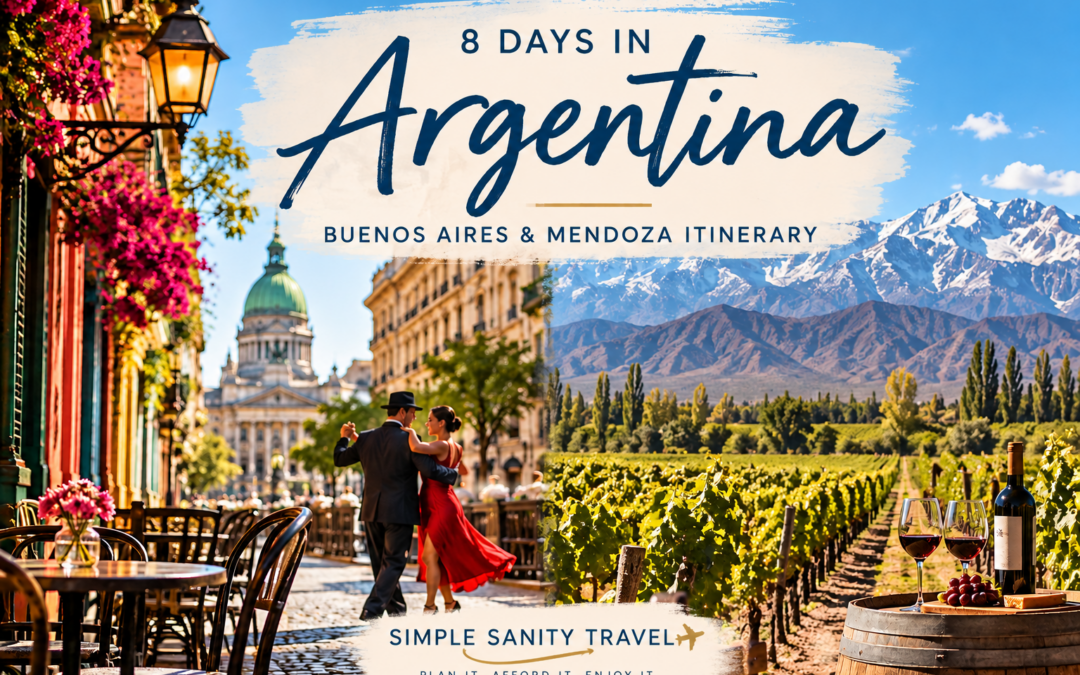
How to Travel to Argentina Without Losing Your Sanity
Argentina is the kind of country that makes an eight-day vacation feel wildly insufficient.
Buenos Aires. Mendoza. Iguazú Falls. Patagonia. Bariloche. Salta. Ushuaia. The list gets long very quickly, and the distances between those places are not small. Argentina’s tourism board highlights exactly that geographic variety, from subtropical Iguazú to the vineyards of Mendoza and the landscapes of Patagonia.
So for a first trip, I wouldn’t try to see Argentina.
I’d choose two very different pieces of it.
This 8-day Argentina itinerary combines Buenos Aires and Mendoza, giving you tango, architecture, neighborhoods, cafés, Argentine food, wine country, and the Andes without spending half your vacation checking in and out of hotels.
This post may contain affiliate links. If you book or purchase through one of these links, I may earn a commission at no additional cost to you. I only share options that I believe are genuinely useful for planning your trip.
Why Go to Argentina?
Argentina gives you a problem I generally enjoy having: too many genuinely good choices.
Buenos Aires alone could fill a week. Its 48 barrios range from historic San Telmo to elegant Recoleta and sprawling Palermo, with museums, parks, cafés, markets, tango venues, restaurants, and residential streets that reward wandering without a checklist.
Then there’s Mendoza.
Set against the Andes, Argentina’s best-known wine region combines vineyards and wineries with excellent food, mountain scenery, outdoor activities, and everything from urban hotels to luxury wine-country stays.
Put the two together and you get a first trip that actually feels different from one half to the other.
| If You Want… | Start With… |
|---|---|
| Architecture, museums and neighborhoods | Buenos Aires |
| Tango and nightlife | Buenos Aires |
| Cafés and city wandering | Buenos Aires |
| Wine and long lunches | Mendoza |
| Andes scenery | Mendoza |
| Outdoor adventure | Mendoza |
| Waterfalls and subtropical nature | Save Iguazú for another trip |
| Glaciers and Patagonia | Save southern Argentina for another trip |
| A manageable first visit | Buenos Aires + Mendoza |
PLAN IT
How Many Days Do You Need for Buenos Aires and Mendoza?
I recommend eight days, split roughly like this:
Days 1–4: Buenos Aires
Neighborhoods, history, food, museums, tango, and enough unscheduled time to enjoy the city.
Day 5: Fly to Mendoza
Make this mostly a travel and settling-in day.
Days 6–7: Mendoza
One wine-country day and one flexible Mendoza or Andes day.
Day 8: Departure or onward travel
If you have nine or 10 days, even better.
Add the extra time rather than adding another destination.
That’s an important distinction.
Argentina is enormous. Adding days makes this itinerary more relaxing.
Adding destinations makes it more complicated.
Where Should You Stay in Buenos Aires?
Your neighborhood matters because Buenos Aires is a city you experience at street level.
For most first-time visitors, I’d start by looking at Palermo, Recoleta, or San Telmo, depending on the kind of trip you want.
Is Palermo a Good First-Time Base?
Yes, especially if restaurants, cafés, parks, shops, and evening options matter to you.
Palermo is Buenos Aires’ largest neighborhood, and different sections have very different personalities. Its eastern side includes large parks and gardens, while Palermo Soho and Palermo Hollywood have become major dining, shopping, and nightlife areas.
It’s a particularly useful base if you want to come back from sightseeing and still have plenty of choices nearby.
What About Recoleta?
Choose Recoleta if you prefer elegant architecture, museums, galleries, and a more polished city atmosphere.
It’s also convenient for some of the city’s best-known cultural attractions.
If you like a hotel that feels like part of the trip rather than simply somewhere to sleep, this is also a neighborhood where some of the higher-end properties become tempting.
Very tempting.
We will discuss points later.
Should You Stay in San Telmo?
San Telmo makes sense if historic atmosphere is high on your list.
It’s one of the city’s oldest neighborhoods, known for cobbled streets, historic buildings, tango, antiques, galleries, cafés, the San Telmo Market, and the Sunday antiques fair around Plaza Dorrego.
It can feel more atmospheric than polished, which may be exactly what you want.
What Should You Actually Do in Buenos Aires?
Don’t build this part of the trip around individual attractions.
Build it around neighborhoods.
Buenos Aires rewards walking, stopping, eating, looking around, and discovering that the café you planned to visit is apparently going to require another 45 minutes because you’re still sitting at the previous café.
That’s fine.
Day 1: Arrive and Stay Close to Your Hotel
International arrival days are not the time to prove anything.
Check in.
Walk around your neighborhood.
Eat.
Sleep.
You have four days.
Day 2: Start With the Historic Center and San Telmo
Begin around Plaza de Mayo and Avenida de Mayo, then work your way toward San Telmo.
The city’s official tourism material specifically connects this area with Buenos Aires’ historic core, while San Telmo gives you cobbled streets, cafés, antiques, tango, and some of the city’s oldest atmosphere.
If your visit falls on a Sunday, this is a particularly good day for the Plaza Dorrego antiques fair.
Don’t turn the day into a march through 14 landmarks.
Walk.
Stop for coffee.
Have lunch.
Go into something because it looks interesting.
That’s part of the plan.
Day 3: Recoleta and Palermo
Spend part of the day around Recoleta, then move toward Palermo.
This is a good museum day if that’s your thing. It’s also a perfectly good parks, architecture, café, and long-lunch day if museums are not your thing.
You do not need to develop a sudden passion for every art movement because you crossed an international border.
Choose what interests you.
Day 4: Give Buenos Aires Some Breathing Room
This is where I would put whatever matters most to you personally.
Maybe that’s La Boca and Caminito.
Maybe it’s a food tour.
Maybe it’s football.
Maybe it’s a museum you skipped.
Maybe it’s shopping.
Maybe you spend three hours at lunch.
Buenos Aires has more than 50 officially recognized historic bares notables, along with a large museum scene and an enormous range of cultural activities.
Your final day in the city doesn’t need another master list.
It needs a choice.
Do You Need to See a Tango Show?
You don’t need to.
But you should understand that tango is not simply entertainment created for tourists. It developed in the Río de la Plata region in the 19th century and remains part of Buenos Aires’ cultural identity.
You have several ways to experience it.
You can book a polished dinner show.
You can take a tango class.
You can visit a milonga, where tango functions as a social dance rather than a stage production.
Or you can choose a smaller performance.
Pick the version that sounds interesting to you.
If sitting through a large theatrical dinner show sounds like something you’re booking because the internet said you’re supposed to, don’t.
How Do You Get Around Buenos Aires?
This is one place where I would not rent a car.
Buenos Aires has an extensive public transportation system that includes the Subte subway, buses and trains, plus taxis and other transportation options. The official tourism office recommends the rechargeable SUBE card for public transportation.
Walking also does a lot of the work within individual neighborhoods.
Save the rental-car paperwork for another vacation.
Why Pair Buenos Aires With Mendoza?
Because Mendoza changes the entire mood of the trip.
After several days in one of Latin America’s great cities, you fly west and suddenly the Andes are part of the scenery.
Mendoza’s wine tourism extends through several wine-growing areas, including the Central region, East, Uco Valley and South, and the province also offers hiking, rafting, kayaking, climbing and other outdoor activities.
You don’t have to be deeply interested in wine to enjoy Mendoza.
But if you actively dislike wine, I would reconsider whether this should be your second stop.
Argentina has plenty of alternatives.
Should You Fly or Take the Bus From Buenos Aires to Mendoza?
For an eight-day itinerary, fly.
The point of this route is to reduce unnecessary logistics, and Mendoza has an international airport with domestic connections.
A long-distance bus can make sense if you have more time, enjoy overland travel, or are building a longer Argentina trip.
For eight days?
Buy back the time.
Where Should You Stay in Mendoza?
You have an interesting choice here.
Stay in Mendoza city if you want restaurants, easier transportation, urban conveniences, and a straightforward base for day trips.
Stay in wine country if the vineyard setting itself is one of the reasons you’re going.
For a first trip with only three nights, I lean toward one base.
Changing hotels again so you can technically sleep closer to some grapes is not automatically an improvement.
If you have more time, splitting the stay between Mendoza city and the Uco Valley becomes more appealing.
How Should You Plan a Mendoza Wine Day?
This is where I’d spend some money.
Choose a wine region or a thoughtfully organized route rather than trying to collect as many wineries as possible.
A good day might include two or three wineries and a long lunch.
That’s enough.
Wine tasting is not a competitive sport.
And transportation matters. If you’re tasting wine, arrange a driver, tour, or other transportation that allows you to enjoy the day without worrying about driving.
What If You Don’t Drink Wine?
Mendoza can still work.
The Andes are not decorative background for the Malbec.
The province offers mountain scenery and outdoor activities, including hiking, rafting, kayaking and climbing.
Use your second full day for an Andes-focused outing, a scenic drive, outdoor activity, spa time, a food experience, or simply a slower day in Mendoza.
If nobody in your group drinks and nobody particularly cares about wine culture, however, I wouldn’t force Mendoza into the itinerary.
Consider Iguazú, Bariloche, or another region instead.
What’s the Best Time to Visit Buenos Aires and Mendoza?
For this particular combination, spring and fall are especially appealing because you’re avoiding some of the temperature extremes while still getting good city and wine-country conditions.
But Argentina is a year-round destination, and the best season depends heavily on which parts of the country you’re visiting.
That’s another reason not to talk about “the best time to visit Argentina” as though Patagonia, Buenos Aires, Mendoza and subtropical Iguazú all share a weather forecast.
They very much do not.
If you’re traveling during a major festival, holiday, or wine event, expect availability and pricing to behave accordingly.
What Are the Current Argentina Entry Requirements?
For U.S. passport holders traveling for tourism, Argentina currently does not require a tourist visa for stays of up to 90 days, and the former reciprocity fee for U.S. citizens remains suspended. Argentina’s consular authorities confirmed this information in updated 2026 guidance.
Argentina’s immigration law also currently requires foreign visitors seeking admission to declare that they have health insurance to cover medical needs.
Requirements differ by nationality, and travelers who do need a tourist visa have additional passport, financial, itinerary and documentation requirements.
Entry rules can change, so check Argentina’s official immigration and consular guidance for your nationality and travel dates before departure.
Is This Argentina Itinerary Good for Solo Travelers, Kids, or Multigenerational Groups?
Yes, with some adjustments.
Solo travelers: Buenos Aires works especially well when you choose a walkable neighborhood and use organized experiences for the things you’d rather not arrange alone. Mendoza wine tours also solve the transportation question nicely.
Families: Don’t assume Buenos Aires has to become a history lesson from breakfast through dinner. Parks, markets, food, neighborhood walks and carefully chosen museums can break things up. Mendoza can add outdoor experiences to the trip.
If you’re planning with children, my guide to preparing your kids for travel can help before you start assigning an activity to every available hour.
Multigenerational travelers: Buenos Aires gives different members of the group plenty of ways to participate at their own pace. In Mendoza, pay close attention to transportation, walking requirements and how long winery days actually last.
My guide to planning multigenerational vacations is useful here because the goal isn’t to make every person do every activity together.
AFFORD IT
How Much Should You Budget for 8 Days in Argentina?
Argentina is one destination where I would be especially cautious about publishing a hyper-specific budget and pretending it will remain accurate forever.
Exchange rates and local prices can move.
For planning purposes, I’d start with these per-person daily ranges, excluding international airfare and the domestic flight between Buenos Aires and Mendoza:
| Travel Style | Planning Range Per Person, Per Day |
|---|---|
| Affordable | $75–$125 |
| Comfortable | $150–$275 |
| Upscale | $350+ |
Those ranges assume two people sharing accommodations.
A comfortable trip can include good hotels, restaurants, paid experiences, and a wine-country day without requiring luxury everything.
At the upper end, Argentina can get very expensive very quickly.
Buenos Aires has sophisticated luxury hotels and restaurants. Mendoza has high-end vineyard properties, private transportation, elaborate tasting menus, and wine experiences that can turn “let’s visit a winery” into a rather impressive credit-card notification.
Where Is It Worth Spending More?
A well-located Buenos Aires hotel.
Location can save you time and transportation while making evenings much easier.
A Mendoza wine day.
Transportation, reservations, and a well-planned route are worth paying for when they remove logistics and let everyone participate safely.
One memorable meal.
Argentina gives you plenty of reasons to care about food. Leave room in the budget for one meal where price isn’t the first filter.
The domestic flight.
On an eight-day trip, saving time has value.
Where Can You Save?
Buenos Aires neighborhood days.
Walking through San Telmo, Palermo, Recoleta, or the historic center does not require a paid excursion every few hours.
Public transportation.
Buenos Aires has a substantial transit network, so you don’t need private transportation for every movement around the city.
Your second Mendoza day.
After a more expensive winery day, choose a lower-key day rather than immediately booking another full-day tour.
By staying longer in fewer places.
This one gets ignored constantly.
Every extra destination can mean another airport transfer, flight, hotel, luggage move, and day partly consumed by transportation.
Sometimes the best budget strategy is simply to stop moving.
Can You Use Hotel Points in Buenos Aires and Mendoza?
Yes, and this is one of the better itineraries in this series for hotel points.
Buenos Aires currently has a meaningful major-loyalty footprint. Marriott Bonvoy lists multiple properties in the city, IHG has both InterContinental and Holiday Inn Express options, Hilton operates Hilton Buenos Aires, and World of Hyatt includes Palacio Duhau – Park Hyatt Buenos Aires.
Mendoza also gives you real choices. Marriott has the Sheraton Mendoza, Hilton operates Hilton Mendoza, and Hyatt has Park Hyatt Mendoza.
That’s useful.
It does not mean you should automatically use points.
Compare the cash price with the number of points required.
If the cash rate is reasonable and the award price is painful, keep the points.
If Buenos Aires is expensive for your dates and you’ve found a strong redemption, that’s when the points become interesting.
If you’re still figuring out what counts as a good hotel redemption, start with my Hotel Points 101 guide.
Is There a Hotel Tax Benefit for Foreign Visitors?
There can be.
Argentina provides qualifying foreign tourists an exemption from the 21% VAT on accommodation when the requirements are met, including appropriate payment methods and proof of foreign visitor status.
Don’t assume every rate you’re looking at online has already handled this correctly.
Check how the hotel displays taxes and what documentation or payment method is required for your stay.
What About Airline Miles and Credit Card Points?
Argentina is exactly the kind of destination where I would compare several approaches before transferring points.
Start with:
Cash fare
Round-trip award
One-way awards
Different airline programs
Buenos Aires arrival plus separate domestic ticket
Then calculate the taxes and fees.
Don’t transfer a large pile of flexible points simply because an airline website uses the word “award.”
You still have to do the math.
If you’re booking multiple seats, my guide to using credit card points for family travel can help you think through the tradeoffs before you empty the account for one trip.
Should You Use Airbnb or Vrbo in Argentina?
They can make sense, particularly in Buenos Aires.
A vacation rental may be useful for families, groups, longer stays, or anyone who values a kitchen and separate living space.
But compare the total cost with a hotel.
Look at cleaning and service fees, exact location, cancellation policy, air conditioning or heating, elevators, luggage storage, front-desk support, and what happens if your international flight arrives well before check-in.
In Mendoza, location matters even more.
A beautiful rental that leaves you arranging transportation every time you want to eat or visit a winery may not be the bargain you thought it was.
How Should You Handle Money in Argentina?
Argentina uses the Argentine peso, and the city’s official tourism guidance notes that hotels and many larger businesses accept cards while some smaller businesses may still require cash.
Because currency conditions and payment rules can change, this is something I would check again shortly before your trip rather than relying on a travel post you bookmarked six months earlier.
Carry more than one payment method.
Keep some local cash.
And don’t build your entire vacation around chasing the theoretically perfect exchange rate.
There are more enjoyable hobbies.
Where Should Your Travel Dollars Go?
Buenos Aires makes this easy.
Spend at neighborhood restaurants and cafés.
Buy from independent shops and markets.
Hire a knowledgeable local guide when context will improve the experience.
In Mendoza, look for experiences where the food, wine, transportation, and guiding genuinely add value rather than choosing solely by the number of winery stops.
You can still use hotel points.
You can still stay somewhere luxurious.
You can still save money.
These ideas are not in conflict.
Use the points where useful, save strategically, and be thoughtful about where the rest of your travel dollars go.
ENJOY IT
Protect Your Peace: Do You Really Need to Add Iguazú or Patagonia?
No.
This may be the most important part of the entire itinerary.
Argentina is huge.
Iguazú Falls alone sits in the subtropical province of Misiones and deserves its own time. Argentina’s tourism board recommends one to two days specifically for the falls, with multiple trails and experiences inside the national park.
Patagonia isn’t a side trip either.
So if you have eight days, Buenos Aires + Mendoza is enough.
If Iguazú is the reason you’re going to Argentina, change the itinerary.
If Patagonia is the dream, build the trip around Patagonia.
Don’t add them because you’re afraid you may never return.
That’s how an eight-day vacation becomes a tour of Argentine airports.
What Should You Not Over-Plan in Buenos Aires?
Meals.
Neighborhood walks.
Café stops.
Your final afternoon.
Buenos Aires is exactly the kind of city where some of the trip happens between the things you planned.
Give that a chance to happen.
You don’t need San Telmo, Recoleta, Palermo, La Boca, Puerto Madero, three museums, two tango experiences, a football match, a food tour, and an emotional relationship with every empanada shop in four days.
Choose.
How Many Wineries Do You Really Need in One Day?
Not seven.
Two or three thoughtfully chosen wineries with time for lunch is a completely respectable day.
You’re there to enjoy Mendoza, not establish a quarterly tasting record.
This is also why I’d rather pay for a well-organized wine day than spend the entire morning checking maps and calculating driving times.
Decision fatigue is still fatigue, even when the decisions involve Malbec.
What If Wine Isn’t Your Thing?
Don’t apologize to Mendoza.
Go see the mountains.
Eat.
Walk around.
Book an outdoor experience.
Have a spa afternoon.
Or choose another second destination altogether.
An itinerary should reflect what you enjoy, not what you’re supposedly required to enjoy because of where you landed.
How Do You Keep This Trip From Feeling Rushed?
Keep one hotel in Buenos Aires and one in Mendoza.
Fly between them.
Don’t schedule a major sightseeing day around the flight.
Plan one primary experience per day and let the rest build around it.
In Buenos Aires, that primary experience might simply be a neighborhood.
In Mendoza, it might be the winery day.
That’s enough structure to keep you moving without making the vacation feel managed by a clipboard.
Is Buenos Aires and Mendoza the Only Good First Argentina Trip?
Definitely not.
That’s part of the point.
If waterfalls matter more than wine, Buenos Aires + Iguazú is a strong alternative.
If Patagonia is why Argentina has been sitting on your travel list for years, go south.
If you have more time, you can start building a larger route.
But for someone who wants a first taste of Argentina’s culture, food, city life, wine country, and Andes scenery without constantly changing hotels, Buenos Aires + Mendoza makes a lot of sense.
You don’t need to see the entire country for the trip to count.
You need enough time to notice where you are.
Want Someone Else to Handle the Bigger Argentina Trip?
Maybe you’ve reached the end of this itinerary and thought:
That’s nice, but I do want Iguazú Falls and Patagonia.
Fair.
One of my travel partners offers a larger Argentina itinerary that combines Buenos Aires, Iguazú Falls, and Patagonia, giving you a much broader look at the country while taking a significant amount of the transportation and planning off your plate.
That’s a very different trip from the slower Buenos Aires + Mendoza itinerary I’ve outlined here.
It also solves a different problem.
If your priority is seeing several of Argentina’s major landscapes on one vacation and you’d rather not coordinate all of those moving pieces yourself, an organized trip becomes considerably more appealing.
Explore the Argentina trip from my travel partner
Travel information in this guide was accurate at the time of posting. Prices, routes, schedules, hotel and tour availability, entry requirements, and other travel details can change. Always confirm current information directly with the relevant provider or official source before your trip.
Related Blog Posts
Hotel Points 101: How to Earn Free Nights Without Turning It Into Another Job
How to Prepare Your Kids for Travel: Start With Yourself
Five Multigenerational Vacation Ideas for Families Traveling With Elderly Parents or Grandparents
The Overwhelmed Parent’s Guide to Using Credit Card Points for Family Travel