
How to Travel to Chile Without Losing Your Sanity
Chile looks deceptively manageable on a map.
It’s skinny. How hard could this be?
Then you realize the country stretches more than 4,300 kilometers from north to south, with the Atacama Desert at one end, Patagonia toward the other, and enough cities, wine valleys, mountains, islands, glaciers, and coastline in between to make a first-time itinerary spiral out of control very quickly. Chile’s own tourism board warns that seeing the country in one trip is much harder than travelers expect.
So we’re not going to try.
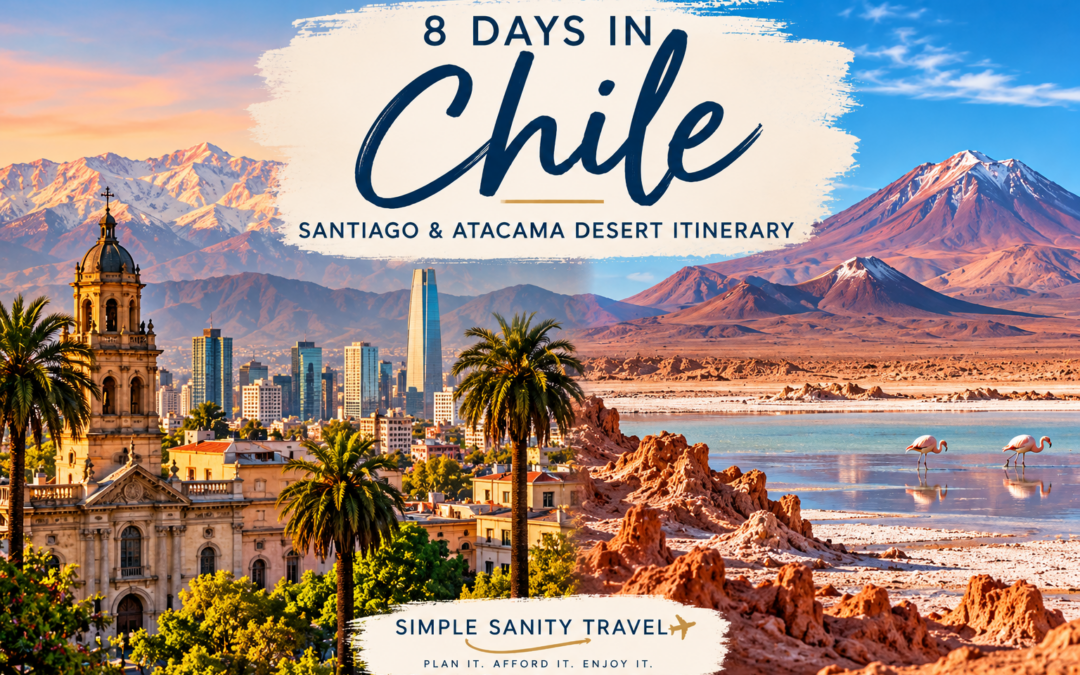
This 8-day Chile itinerary combines Santiago and San Pedro de Atacama, giving you city life, Chilean food and culture, Andes views, desert landscapes, salt flats, flamingos, geysers, and some seriously good stargazing without adding Patagonia just because you found an empty square on the calendar.
This post may contain affiliate links. If you book or purchase through one of these links, I may earn a commission at no additional cost to you. I only share options that I believe are genuinely useful for planning your trip.
Why Go to Chile?
Because very few countries give you this much geographic contrast.
Chile stretches from the Atacama Desert in the north to glaciers and fjords in Patagonia, with Pacific coastline, fertile valleys, mountains, forests, cities, and islands in between.
For a first visit, Santiago and Atacama make a particularly good pair.
Santiago gives you a modern South American capital surrounded by the Andes, with historic areas, museums, parks, markets, restaurants, wine country nearby, and a public transportation system that makes independent exploring relatively easy.
Then you fly north.
San Pedro de Atacama is your base for exploring salt flats, high-altitude lagoons, flamingos, geysers, rock formations, Indigenous culture, volcanoes, and some of the clearest night skies on the planet.
That’s plenty of Chile for eight days.
| If You Want… | Start With… |
|---|---|
| City life and culture | Santiago |
| Restaurants and neighborhoods | Santiago |
| Andes views | Both |
| Wine country | Day trip from Santiago |
| Desert landscapes | San Pedro de Atacama |
| Salt flats and flamingos | Atacama |
| Stargazing | Atacama |
| Geysers | Atacama |
| Glaciers and major hiking | Save Patagonia for another trip |
| A manageable first visit | Santiago + Atacama |
PLAN IT
How Many Days Do You Need for Santiago and Atacama?
I recommend eight days, roughly divided like this:
Days 1–3: Santiago
Neighborhoods, history, food, city views, and one flexible day for whatever interests you most.
Day 4: Fly Santiago to Calama and transfer to San Pedro de Atacama
Travel, settle in, hydrate, and take it easy.
Days 5–7: Atacama Desert
Three days for desert landscapes, high-altitude environments, and stargazing without trying to book every excursion offered in town.
Day 8: San Pedro to Calama and onward travel
If you have nine or 10 days, add them.
Do not immediately add Patagonia.
That is how this starts.
Where Should You Stay in Santiago?
For a first visit, I would start by looking at Providencia or Las Condes, particularly if easy transportation, restaurants, and straightforward logistics matter to you.
Santiago’s Metro and integrated transportation network make it relatively easy to move around without a car, and official tourism information specifically identifies Providencia and Las Condes as major hotel areas connected by Metro.
Providencia is my preference for many first-time visitors because it gives you restaurants, shops, transit, and a useful location for exploring different parts of the city.
Las Condes makes sense if you prefer newer hotels, a polished business district, shopping, and access to several major international hotel brands.
If atmosphere and independent hotels matter more than points, broaden the search.
The important thing is not finding the theoretical “best neighborhood.”
It’s finding a location that makes the trip you’re actually planning easier.
What Should You Do With Three Days in Santiago?
Don’t try to turn Santiago into a 72-hour checklist.
Use the first day to get oriented, the second to explore more deeply, and the third for whatever part of central Chile interests you most.
Day 1: Arrive and Keep It Simple
International arrival day is not the day for your ambitious Santiago master plan.
Check in.
Walk around your neighborhood.
Eat something.
If you have the energy, find somewhere with a view of the Andes.
Then go to bed.
The city will remain open tomorrow.
Day 2: Explore Santiago
Spend a day combining some of Santiago’s historic core with one or two neighborhoods that interest you.
You might include Plaza de Armas, La Moneda, Cerro Santa Lucía, Lastarria, Bellavista, or Cerro San Cristóbal, depending on your interests and energy.
Cerro San Cristóbal is particularly useful early in the trip because the elevated perspective helps you understand Santiago’s position against the Andes.
But don’t collect neighborhoods.
Choose a few places and spend time in them.
Stop for lunch.
Go into a museum because you want to, not because a list told you there are seven museums nearby and apparently you’re now responsible for all of them.
Day 3: Santiago, Wine Country, or More City Time?
This is where I’d let your interests decide.
If you’re interested in Chilean wine, use this day for a wine-valley experience outside the city.
If wine isn’t particularly important to you, keep the day in Santiago.
Visit another neighborhood.
Spend more time at a museum.
Go to a market.
Have a long lunch.
The goal isn’t to prove you used every possible excursion slot.
Do You Need a Rental Car in Santiago?
No.
Santiago has an extensive Metro and bus network, and Chile’s official tourism information describes the integrated Red Movilidad system as an easy way to combine Metro and buses.
You can supplement public transportation with taxis or other local transportation when that makes more sense.
For this itinerary, I would not rent a car in Santiago simply because car rental exists.
You’re about to spend several days navigating a desert.
You can give yourself a break first.
How Do You Get From Santiago to the Atacama Desert?
This part is easier than the map makes it look.
Fly from Santiago to El Loa Airport in Calama (CJC).
San Pedro de Atacama does not have its own commercial airport. Calama is the primary gateway, about 100 kilometers from San Pedro, with the ground trip taking roughly 1½ hours. Transfers, buses, and rental cars are available for the final leg.
Could you drive from Santiago?
Technically.
Chile’s tourism board puts the overland route at roughly 1,530 kilometers and 22 hours, and recommends breaking it into stages.
On an eight-day vacation?
Fly.
Your vacation does not need a 22-hour subplot.
Why Stay in San Pedro de Atacama?
Because San Pedro is the practical base for exploring this part of the desert.
The small oasis town gives you access to Valle de la Luna, El Tatio geysers, high-altitude lagoons, salt flats, flamingo habitats, hot springs, archaeological sites, and astronomical experiences.
You stay in town.
The landscapes are the day trips.
That makes San Pedro especially useful for travelers who don’t want to independently navigate remote desert roads.
What Should You Do With Three Days in Atacama?
This is where restraint becomes useful.
There are enough excursions around San Pedro to fill a week.
You have three days.
Pick experiences that feel genuinely different.
Day 5: Start Lower and Give Yourself Time to Adjust
Don’t make your first morning in the desert your highest-altitude adventure.
You’ve just arrived from Santiago, and some Atacama excursions climb well above 4,000 meters.
Start with something like Valle de la Luna, where wind and water erosion have created dramatic salt and rock formations close to San Pedro. The landscape is especially known for its colors around sunset.
Then come back to town.
Eat.
Drink water.
Do less than you think you should.
This is intentional.
How Serious Is the Altitude in Atacama?
Serious enough that it should influence your itinerary.
San Pedro itself sits at high elevation, and some popular excursions climb much higher. The Altiplanic Lagoons, for example, sit at more than 4,100 meters above sea level. Chile’s tourism authority specifically recommends acclimatization, hydration, sun protection, and appropriate clothing for high-altitude outings.
That’s why I wouldn’t stack your highest excursions immediately after arrival.
Give your body time.
Stay hydrated.
Avoid assuming your normal hiking pace at sea level will translate perfectly to 4,000 meters.
If you feel unwell, tell your guide and take symptoms seriously.
There is no medal for winning vacation against oxygen.
Should You Visit the Altiplanic Lagoons?
If the high altitude works for you, yes.
The Miscanti and Miñiques lagoons sit amid volcanic landscapes at more than 4,100 meters, with intensely colored water, snow-capped peaks, and birdlife adapted to the high Andes.
This is one of the experiences that shows you Atacama isn’t simply endless brown desert.
But it is a long, high-altitude outing.
For travelers with mobility concerns, certain medical conditions, young children, or anyone who doesn’t tolerate altitude well, this is something to discuss carefully with your healthcare provider and tour operator before booking.
There are plenty of ways to experience Atacama without reaching the highest elevations.
Are El Tatio Geysers Worth the Early Morning?
They can be.
El Tatio is one of San Pedro’s signature excursions, but the tours typically mean a very early departure and exposure to high altitude and cold temperatures.
This is one of those experiences where the question isn’t only “Is it worth seeing?”
It’s also:
Is it worth seeing for you?
If early wake-ups, altitude, and cold are going to wipe you out for the rest of the day, skipping it doesn’t mean you failed Atacama.
You could choose lagoons, Valle de la Luna, hot springs, cultural experiences, or another desert landscape instead.
Your vacation does not need suffering to become legitimate.
Should You Go Stargazing in Atacama?
This is one experience I’d make room for.
Atacama’s exceptionally clear skies and low light pollution have made the region internationally important for astronomy, and astronomical tours around San Pedro commonly take visitors outside town for darker conditions and telescope viewing.
But timing matters.
Bright moonlight can interfere with some stargazing experiences, and tours can be affected by clouds and weather. Chile Travel notes that some astronomical tours do not operate around the full moon because of the amount of light.
Check the moon phase when planning.
This is one of the rare times I will encourage you to schedule your vacation around something happening at night.
When Is the Best Time to Visit Santiago and Atacama?
There’s no perfect season for every traveler, but April through June is particularly interesting for Atacama.
Chile’s tourism board currently recommends this autumn period for more moderate temperatures, fewer visitors, clearer post-summer conditions, and potentially better hotel and tour availability. It also notes that December through March can bring the altiplanic winter, when high-altitude rain and storms can affect routes.
Winter brings colder temperatures, especially at night and at altitude.
Summer can mean higher demand.
And Santiago has its own seasonal pattern.
The practical answer is to choose your dates based on the experience you care about most, then pack for both Santiago and a high desert with dramatic temperature changes.
A desert does not automatically mean hot.
At night, Atacama would like a word.
What Are the Current Chile Entry Requirements?
Chile admits eligible foreign visitors under Permanencia Transitoria, generally for stays of up to 90 days, although the permitted period can be limited in individual cases. Whether advance authorization or a visa is required depends on nationality.
Before traveling, check Chile’s official immigration or consular guidance for the passport you’ll be using rather than relying on requirements written for another nationality.
Also make sure you understand any documents given to you at entry and keep them accessible during the trip.
Immigration rules can change, so confirm the requirements again shortly before departure.
Is This Chile Itinerary Good for Solo Travelers, Kids, or Multigenerational Groups?
Yes, but Atacama deserves some extra planning.
Solo travelers: Both Santiago and San Pedro work well for independent travelers. Chile’s tourism board specifically highlights both as strong solo destinations because of their visitor services and range of organized experiences.
San Pedro’s tour infrastructure is particularly useful because you can join excursions without needing to arrange a private driver or find someone willing to accompany you into the desert.
Families: Santiago is straightforward to adapt. In Atacama, pay attention to altitude, excursion length, early departures, temperature changes, and age restrictions.
Before filling the family calendar, my guide to preparing your kids for travel can help you think about what your children actually need from the trip.
Multigenerational groups: Chile can work very well when you stop assuming everyone has to do every Atacama excursion together.
One person can tackle a higher-altitude outing while someone else spends a slower day around San Pedro or chooses a lower-elevation experience.
My guide to planning multigenerational vacations can help with those decisions before the group chat becomes its own endurance event.
AFFORD IT
How Much Should You Budget for 8 Days in Chile?
Chile isn’t the destination where I would build a budget around the assumption that South America automatically means inexpensive.
For this Santiago + Atacama itinerary, I’d start with these planning ranges per person, per day, excluding international airfare and the Santiago-Calama flight:
| Travel Style | Planning Range Per Person, Per Day |
|---|---|
| Affordable | $85–$135 |
| Comfortable | $175–$300 |
| Upscale | $375+ |
These are planning ranges, not fixed prices.
Atacama is the part that can push the total upward.
You’re staying in a remote tourism hub and paying for transportation into landscapes that often require guides, specialized vehicles, entrance fees, or full-day excursions.
At the luxury end, Atacama also has high-end lodges where accommodations, meals, and excursions may be bundled together.
That can be wonderful.
It can also produce a number on your credit-card statement that encourages quiet reflection.
Where Is It Worth Spending More?
A well-located Santiago hotel.
Being near useful transportation and restaurants makes a short city stay easier.
Your Calama-San Pedro transfer.
Pay for the option that works reliably with your flight schedule rather than making this the logistical puzzle you save $14 solving.
One or two excellent Atacama excursions.
A knowledgeable guide and responsible operator matter when you’re traveling into remote, high-altitude landscapes.
Chile Travel specifically recommends using tourism providers registered with Sernatur for activities in the region.
Stargazing.
If astronomy is part of why Atacama appeals to you, this is not where I’d choose the cheapest tour simply because it appeared first.
Where Can You Save?
Santiago.
Public transportation, neighborhood walks, parks, markets, and carefully chosen attractions can keep city days relatively reasonable.
By not booking every Atacama tour.
This is a major one.
San Pedro tour menus can make you feel as though you’re supposed to complete Atacama.
You’re not.
Pick three experiences you care about.
Maybe even two.
By skipping the rental car.
If you’re joining guided excursions, you may not need one at all.
By adding days instead of destinations.
You already paid to get to Chile.
Staying another night in the same hotel can cost less than adding another flight, transfer, and destination.
Can You Use Hotel Points in Santiago?
Yes.
Santiago has a strong major-hotel footprint.
Marriott Bonvoy currently lists numerous Santiago properties across several price levels, including Four Points, Courtyard, AC, Sheraton, Marriott, W, Renaissance, Le Méridien, and Ritz-Carlton.
Hilton Honors also has several Santiago options, including DoubleTree, Hampton, Hilton Garden Inn, Tapestry Collection, and an SLH property participating through Hilton.
IHG One Rewards has InterContinental and Holiday Inn properties in Santiago as well.
That gives you actual choices.
Compare the cash price and points price before redeeming.
If Santiago rates are reasonable for your dates, paying cash may be smarter.
If rates spike while award pricing remains useful, points become much more interesting.
My Hotel Points 101 guide explains how to make that decision without turning your vacation into a spreadsheet competition.
What About Hotel Points in San Pedro de Atacama?
This is where I would loosen your loyalty-program grip.
San Pedro has a much stronger independent, boutique, lodge, and experience-focused accommodation culture than a traditional big-brand hotel footprint.
That’s not a problem.
It’s an opportunity to use your points strategically in Santiago and then choose the San Pedro property that best fits the experience you want.
Don’t choose an awkward itinerary just because a hotel logo makes you feel productive.
Points are a tool.
They are not the itinerary.
Can Airline Miles Help With Chile?
Potentially.
Compare cash and award options for your international flight into Santiago before transferring flexible points.
Then price the Santiago-Calama flight separately.
Sometimes the domestic segment works nicely as part of a larger ticket.
Sometimes buying it separately makes more sense.
Calculate the entire trip, including taxes, baggage, airport timing, and transfer costs.
If you’re booking several seats, my guide to using credit card points for family travel can help you think through whether a redemption is actually saving your family meaningful money.
Should You Book an Airbnb or Vrbo?
In Santiago, vacation rentals can make sense for families, groups, longer stays, or travelers who want a kitchen and more living space.
Compare the total price with a hotel after cleaning and service fees.
Then compare location.
A cheaper apartment that adds transportation time to everything you want to do is not necessarily cheaper in any useful sense.
In San Pedro, I would pay even more attention to practical details.
Look at heating, cooling, hot water, exact location, transportation arrangements, luggage storage, cancellation terms, and how the property handles the desert’s large temperature swings.
A pretty picture of an adobe wall is not the complete accommodation review.
How Should You Handle Money in Chile?
Chile uses the Chilean peso (CLP).
Chile’s tourism authority says credit and debit cards are accepted in most places, while carrying some cash remains useful for markets, tips, and rural areas.
Carry more than one payment method.
Check the current exchange rate before traveling.
And don’t spend your entire vacation calculating what lunch would have cost at Tuesday morning’s exchange rate.
You came to see Chile.
Where Should Your Travel Dollars Go?
Santiago gives you plenty of opportunities to spend with local restaurants, cafés, markets, shops, and guides.
Atacama makes this even more important.
This is not an empty landscape waiting for tourists to photograph it.
Northern Chile has living Indigenous communities, local traditions, archaeological heritage, and communities that have existed in this environment long before desert tourism became an international draw. Chile’s tourism authority explicitly includes Indigenous tourism, archaeology, culture, and heritage among the region’s experiences.
Choose responsible operators.
Respect protected landscapes.
Follow access rules.
And where possible, spend with businesses and guides connected to the communities you’re visiting.
You can still use points.
You can still book luxury.
You can still save strategically.
Use the points where useful, save strategically, and be thoughtful about where the rest of your travel dollars go.
ENJOY IT
Protect Your Peace: Do You Really Need to Add Patagonia?
No.
Patagonia is extraordinary.
It is also at the opposite end of a country more than 4,300 kilometers long.
If Patagonia is the reason you’re going to Chile, build a Patagonia trip.
If Atacama is the reason you’re going, build an Atacama trip.
Trying to make Santiago, Atacama, Valparaíso, wine country, and Patagonia fit into eight days because Chile looks narrow on Google Maps is how you end up experiencing a fascinating selection of airport terminals.
Santiago + Atacama is enough.
Do You Need to Take Every Famous Atacama Excursion?
Also no.
San Pedro makes this difficult because there are so many interesting choices.
Valle de la Luna.
El Tatio.
Altiplanic lagoons.
Piedras Rojas.
Salt flats.
Flamingos.
Hot springs.
Stargazing.
Archaeological sites.
You could fill every waking hour.
Please don’t.
Choose one major experience per day.
And remember that your stargazing tour may happen at night.
A sunrise geyser excursion followed by an afternoon tour followed by a nighttime astronomy tour is technically possible.
So is regretting it.
What Should You Not Over-Plan in Santiago?
Your arrival day.
Meals.
Neighborhood time.
And whichever afternoon you deliberately leave open.
Santiago is not just the place where you change planes for the desert.
Give yourself time to eat, walk around, see how the city sits against the mountains, and notice the difference between Santiago and where you’re going next.
Contrast is one of the reasons this itinerary works.
What If the Altitude Is Too Much?
Change the plan.
This is important.
You do not have to reach every high-altitude attraction to say you experienced Atacama.
Stay closer to San Pedro.
Choose lower-elevation excursions.
Visit cultural and archaeological sites.
Explore Valle de la Luna.
Enjoy the town.
Go stargazing.
Build the itinerary around what your body can comfortably handle.
The high-altitude lagoons do not need you to prove anything to them.
How Do You Make Atacama Feel Like a Vacation Instead of an Expedition?
By remembering that being in the desert is part of the experience.
You don’t need an activity every time the sun changes position.
Have breakfast slowly.
Walk around San Pedro.
Sit outside.
Watch the light change.
Take the astronomy tour.
Come back and sleep.
Some of Atacama’s appeal is scale, silence, sky, and landscape.
Those things don’t require you to be holding a reservation confirmation.
Is Santiago and Atacama the Only Good First Chile Trip?
Not at all.
That’s what makes Chile difficult to plan.
If wine and coastal cities matter more than desert landscapes, you could build a trip around Santiago, Valparaíso, and the wine valleys.
If hiking and glaciers are the reason Chile has been sitting on your list, build the trip around Patagonia.
If Indigenous Polynesian culture and archaeological heritage are the priority, Rapa Nui is an entirely different trip.
Chile’s tourism authority divides the country into distinct travel regions precisely because the experiences differ so dramatically.
For a first-time traveler who wants a dramatic contrast without changing hotels every other night, though, Santiago + Atacama is a strong combination.
You get city.
Mountains.
Culture.
Desert.
Wildlife.
Stars.
And enough time to remember what you saw.
Want Someone Else to Handle the Bigger Trip?
If Santiago and Atacama sound exactly right but arranging the domestic flight, Calama transfer, desert excursions, and all those moving pieces sounds considerably less appealing, this is a destination where an organized option can solve a real problem.
One of my travel partners offers a Santiago and Atacama trip that handles much of the larger itinerary and transportation planning for you.
That’s particularly useful in Atacama, where many of the places you came to see are well outside San Pedro and require transportation, advance planning, or guided excursions.
You’ll give up some of the flexibility of planning everything independently.
In return, somebody else deals with a significant portion of the logistics.
For some travelers, that’s a very worthwhile trade.
Explore the Santiago & Atacama trip from my travel partner
Travel information in this guide was accurate at the time of posting. Prices, routes, schedules, hotel and tour availability, entry requirements, and other travel details can change. Always confirm current information directly with the relevant provider or official source before your trip.
Related Blog Posts
Hotel Points 101: How to Earn Free Nights Without Turning It Into Another Job
How to Prepare Your Kids for Travel: Start With Yourself
Five Multigenerational Vacation Ideas for Families Traveling With Elderly Parents or Grandparents
The Overwhelmed Parent’s Guide to Using Credit Card Points for Family Travel