How to Travel to Peru Without Losing Your Sanity
I went to Peru when I was nine, almost 30 years ago. I don’t remember the name of our hotel, but somehow I still remember eating the best eggs of my life there every morning. Childhood travel memories are funny like that.
What stayed with me most, though, was Machu Picchu. I didn’t have the historical vocabulary for it at nine. I just remember feeling that there was something sacred about the land itself. Now, planning this trip as an adult, I understand a little better why that feeling has stuck with me.
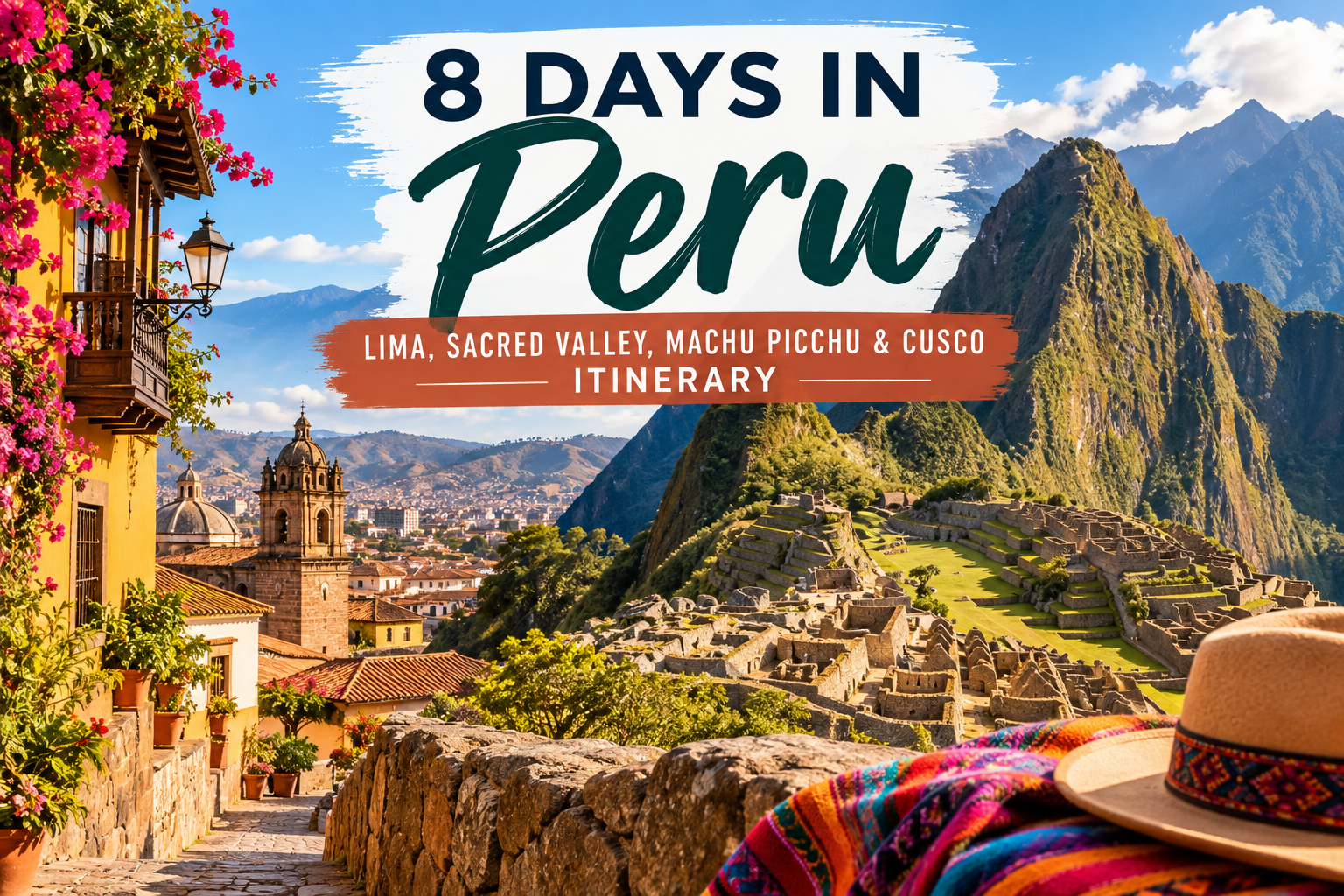
For a first trip today, I’d spend eight days traveling from Lima to the Sacred Valley, Machu Picchu, and Cusco. The order is intentional. Instead of flying into the Andes and immediately filling your Cusco schedule, you’ll move through the Sacred Valley first, give yourself some room to adjust, experience Machu Picchu without treating it like a day-trip trophy, and finish in Cusco before connecting through Lima for your flight home.
This post may contain affiliate links. If you book or purchase through one of these links, I may earn a commission at no additional cost to you. I only share options that I believe are genuinely useful for planning your trip.
Why Go to Peru?
Machu Picchu may be the photograph that gets people to Peru, but it shouldn’t be the only thing you see once you arrive.
Lima brings the Pacific coast, museums, historic neighborhoods, and one of Latin America’s most celebrated food scenes. The Sacred Valley brings Andean landscapes, Indigenous communities, archaeological sites, agriculture, textiles, and towns such as Pisac and Ollantaytambo. Cusco was the capital of the Inca Empire, and layers of Inca and Spanish colonial history remain visible throughout the city.
Then there is Machu Picchu itself.
It was one of the Inca Empire’s most important religious, political, and administrative centers. Its agricultural terraces and urban structures sit within a mountain landscape that is very much part of the experience, not simply scenery surrounding it.
That’s why this itinerary doesn’t race directly there.
The journey through Peru should help you understand what you’re seeing when you finally arrive.
PLAN IT
How Many Days Do You Need for a First Trip to Peru?
For Lima + Sacred Valley + Machu Picchu + Cusco, I would give yourself at least eight days.
Here’s the basic route:
| Day | Overnight | Main Plan |
|---|---|---|
| 1 | Lima | Arrive and settle in |
| 2 | Lima | History, neighborhoods, and food |
| 3 | Sacred Valley | Fly Lima → Cusco, transfer into the valley |
| 4 | Sacred Valley | Choose one focused valley day |
| 5 | Machu Picchu Pueblo | Ollantaytambo + train |
| 6 | Cusco | Machu Picchu + continue to Cusco |
| 7 | Cusco | Historic Cusco |
| 8 | — | Fly Cusco → Lima → home |
If you have nine or ten days, even better.
Add another Sacred Valley or Cusco day. Don’t immediately respond to extra vacation time by adding Lake Titicaca, Arequipa, the Amazon, Rainbow Mountain, and a six-hour hike.
That’s how an eight-day vacation quietly becomes a transportation project.
Should You Start in Lima?
Yes, even if Machu Picchu is the reason you booked the flight.
Lima gives you a very different introduction to Peru.
For a first trip, Miraflores or Barranco are practical areas to consider. Miraflores offers hotels, restaurants, parks, coastal views, and a large tourism infrastructure. Barranco has more of an artsy, historic neighborhood feel.
Give yourself one full day rather than trying to “do Lima” during an airport connection.
You could combine a historic or museum experience with Miraflores and Barranco, but I would leave plenty of room for food. Lima’s culinary identity is not a side attraction.
Choose one meal you genuinely care about.
Then leave enough room to get hungry again.
Why Go to the Sacred Valley Before Cusco?
This is one of the biggest decisions I’d make differently from a rushed Peru itinerary.
Cusco sits high in the Andes, and altitude can affect travelers differently.
Rather than landing and immediately launching into a packed Cusco sightseeing day, I would transfer into the Sacred Valley and make that first afternoon easy.
This isn’t a guarantee that you won’t experience altitude symptoms. It is simply a gentler itinerary design.
Eat.
Hydrate.
Walk if you feel like it.
Look at the mountains.
Your first day in the Andes does not need a performance review.
If you have medical concerns about altitude, discuss them with your healthcare provider before traveling. If you develop concerning or worsening symptoms during your trip, seek medical attention rather than trying to push through the itinerary.
Where Should You Stay in the Sacred Valley?
For this route, I particularly like Ollantaytambo or the Urubamba area.
Urubamba has a broad lodging and tourism infrastructure, including larger and upscale properties. Ollantaytambo gives you an archaeological site, a historic Andean town, and particularly useful access to trains toward Machu Picchu.
If your priority is convenience for the Machu Picchu train, Ollantaytambo has a strong advantage.
If your priority is a relaxing resort or hacienda-style experience, broaden the search around Urubamba.
I would not change hotels every night just to sample the valley.
Choose a base and let it do its job.
What Should You See in the Sacred Valley?
This is where restraint becomes useful.
The Sacred Valley includes places such as Pisac, Chinchero, Maras, Moray, Urubamba, and Ollantaytambo, along with communities where Indigenous traditions remain part of daily life.
You do not need all of them in one day.
Choose according to your interests.
If archaeological sites are your priority, consider Pisac and Ollantaytambo.
If landscapes and agricultural history interest you, consider Maras and Moray.
If textiles and traditional weaving interest you, Chinchero may deserve your time.
And when visiting community or textile experiences, pay attention to who is actually interpreting the culture, producing the work, and benefiting financially.
This is living culture, not set decoration on the way to Machu Picchu.
How Do You Get to Machu Picchu?
For this itinerary, I’d travel by train from the Sacred Valley toward Machu Picchu Pueblo, also known as Aguas Calientes, and spend the night.
Ollantaytambo is particularly convenient because it is one of the main departure points for trains toward Machu Picchu.
This part makes me laugh a little because one of my clearest childhood memories of Peru is the train.
I remember it being long and cold.
That was almost 30 years ago, during winter, and is absolutely not useful information for choosing a train today.
What it is useful for is reminding me how much transportation becomes part of a travel memory.
Today there are different train classes and service levels, including options designed around panoramic views. Compare the schedule and experience you actually want rather than assuming the most expensive train is automatically necessary.
What Should You Know About Luggage on the Machu Picchu Train?
This is a detail that can catch people off guard.
Train services to Machu Picchu have specific luggage rules, and depending on your train and service, you may be limited to a small bag rather than the full suitcase you packed for Peru.
Check the current luggage allowance directly with your train operator before departure.
Plan a smaller overnight bag for Machu Picchu and arrange storage or luggage transfer for the rest.
It’s a small logistical decision that makes this section of the trip considerably easier.
How Far Ahead Should You Book Machu Picchu?
This is the part of Peru I would not leave to spontaneity.
Machu Picchu operates with defined visitor circuits, routes, entry times, and ticket controls.
Book your Machu Picchu admission before building nonrefundable train and hotel plans around a date.
Then coordinate:
- Machu Picchu ticket and circuit
- Machu Picchu Pueblo hotel
- train
- local transportation
- Sacred Valley and Cusco hotels
The exact ticket system, routes, capacity rules, and schedules can change, so check Peru’s official Machu Picchu information while planning.
This is not the moment to trust a screenshot from somebody’s trip three years ago.
Which Machu Picchu Circuit Should You Choose?
The best circuit depends on what you want to see, current route availability, mobility, and whether you are adding one of the mountain hikes.
Rather than declaring one circuit universally “best,” look at the current official route maps before buying.
Ask yourself:
Do you want the classic elevated view?
How much walking and climbing are you comfortable doing?
Is seeing particular archaeological areas important?
Are you traveling with children or someone with mobility limitations?
Are you adding Huayna Picchu or another hike?
Your Machu Picchu ticket is not simply admission through a front gate. Your route affects what you’ll experience.
Why Spend the Night Near Machu Picchu?
Because I don’t want the most anticipated part of the trip wedged between transportation connections.
Staying in Machu Picchu Pueblo gives you more breathing room around your visit and removes one piece of same-day transportation pressure.
It does mean another hotel night.
For me, this is one hotel change that earns its place.
What I remember from visiting Machu Picchu as a child isn’t a list of structures.
I remember how the place felt.
At nine, I didn’t know how to explain that. The mountains, the ruins, the landscape around them all felt sacred to me.
Nearly 30 years later, that is still the strongest memory I have of Peru.
I don’t want to tell you what you’re supposed to feel when you get there. But I do think Machu Picchu deserves enough time and attention for you to have your own reaction to it.
Why Finish in Cusco?
Because Cusco deserves to be experienced as a destination rather than a waiting room for Machu Picchu.
The city was the capital of the Inca Empire, and today you’ll encounter Inca stonework, Spanish colonial architecture, churches, plazas, markets, museums, restaurants, and living Andean culture throughout the historic center.
Places you might consider include Qorikancha, Plaza de Armas, San Pedro Market, and nearby Sacsayhuamán.
By placing Cusco toward the end, you’ve also had several days in the Andes before giving yourself a full sightseeing day here.
Walk.
Eat.
Visit a few places that genuinely interest you.
Sit in the plaza.
Buy something directly from an artisan if you find something you love.
Cusco does not need to become a scavenger hunt.
Can You Fly Home From Cusco?
For most U.S. travelers, plan on connecting through Lima rather than flying nonstop from Cusco to the United States.
That does not necessarily mean you need another night in Lima.
You may be able to book Cusco through to your final destination on one itinerary, with Lima as your connection.
When comparing flights, pay close attention to:
- connection time in Lima
- whether the flights are on one ticket
- baggage rules
- whether you need to collect and recheck luggage
- terminal and check-in requirements
For this itinerary, Day 8 is therefore Cusco → Lima → home.
If the available flight schedules create a connection you’re uncomfortable with, add a Lima night rather than building the final day around a connection that makes you nervous.
When Is the Best Time to Visit Peru?
For this particular itinerary, many travelers favor the drier Andean months roughly from May through September because rainfall is generally lower around Cusco and Machu Picchu.
That doesn’t mean warm.
I can personally confirm the existence of cold Peru memories.
I went during the Andean winter, and apparently nine-year-old me decided the train temperature deserved permanent storage in my brain.
Expect significant temperature changes between day and night in the Andes. Layers matter.
The wetter months can bring greener landscapes and potentially fewer visitors at certain times, but rain can affect hiking and transportation.
There is no single perfect month. Choose based on your tolerance for rain, cold, crowds, and pricing.
What Should Families, Solo Travelers, and Multigenerational Groups Know?
For solo travelers, you can build this route fairly easily using flights, trains, transfers, and guided excursions without needing to drive. Book reputable transportation and keep current local safety guidance in mind.
For families, resist the temptation to make every archaeological site mandatory.
I visited Machu Picchu at nine and remember remarkably little of the historical information. I remember the landscape, the train, the cold, and those hotel eggs.
Kids absorb travel differently.
My guide to preparing your kids for travel can help you think about expectations before the trip.
For multigenerational travelers, altitude, stairs, uneven surfaces, train logistics, and the specific Machu Picchu circuit matter. Build around the traveler who needs the most physical consideration instead of assuming everyone can simply keep up.
My guide to multigenerational travel goes deeper into that planning process.
Splitting up for one activity is allowed.
You remain a family.
What Are the Current Travel Guidelines for Peru?
Entry requirements depend on nationality, so check the rules that apply to your passport before traveling.
Passport validity, visa requirements, immigration rules, and travel advisories can change.
Regional security guidance can also vary within Peru, so don’t assume a warning for one part of the country automatically applies in exactly the same way everywhere else.
Before departure, check Peru’s current official immigration requirements and your own government’s latest travel guidance.
AFFORD IT
How Much Should You Budget for 8 Days in Peru?
Peru can work across a wide range of budgets, but Machu Picchu changes the math.
For this Lima + Sacred Valley + Machu Picchu + Cusco itinerary, I’d use these planning ranges per person, per day, assuming two people share a room and excluding international airfare:
| Travel Style | Planning Range |
|---|---|
| Affordable | $90–140 per person/day |
| Comfortable | $175–300 per person/day |
| Upscale | $375+ per person/day |
Your Machu Picchu segment will probably be more expensive than an ordinary sightseeing day because you’re combining admission, transportation, train travel, and potentially a guide.
A luxury train or high-end Sacred Valley property can push the budget substantially higher.
These are planning ranges, not promises that your trip will land on a particular number.
Where Is It Worth Spending More?
Your Machu Picchu logistics.
This is not where I’d choose the itinerary with three questionable connections because it saves $37.
A good guide.
At archaeological sites, context matters. You are looking at places connected with complicated histories, beliefs, engineering, politics, agriculture, and living cultures.
A well-located Sacred Valley stay.
A property that works with your route can eliminate unnecessary transportation.
One memorable meal in Lima.
Peru’s food culture deserves its own place in your budget.
Where Can You Save?
Use points for Lima or Cusco when the redemption makes sense.
Choose a standard train rather than a luxury train if the schedule works.
Eat at a mix of restaurants, markets, cafés, and casual local places rather than making every meal a reservation.
Don’t turn the Sacred Valley into six separate paid tours.
And skip the activity you added only because someone on TikTok said it was “a must.”
Peru already has enough actual musts.
Can You Use Hotel Points in Peru?
Yes, and Peru gives you more opportunities than you might expect.
Lima has a substantial major-brand footprint, including options through programs such as Marriott Bonvoy, Hilton Honors, and IHG One Rewards.
Cusco also has useful loyalty options.
That makes Lima and Cusco the places where I would look first if you have hotel points available.
The Sacred Valley is where I’d be more willing to step outside a loyalty program for a property that improves the actual experience or location.
Machu Picchu Pueblo is another place where convenience may matter more than loyalty.
Compare cash and points rather than assuming points are automatically a bargain.
My Hotel Points 101 guide explains the approach.
Use the points where useful, save strategically, and be thoughtful about where the rest of your travel dollars go.
Should You Use Airbnb or Vrbo in Peru?
They’re worth comparing, particularly in Lima and Cusco if you’re traveling as a family or group.
A vacation rental can make sense when you need multiple bedrooms, laundry, a kitchen, or more living space.
But compare the total cost and logistics, not just the nightly rate.
Check:
- exact location
- stairs and elevators
- heating
- hot water
- luggage access
- cleaning fees
- cancellation terms
- nighttime noise
- proximity to transportation
- luggage storage on arrival or departure days
For a one-night Machu Picchu Pueblo stay, I would usually prioritize convenience over apartment space.
You are not moving in.
Can Points and Miles Help With Flights?
Potentially.
Compare your international award options into Lima with cash fares first.
Then price the Lima-to-Cusco domestic flight separately, or compare an itinerary that includes your domestic connections.
For an eight-day trip, I would fly between Lima and Cusco rather than sacrifice a large portion of the itinerary to overland transportation simply to save money.
Remember that the return journey will generally involve Cusco → Lima → international destination, so look at the complete flight plan before transferring points or booking separate tickets.
If you’re new to award travel, my guide to using credit card points for family travel explains how to compare options without making points another full-time responsibility.
How Can Your Travel Dollars Support Peru’s Local Economy?
Use your hotel points when they genuinely help.
Then think about where some of the rest goes.
Eat at locally owned restaurants.
Hire knowledgeable local guides.
Buy textiles and crafts directly from artisans and cooperatives when possible.
Choose community-based experiences where local people are actually involved in telling their own stories and benefiting from tourism.
That matters particularly in the Sacred Valley, where travelers aren’t visiting a culture that exists only in archaeological ruins. Indigenous communities, languages, traditions, agriculture, textiles, and beliefs remain part of life throughout the region.
Intentional spending does not mean you have to research the ownership structure of every empanada.
It means paying attention when you have a meaningful choice.
ENJOY IT
Protect Your Peace: Do You Need Rainbow Mountain Too?
No.
Rainbow Mountain can be a great experience for travelers who genuinely want the hike and are prepared for the elevation and physical demands.
It is not a required attachment to Machu Picchu.
This itinerary already involves altitude, archaeological sites, trains, transfers, hotel changes, and one of the most anticipated places you’re likely to visit.
If Rainbow Mountain is a major goal, give yourself additional time and research the altitude and physical requirements carefully.
Do not add it because you found an empty square on Day 8.
Do You Need to Hike the Inca Trail to “Really” Experience Machu Picchu?
Also no.
If hiking the Inca Trail is important to you, build your trip around it. It requires a different itinerary, permits, physical preparation, and more time.
If you want to take the train, take the train.
Arriving by train does not make your reaction to Machu Picchu less meaningful.
Nine-year-old me certainly wasn’t evaluating anybody’s adventure credentials.
What Should You Do if Altitude Changes Your Plans?
Change the plans.
Don’t treat the itinerary as a contract you signed before your body got a vote.
Rest.
Choose an easier day.
Skip a hike.
Use transportation instead of walking uphill.
Seek medical help if symptoms are concerning or worsening.
Cusco and the Sacred Valley offer plenty to experience without turning every day into an altitude endurance test.
The goal is Peru.
Not proving something to Peru.
What Should You Not Over-Plan in the Sacred Valley?
Every archaeological site.
Every market.
Every weaving demonstration.
Every viewpoint.
Every meal.
Choose a few places and give them time.
The Sacred Valley is one of those destinations where the landscape between the attractions is part of why you came.
If your entire day is spent checking the clock because the driver needs to get you to Stop Number Seven, you’ve missed some of the point.
How Much Time Should You Give Machu Picchu?
Enough that you’re not thinking about your next train while you’re standing there.
Your specific visit duration will depend on your ticket, circuit, entry time, and current regulations.
But mentally, give the place your attention.
Machu Picchu is not just the famous viewpoint.
It represents Inca architecture, engineering, agriculture, political and religious life, all constructed within an extraordinary mountain environment.
I was nine when I went.
I don’t remember the details someone probably explained to me.
But I remember feeling that the land was sacred.
I think that’s part of why travel matters. You don’t always know which part of a trip your brain is going to carry around for the next 30 years.
Sometimes it’s Machu Picchu.
Apparently, sometimes it’s breakfast eggs.
What’s the Sanity-Saving Take on Peru?
Don’t build your first Peru trip around the idea that Machu Picchu is the only thing that matters.
And don’t go to the opposite extreme and try to see the entire country because you’ve already flown this far.
Give Lima a day.
Slow down in the Sacred Valley.
Plan Machu Picchu carefully.
Finish in Cusco.
Then connect through Lima for your flight home.
Leave something for next time.
Peru has the Amazon, Lake Titicaca, Arequipa, Colca Canyon, northern archaeological sites, beaches, desert landscapes, trekking routes, and far more than one eight-day itinerary can responsibly hold.
You don’t need to collect Peru.
You need enough time to notice where you are.
Want Someone Else to Handle the Planning?
Machu Picchu is one of those destinations where having someone else coordinate the moving pieces can be genuinely useful.
One of my travel partners offers a Sacred Land of the Incas itinerary for travelers who would rather have more of the accommodations, transportation, excursions, and major logistics coordinated for them.
That can be especially appealing if the part of Peru planning that is making you hesitate is coordinating flights, transfers, hotels, trains, Machu Picchu logistics, and guided sightseeing.
You’ll trade some independence for convenience.
If that trade sounds good to you, you can explore the Sacred Land of the Incas itinerary through my travel partner.
If you’d rather control your own pacing, hotel choices, meals, and free time, use the independent route in this guide as your starting point.
Both approaches can get you to Machu Picchu.
The better question is how much of the planning you want to carry yourself.
Travel information in this guide was accurate at the time of posting. Prices, routes, schedules, hotel and tour availability, Machu Picchu tickets and circuits, entry requirements, safety conditions, and other travel details can change. Always confirm current information directly with the relevant provider or official source before your trip.
Related Blog Posts
How to Prepare Your Kids for Travel: Start With Yourself
Five Multigenerational Vacation Ideas for Families Traveling With Elderly Parents or Grandparents
Hotel Points 101: How to Earn Free Nights Without Turning It Into Another Job
The Overwhelmed Parent’s Guide to Using Credit Card Points for Family Travel