
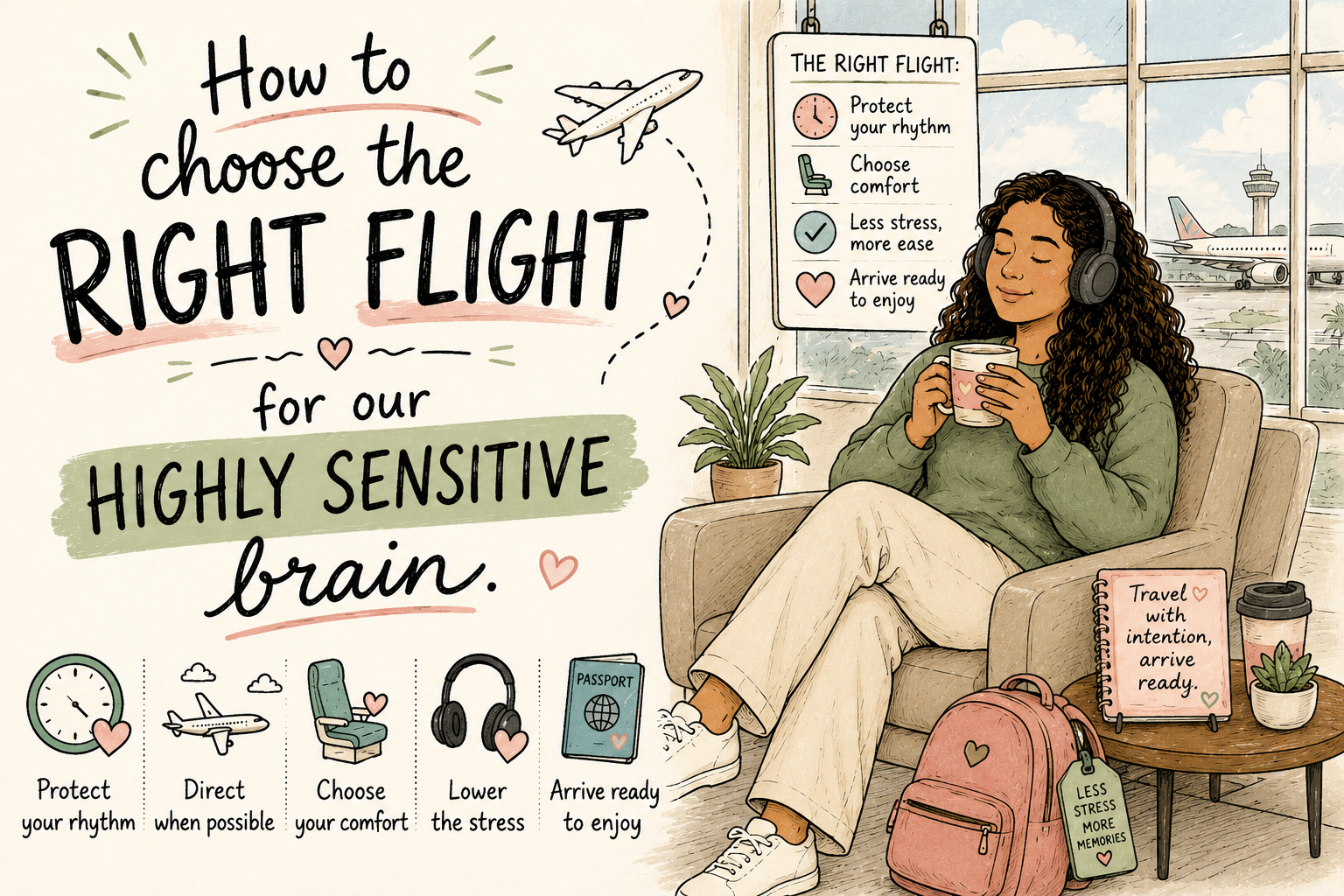
Why Your Nervous System Deserves a Seat at the Flight-Booking Table
When most people search for flights, they’re focused on one thing: price.
But if you’re neurodivergent, highly sensitive, prone to anxiety, or simply someone who gets overwhelmed by travel stress, the cheapest flight isn’t always the best choice.
In fact, I’ve found that some of the most expensive travel mistakes happen when we ignore what our nervous system actually needs.
Over the years, I’ve learned that choosing the right flight can mean the difference between arriving excited and ready to explore or arriving exhausted, overstimulated, and needing days to recover.
The good news? With a little planning, you can choose flights that work with your brain instead of against it.
The Best Flight Isn’t Always the Cheapest Flight
Travel websites are designed to highlight the lowest fare. What they don’t show is the hidden cost of stress.
That bargain ticket might include:
- A 5:30 a.m. departure
- A rushed connection
- A middle seat
- A crowded airport
- A disrupted sleep schedule
- An exhausting arrival time
For many travelers, those inconveniences are manageable. For highly sensitive, anxious, or neurodivergent travelers, they can significantly impact the entire trip.
One of the biggest mindset shifts I encourage clients to make is this:
The best flight isn’t always the cheapest one, it’s the one your nervous system can successfully navigate.
This is especially important when evaluating travel packages.
Package vacations often advertise an incredible overall price, but the savings sometimes come from less desirable flight options: inconvenient departure times, multiple connections, long layovers, or less comfortable seating assignments.
Before booking a package, take a close look at the flight details. A package that costs a few hundred dollars more but includes better flight times, fewer connections, or a more comfortable routing can be a significantly better value.
As a travel advisor, I often remind clients that a vacation starts the moment you leave home—not when you arrive at the resort. If the journey drains all your energy, the “deal” may not feel like much of a deal at all.
Protect Your Circadian Rhythm Whenever Possible
One of the biggest factors in how I feel during a trip is whether I can maintain my normal sleep schedule.
Travel is already full of unfamiliar environments, sensory input, and decision-making. Disrupting your body’s natural rhythm on top of that can make everything feel harder.
Whenever possible, I look for flights that allow me to:
- Wake up at my normal time
- Eat meals on a familiar schedule
- Arrive before I’m completely exhausted
- Maintain a consistent bedtime
I generally avoid extremely early departures because they force me to rush through the morning and start the day in a heightened state of stress.
I’ve also learned to be cautious about red-eye flights. While they may look efficient on paper, they often leave travelers sleep-deprived and overstimulated upon arrival.
As a highly sensitive person, I know that a disrupted sleep schedule can affect not only my energy levels but also my patience, emotional resilience, and ability to enjoy new experiences. Protecting my circadian rhythm is one of the most valuable travel choices I can make.
Direct Flights Are Often Worth the Investment
If a flight is under seven hours, I almost always recommend considering a nonstop option whenever possible.
Connections introduce additional variables:
- Delays
- Gate changes
- Crowded terminals
- Uncertainty
- More sensory input
- More opportunities for travel disruptions
For travelers with anxiety or sensory sensitivities, each additional step can increase stress.
A nonstop flight may cost more, but it removes an entire layer of complexity from the travel experience.
When evaluating flight options, don’t just compare dollars. Compare the amount of mental energy each itinerary will require.
Strategic Seat Selection Matters More Than You Think
Many travelers treat seat assignments as an afterthought.
For sensitive travelers, seat selection can have a significant impact on comfort and stress levels.
Personally, I prefer sitting toward the front of the aircraft whenever possible. I tend to notice less movement, boarding and deplaning feel smoother, and I can get off the plane more quickly after landing.
Why I Rarely Recommend the Middle Seat
If you’re sensitive to sensory input, the middle seat is almost never the best choice.
In a window or aisle seat, you’re managing one neighboring passenger. In a middle seat, you’re managing two.
That means twice as many sensory variables:
- Different perfumes or fragrances
- Body heat
- Conversation
- Eating noises
- Armrest negotiations
- Fidgeting and movement
- Screen brightness
- Different comfort preferences
For highly sensitive travelers, anxious travelers, and many neurodivergent travelers, reducing sensory variables can make a meaningful difference in overall comfort.
Whenever possible, reserve your seat in advance and avoid leaving the assignment to chance.
Extra Legroom Can Be Worth Every Penny
Having additional personal space can dramatically improve your experience.
Extra legroom often provides:
- Better comfort
- Easier movement
- Reduced feelings of confinement
- Less sensory intrusion from neighboring passengers
- Lower overall stress
This is one of the upgrades I frequently recommend when it meaningfully improves comfort.
Choose Airports as Carefully as You Choose Flights
Many travelers compare airlines but forget to compare airports.
Airport design, size, and layout can dramatically influence your travel experience.
A lower fare may require navigating:
- Massive terminals
- Long walks
- Multiple train connections
- Heavy crowds
- Complex layouts
Meanwhile, a slightly more expensive option through a calmer airport may create a far more manageable experience.
Think Beyond the Airport Itself
The airport experience doesn’t end when the plane lands.
When comparing flight options, consider what happens next.
Some airports may offer lower fares but require:
- Long train rides
- Multiple transfers
- Complicated public transportation
- Lengthy taxi queues
- Heavy traffic
Others may provide a much simpler route to your final destination.
Whenever possible, prioritize airports that offer easy, direct access to where you’re staying. Fewer transportation decisions often mean less stress and a smoother arrival day.
Consider Outsourcing Decisions with a Private Transfer
One of the most underrated travel upgrades for sensitive or anxious travelers isn’t on the airplane at all.
It’s arranging transportation from the airport to your hotel before you leave home.
After a flight, your brain is often processing:
- New surroundings
- Unfamiliar signage
- Language differences
- Crowds
- Fatigue
Adding transportation logistics on top of that can quickly become overwhelming.
A pre-arranged private transfer removes nearly all of those decisions.
Instead of figuring out taxis, rideshares, trains, or shuttle systems after landing, someone is already expecting you.
You’re essentially delegating the entire airport-to-hotel journey to another person.
For many travelers, that reduction in decision fatigue creates an immediate sense of relief and allows them to start their vacation feeling calm rather than depleted.
Travel on Calmer Days When Possible
Not all travel days feel the same.
Flying during peak travel periods can increase:
- Security wait times
- Airport congestion
- Noise levels
- Delays
- General unpredictability
For sensitive travelers, that can quickly become overwhelming.
How to Identify a Quieter Travel Day
While there are exceptions, some travel days are consistently busier than others.
In general:
- Fridays and Sundays tend to be heavier travel days.
- The days immediately before and after holidays are often the busiest.
- School vacation weeks can significantly increase airport congestion.
- Tuesdays and Wednesdays are often calmer.
- Midday flights can sometimes feel less rushed than very early departures.
When searching flights, pay attention to seat maps and overall availability. Flights that appear nearly full weeks in advance may indicate heavier travel demand.
If your schedule is flexible, shifting your departure by even a day or two can sometimes create a noticeably calmer travel experience.
Don’t Leave Food to Chance
One mistake I’ve learned to avoid is relying entirely on airplane food.
Travel days often disrupt normal eating patterns, and many travelers end up under-fueled without realizing it.
When blood sugar drops, stress, irritability, anxiety, and sensory sensitivity often increase.
Before flying, I try to:
- Eat a proper meal
- Bring familiar snacks
- Stay hydrated
- Avoid long stretches without food
I also bring snacks on board that I know my body will welcome. A well-fed nervous system handles travel challenges far better than a hungry one.
Give Yourself Permission to Travel Differently
Perhaps the most important lesson I’ve learned is that there is no prize for enduring unnecessary discomfort.
- You don’t need to choose the hardest itinerary.
- You don’t need to book the cheapest flight if it’s going to leave you depleted.
- You don’t need to travel the same way everyone else does.
The most successful travel plans aren’t built around maximizing every dollar. They’re built around protecting your energy.
When you start evaluating flights through the lens of nervous-system capacity rather than price alone, you often make different decisions—and those decisions frequently lead to a better overall travel experience.
For neurodivergent travelers, highly sensitive people, and anyone who experiences travel anxiety, self-accommodation isn’t indulgent.
Final Thoughts
Travel should expand your world, not overwhelm your nervous system.
The next time you’re comparing flights, look beyond the ticket price. Consider how each option aligns with your energy, sensory needs, sleep patterns, and stress levels.
The right flight isn’t necessarily the cheapest one or the fastest one. It’s the one that allows you to arrive feeling like yourself. And that may be one of the most valuable travel investments you can make.