
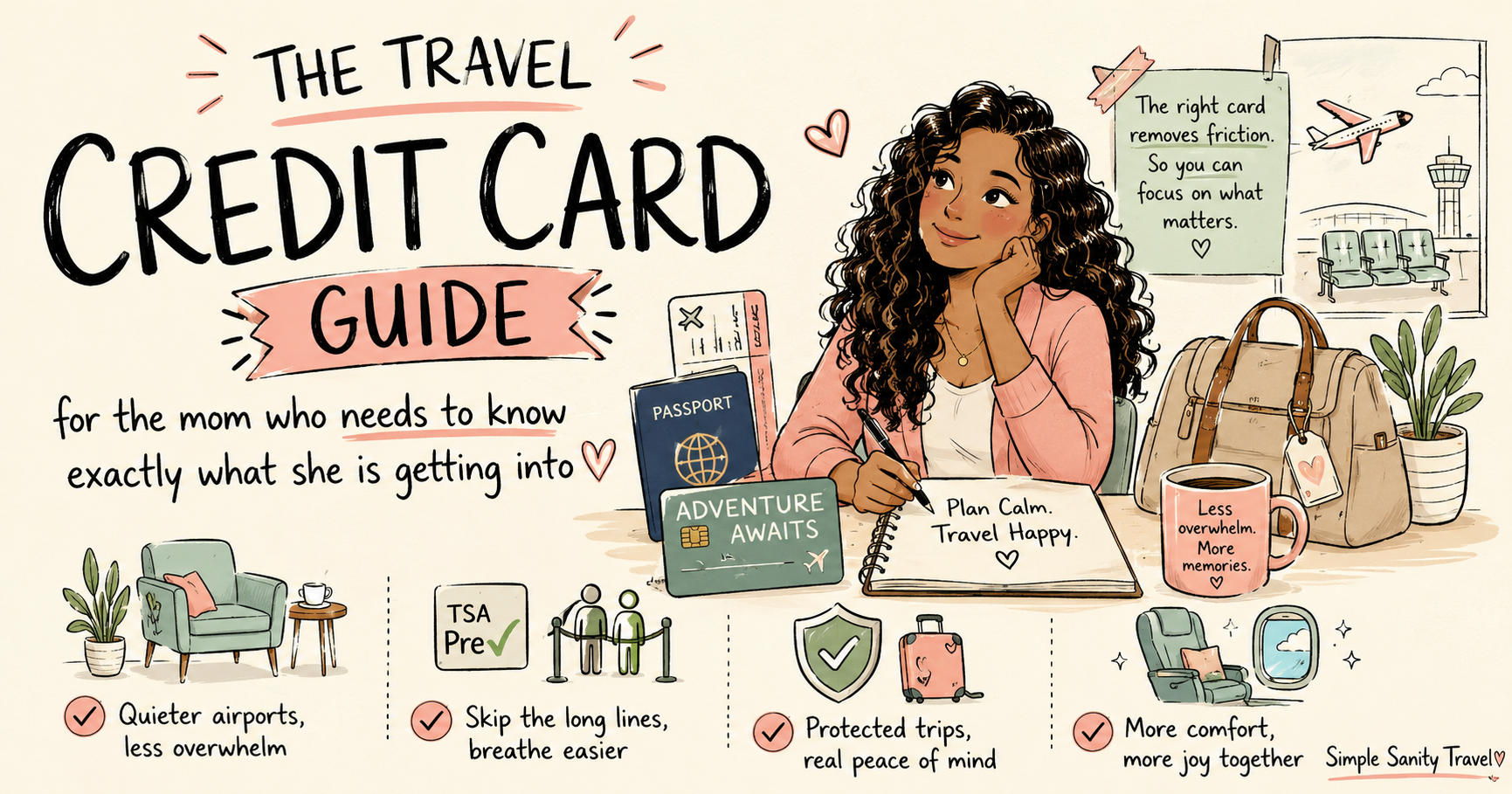
The travel credit card guide for the mom who needs to know exactly what she is getting into
Most credit card guides tell you to pick the card with the highest sign-up bonus or the best points-per-dollar on dining.
That is not what this is.
This is for the mom who needs to know that the airport will not swallow her whole. That the hotel room will be quiet enough. That if something goes wrong, there is a plan already in place and she does not have to figure it out on the spot.
The right card does not just earn points. For your family, it removes specific friction. And the friction your family faces is not the same as the friction someone else’s family faces.
So instead of ranking cards, this guide asks a different question: what is the hardest part of travel for you?
Find your answer below. Then follow it to the perks that actually match what your family needs.
Start here: what does travel feel like in your body?
Read each description. Pick the one that sounds most like you. You may recognize yourself in more than one — if so, read all of them.
“The airport itself is the problem.”
The crowds, the noise, the unpredictability of security lines, the sensory overload before you even board the plane.
If this is you, your nervous system needs the airport to be smaller and quieter before you can access any version of calm. The main thing a card can do for you here is get you out of the general population.
Perks to prioritize:
- Airport lounge access. This is the single highest-impact perk for sensory-sensitive families. A lounge is quieter, less crowded, and more predictable than the main terminal. You control when you enter and when you leave. There are no gate announcements blasting at you. Your kids can eat without you worrying about a scene. You sit down before the flight instead of standing in a loud hallway.
Look for cards that offer Priority Pass membership, which opens access to over 1,300 lounges worldwide. But if you want to go a level deeper, look specifically for cards with access to exclusive lounges that are not tied to a single airline. The Amex Centurion Lounges (available with the Amex Platinum) and Capital One Lounges (available with the Venture X) are brand-owned, which means they tend to be quieter, more consistent, and better staffed than a typical airline club.
There is a secondary benefit here that does not get talked about enough: these lounges are located in specific terminals that only service certain airlines. If you are working from a lounge-first strategy, you end up with a shorter list of airlines worth considering, which removes a whole category of decisions from your planning process. You are not choosing the cheapest flight across 12 carriers. You are choosing the flight that leaves from the terminal with the lounge you already know.
The strongest options right now are the Amex Platinum (Centurion Lounges plus Priority Pass), the Chase Sapphire Reserve (Chase Sapphire Lounges plus Priority Pass), and the Capital One Venture X (Capital One Lounges plus Priority Pass, at a lower annual fee than the others).
One thing to check: lounge guest policies have changed in 2026. Capital One recently reduced how many guests you can bring for free. If you are traveling with children, confirm the guest policy before you count on it.
- TSA PreCheck or Global Entry credit. Even if the lounge is your main goal, PreCheck gets you out of the unpredictable standard security line and into a shorter, calmer one. The application fee is $78 for PreCheck and $120 for Global Entry (which includes PreCheck). Nearly every premium travel card covers one or the other. Global Entry is the better choice if you travel internationally, because it also covers customs re-entry.
Once you have PreCheck, add your boarding pass to your phone’s wallet app (Apple Wallet or Google Wallet). Most major airlines now support mobile ID verification at PreCheck lanes, which means you can move through the ID check without pulling out a physical ID or digging through a bag. One less thing to manage at the moment your nervous system is already working hard.
Cards to look at: Amex Platinum, Chase Sapphire Reserve, Capital One Venture X, Capital One Venture, Chase Sapphire Preferred.
“I cannot handle not knowing what might go wrong.”
Flight delays. Cancellations. Lost luggage. A medical situation. The possibility of something going sideways is what makes you want to stay home.
If this is you, the perk that changes everything is not a perk most people think about first. It is travel insurance built into the card itself.
Perks to prioritize:
- Trip cancellation and interruption insurance. If you or someone in your immediate family gets sick before or during the trip, this reimburses your nonrefundable costs. The Chase Sapphire Preferred covers up to $10,000 per person, up to $20,000 per trip, for illness and severe weather. The Chase Sapphire Reserve and Amex Platinum cover similar amounts. This is real money back if something goes wrong.
- Trip delay reimbursement. If your flight is significantly delayed, this covers meals, lodging, and essentials. The Chase Sapphire Reserve kicks in after a 6-hour delay. The Chase Sapphire Preferred covers delays of 12 hours or overnight, up to $500 per ticket. For an anxious family, knowing this exists before you board changes the entire feeling of a delay — it becomes a covered inconvenience instead of a crisis.
- Baggage delay and lost luggage coverage. If your bag does not arrive with you, baggage delay insurance covers essentials like clothing and toiletries. Chase Sapphire cards cover up to $100 per day for five days for delayed bags, and up to $3,000 per passenger for lost luggage. For a family traveling with sensory items, comfort objects, or medical supplies, this matters more than it might for someone else.
- Emergency medical coverage. The Chase Sapphire Reserve includes up to $2,500 in emergency medical and dental coverage on trips, plus emergency evacuation coverage. The Amex Platinum also offers emergency medical evacuation. If your family includes someone with a medical condition or a child who needs a doctor easily, this is worth understanding before you travel internationally.
One practical note: these benefits only apply when you book your travel with the card. Pay for the flight with the card, and the coverage applies. Use points or a different card, and it may not. Always read your Guide to Benefits before a trip.
The simplest strategy: book your entire trip on one primary travel card so the insurance coverage applies to everything. Then reserve co-branded cards for purchases within their own ecosystem. If you have a JetBlue card, use it for in-flight purchases where it gives you 50% back, but let your primary card handle the flight booking itself. Same logic applies to hotel cards: use your Hilton or Marriott card for spending at the property, but book the stay on your primary card if you want the trip cancellation and delay coverage to apply. One card holds the trip. Everything else is a supplement.
Cards to look at: Chase Sapphire Reserve, Chase Sapphire Preferred, Amex Platinum.
“The hotel is where things usually fall apart.”
Not knowing what the room will actually look like. Whether it will be quiet. Whether the sheets will feel right. Whether there will be a sensory situation you did not anticipate and now you cannot fix.
If this is you, the goal is predictability at the property level — not just a good rate.
Perks to prioritize:
- Hotel elite status through your card. This is underused by almost everyone and it matters enormously for your family. Elite status gives you a better room when you check in, sometimes a higher floor or away from the elevator, sometimes a room that has not been assigned to smoking in a previous era. It means the staff knows who you are before you arrive. And at many chains, it means you can make requests ahead of time — for a quiet room, for specific bedding, for anything your family needs — and they are more likely to be honored.
The Amex Platinum gives you automatic Marriott Gold status and Hilton Gold status, which gets you room upgrades when available and late checkout. The Hilton Honors Aspire card gives Hilton Diamond status — the highest tier, which includes executive lounge access at the property and the strongest upgrade priority. The Marriott Bonvoy Brilliant Amex gives Marriott Platinum Elite status.
- Hotel collection benefits. The Amex Platinum’s Fine Hotels and Resorts program and The Hotel Collection both include a $100 hotel credit per stay, room upgrades when available, and sometimes early check-in or late checkout. These are bookable in advance, which means less uncertainty on arrival day. You know more about what you are walking into.
A practical note on ND-friendly hotel chains: Hilton has introduced sensory-friendly room options at select properties, with items like blackout curtains and weighted blankets available upon request. Marriott has made commitments to accessibility training across its staff. This is not universal across every property, but having elite status at a chain that has made these investments gives you more leverage to request what you need and more likelihood of being heard.
Cards to look at: Amex Platinum (for flexibility across Marriott and Hilton), Hilton Honors Aspire (for Hilton Diamond status), Marriott Bonvoy Brilliant Amex (for Marriott Platinum status), IHG One Rewards Premier (for Platinum Elite status at a lower annual fee).
“It is the planning that breaks me, not the travel itself.”
The research. The comparing. The decisions. By the time you get to the airport, you are already depleted.
If this is you, the perk that helps most is not a specific benefit. It is access to someone who handles the decisions for you.
Perks to prioritize:
- Concierge service. Both the Amex Platinum and Chase Sapphire Reserve include 24/7 concierge access. This is not a chatbot. It is a person you can call and say: I need a hotel in this city, I need it to be quiet, I need two beds, and I need it near a grocery store. They research it and send you options. For a planner’s brain, this is not a luxury. It is a systems tool.
- Travel portal booking. Capital One Travel, Chase Travel, and Amex Travel all let you book everything in one place, which reduces the number of tabs and decisions. Chase Travel portal bookings also unlock higher points earning on Sapphire cards.
Cards to look at: Amex Platinum, Chase Sapphire Reserve, Capital One Venture X.
“We need the flight itself to be survivable.”
Long flights with a sensory-sensitive child, or with your own sensory needs, require a different kind of planning. The noise. The seats. The proximity to strangers. The unpredictability of turbulence.
If this is you, the perk that matters most is seat position.
Perks to prioritize:
- Seat upgrade potential. This is harder to guarantee with points alone, but there are ways to improve the odds. Airline co-branded cards often give early access to upgrades or companion upgrade certificates. The Amex Platinum earns at the highest rate on flights booked directly through airlines, which keeps you closer to your airline’s elite track. The higher your status with an airline, the better your upgrade priority, which affects how much noise and proximity you manage on the flight.
- Companion certificates and free checked bags. Some airline co-branded cards include a companion certificate each year — essentially a free flight for one person in your party — which can offset the cost of a premium cabin fare when you need the space. Delta, United, and Southwest all have co-branded cards with variations of this benefit. Free checked bag benefits matter too: packing what your family actually needs without the constraint of carry-on only is a different kind of relief.
CLEAR membership credit. Some cards, including the Amex Platinum, offer a CLEAR membership credit. CLEAR uses biometrics to move you to the front of the ID verification line at select airports. Combined with TSA PreCheck, it shortens the airport experience significantly. It is not available at every airport, but where it exists, it helps.
Cards to look at: Amex Platinum, your preferred airline’s co-branded card, Chase Sapphire Reserve.
A few honest notes before you apply
- Annual fees are real. The Amex Platinum is $695 a year. The Chase Sapphire Reserve is $550. The Capital One Venture X is $395 and is the strongest value at its price point if you want lounge access and a TSA PreCheck credit without going all the way to the premium tier.
- The benefits only work if you use them. A card that gives you $300 in travel credits is only worth it if you actually book travel through the portal. A lounge benefit only helps if you know where the lounge is before you arrive. The system works, but it requires a one-time setup. That setup is something we can walk through together.
- You do not need to carry all of these cards. One well-chosen card that matches your family’s specific friction points will outperform three cards you are not using correctly.
Card benefits change. Everything in this post reflects 2026 benefit structures. Before you apply for any card, verify the current benefits directly with the issuer.
If you are not sure which category fits your family, or you want help figuring out which card makes sense given your specific travel patterns and budget, that is exactly what the Travel Sanity Consultation is for. We look at how your family actually travels, what costs you the most energy, and which perks would remove that specific friction. Then we build a card strategy around it and map out a trip that is kind to your nervous system from the first search to the moment you land home.
You can schedule a Travel Sanity Consultation here. You do not have to research this alone.