How to Travel to Colombia Without Losing Your Sanity
Colombia is one of those countries where researching a first trip can get out of hand quickly.
Bogotá has museums, history, and food. Medellín has mountains, neighborhoods, public spaces, and an entirely different climate. Cartagena gives you history, Afro-Caribbean culture, colorful streets, and the Caribbean coast.
Then someone mentions coffee country, Tayrona, San Andrés, and suddenly you’re planning four vacations at once.
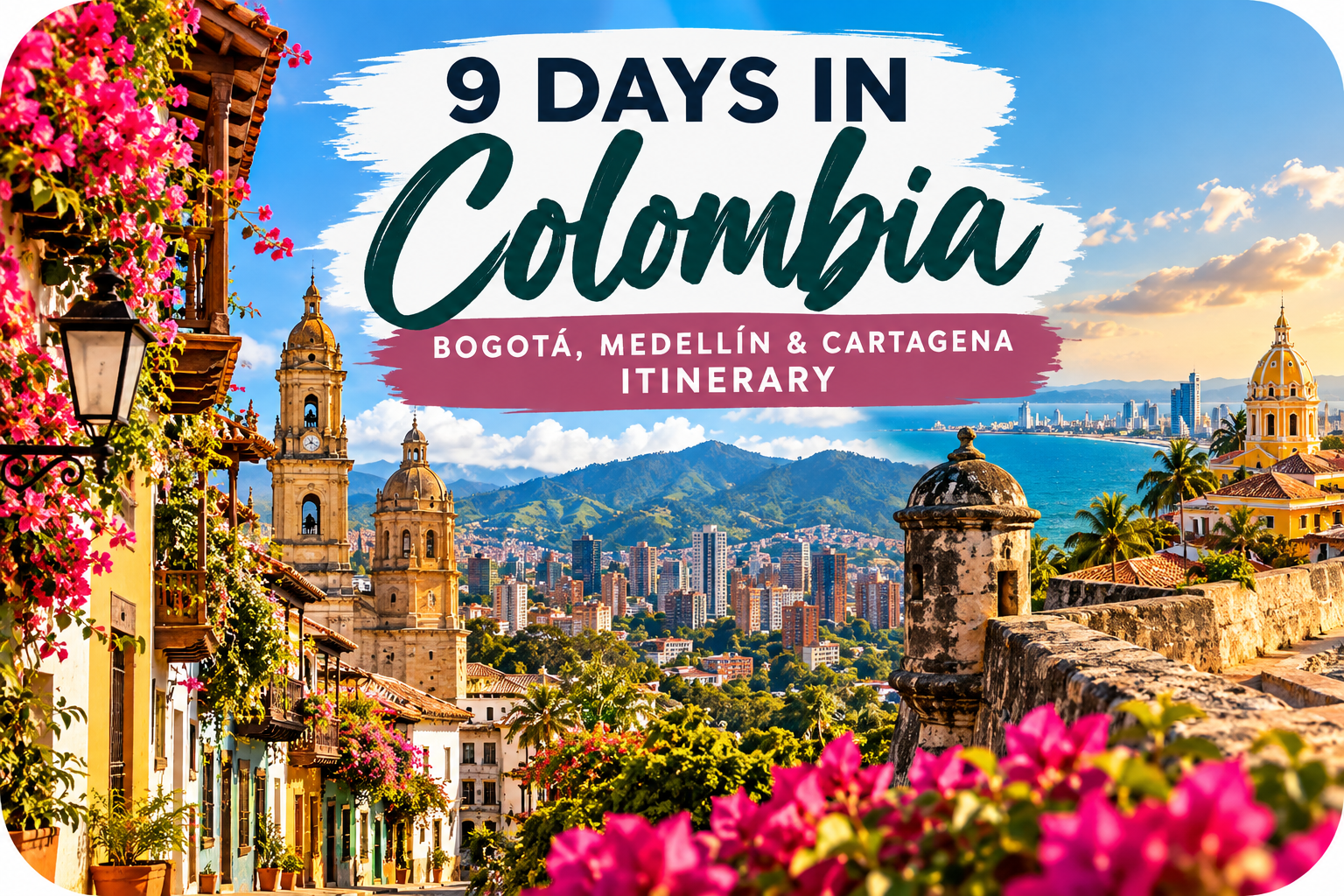
For a first trip, I’d keep it simple: Bogotá → Medellín → Cartagena in nine days.
Three cities. Three completely different sides of Colombia. Two short domestic flights. And enough time in each place that you aren’t unpacking your suitcase just to pack it again.
This post may contain affiliate links. If you book or purchase through one of these links, I may earn a commission at no additional cost to you. I only share options that I believe are genuinely useful for planning your trip.
Why Go to Colombia?
Colombia is much bigger and more geographically varied than a quick glance at the map suggests.
Bogotá sits high in the Andes. Medellín occupies the Aburrá Valley surrounded by green mountains. Cartagena sits on the Caribbean coast, where the architecture, food, climate, and Afro-Caribbean influences create a completely different experience.
And those are only three pieces.
Colombia also has Amazon rainforest, Pacific coastline, coffee-growing mountains, Caribbean islands, national parks, Indigenous communities, colonial towns, and the UNESCO-listed Coffee Cultural Landscape.
That’s why the biggest challenge with a first Colombia trip isn’t finding enough to do.
It’s stopping yourself from doing too much.
PLAN IT
How Many Days Do You Need for Your First Colombia Trip?
For Bogotá, Medellín, and Cartagena, I would plan nine days.
Here’s the basic route:
| Day | Where | Main Plan |
|---|---|---|
| 1 | Bogotá | Arrive and settle in |
| 2 | Bogotá | La Candelaria, museums, historic center |
| 3 | Bogotá | Food, neighborhoods, or Monserrate |
| 4 | Medellín | Fly to Medellín and explore |
| 5 | Medellín | City and neighborhood-focused day |
| 6 | Medellín | Flexible Medellín day or day trip |
| 7 | Cartagena | Fly to Cartagena |
| 8 | Cartagena | Historic Center + Getsemaní |
| 9 | Cartagena | Slow Caribbean morning + departure |
If you have ten or eleven days, add time.
Don’t automatically add another destination.
A fourth city isn’t a reward for finding two extra vacation days.
Why Start in Bogotá?
Because Colombia’s capital gives you context.
Bogotá’s historic La Candelaria neighborhood puts you near colonial architecture, street art, museums, historic sites, and the Gold Museum, which holds an enormous collection of pre-Columbian goldwork and other objects.
The city also has a significant restaurant and café scene drawing from culinary traditions throughout Colombia.
I’d give Bogotá three nights.
Day 1 should be easy, particularly because Bogotá sits at roughly 8,500 feet above sea level.
You may feel perfectly fine.
You may also wonder why carrying your suitcase suddenly feels like cardio.
Give yourself a minute.
Where Should You Stay in Bogotá?
For a first visit, I would compare areas based on the kind of trip you want rather than automatically booking closest to the historic center.
La Candelaria puts you close to major historical and cultural attractions, but I’d pay close attention to the specific location and current nighttime transportation advice.
Chapinero gives you restaurants, cafés, nightlife, and a broader range of modern accommodations.
Areas around Zona Rosa/Zona T and Parque 93 can work well if restaurants, nightlife, and upscale hotels are priorities.
This is one destination where I’d choose your hotel based partly on how you plan to move around after dark.
Saving $18 on a room isn’t particularly helpful if you spend the whole trip negotiating complicated transportation back to it.
What Should You Do With Two Full Days in Bogotá?
Keep the first sightseeing day geographically focused.
Spend time around La Candelaria, choosing from the Gold Museum, Botero Museum, Plaza de Bolívar, historic churches, architecture, street art, cafés, and restaurants.
Do not attempt all of them because I put them in one sentence.
Your second day can change direction.
You might visit Monserrate, explore another neighborhood, focus on food, visit a market, or spend more time in museums.
If you’re traveling with friends, this is also where I’d leave room for a long meal rather than turning the entire trip into organized activities.
Sometimes the three-hour dinner becomes the part everybody talks about later.
Why Fly From Bogotá to Medellín?
Because the road between the two cities is considerably longer than the flight.
Colombia’s mountainous geography makes overland travel slower than distances on a map sometimes suggest. The bus journey can take roughly 8 to 10 hours, depending on traffic and road conditions.
On a nine-day trip, I would fly.
You didn’t come to Colombia to spend an entire vacation day proving you can sit on a bus.
Why Include Medellín?
Because Medellín isn’t simply a warmer Bogotá.
The city occupies a narrow valley surrounded by mountains, and its geography has shaped how neighborhoods and transportation developed.
Its Metro and Metrocable systems are part of the city’s modern infrastructure, while museums, parks, neighborhoods, markets, restaurants, and nearby mountain landscapes give you plenty to do without treating Medellín solely as a launching pad for day trips.
Give it three nights.
That’s enough time to understand that Medellín is a real city with complicated history and contemporary life, not simply a collection of Instagram stops.
Where Should You Stay in Medellín?
Two areas will come up repeatedly when you start searching.
El Poblado has one of the largest concentrations of hotels, restaurants, cafés, nightlife, and tourism services. It’s convenient, especially for a first trip.
Laureles can be appealing if you want restaurants and neighborhood life without making the most tourism-heavy part of El Poblado your home base.
Neither automatically guarantees the experience you want.
If nightlife matters, check what is actually around your hotel.
If sleep matters, also check what is actually around your hotel.
These two research projects are related.
Is Comuna 13 Worth Visiting?
It can be, but I would be thoughtful about how you visit.
Comuna 13’s history includes violence, displacement, state intervention, community organizing, art, music, tourism, and significant urban transformation.
Reducing all of that to “colorful escalators and murals” doesn’t do the community much justice.
If you go, consider using a knowledgeable local guide who can explain the neighborhood’s history and present-day context rather than treating it as a backdrop for photos.
Tourism can bring economic opportunity.
It can also turn communities into spectacles when visitors stop paying attention to the people who live there.
Choose the first version.
Should You Take a Day Trip to Guatapé?
Maybe.
Guatapé’s colorful streets, reservoir landscape, and El Peñol rock make it one of the most popular excursions from Medellín.
But you have only two full Medellín days in this itinerary.
If Guatapé is high on your list, use Day 6.
If you’re more interested in Medellín itself, stay in the city.
This is an easy place to ignore someone else’s “must-do.”
You are allowed to travel all the way to Colombia and not climb a giant rock.
Why Finish in Cartagena?
Because after two Andean cities, Cartagena changes everything.
The temperature changes.
The architecture changes.
The food changes.
The pace changes.
And the Caribbean is suddenly right there.
Cartagena’s historic fortified city is a UNESCO World Heritage Site. Its walls were constructed over several centuries, and its history includes its role as a major colonial port through which goods, enslaved people, pirates, invaders, and imperial power passed.
That history matters.
Cartagena isn’t simply colorful balconies.
Where Should You Stay in Cartagena?
For this itinerary, I’d start by comparing three areas.
The Walled City puts you inside Cartagena’s historic center, close to architecture, restaurants, plazas, museums, and the city walls. It’s convenient and atmospheric, but often expensive.
Getsemaní has restaurants, street art, nightlife, guesthouses, and boutique hotels just outside the core of the Walled City.
Bocagrande has larger hotels, high-rises, pools, and easier beach access, but it gives you a very different experience from staying in historic Cartagena.
If this is your first visit and history is the priority, I would lean toward the Walled City or Getsemaní.
Cartagena is also the most likely stop on this itinerary to push your lodging budget upward.
What Should You Do With One Full Day in Cartagena?
Walk.
This is not the city where I would build a spreadsheet containing 11 attractions.
Explore the Historic Center.
Walk sections of the walls.
Learn about Cartagena’s colonial and Afro-Caribbean history.
Spend time in Getsemaní.
Eat.
Take a break when the heat starts making decisions for you.
Then go back out later.
You could rush through Cartagena’s historic center in a few hours, but you could also spend days wandering its streets, plazas, museums, churches, restaurants, and walls.
I vote for the second approach.
Do You Need to Add an Island Day?
No.
If you have an extra day and want Caribbean water, you can research an island or beach excursion.
But Cartagena itself deserves time.
Don’t arrive on Day 7, leave for an island all day on Day 8, and fly home Day 9, then announce that you visited Cartagena.
You mostly visited Cartagena’s airport.
If beaches are one of the main reasons you’re going to Colombia, I’d extend the trip or build a different itinerary around the Caribbean coast.
When Is the Best Time to Visit Colombia?
This gets tricky because Bogotá, Medellín, and Cartagena have very different climates.
If you were planning each city individually, there are certain periods I’d look at first.
- For Bogotá, the drier stretches generally fall around December through March and July through August. Because the city sits high in the Andes, temperatures stay relatively cool throughout the year. Even during a sunnier period, you’ll want layers and something for rain.
- For Medellín, the climate is mild throughout the year, which is part of the reason it has earned its “City of Eternal Spring” nickname. The relatively drier periods around December through February and June through August can be appealing for sightseeing, while wetter periods generally occur in spring and fall. Rain is still possible whenever you visit.
- For Cartagena, December through April is generally the drier season. That makes it attractive for walking the historic center and spending time along the Caribbean, but it also overlaps with popular travel periods when hotel rates can climb. The wetter months can bring more humidity and rain, although Cartagena remains hot throughout the year.
But when you combine all three cities into this nine-day itinerary, I wouldn’t obsess over finding one magical week with perfect weather in all three places.
It doesn’t really exist.
Instead, choose dates that work for your schedule and budget, check whether a major holiday or festival will affect prices, and pack for three different versions of Colombia.
- For Bogotá, bring layers and a light rain jacket.
- For Medellín, think comfortable warm-weather clothing with rain protection.
- For Cartagena, bring lightweight, breathable clothes, serious sun protection, and whatever you need to make peace with humidity.
This is less about finding the perfect Colombia weather window and more about being prepared when Bogotá makes you reach for a jacket and Cartagena makes you wonder why you packed one.
What Should Solo Travelers, Families, and Groups Know?
- For solo travelers, this itinerary has a strong tourism infrastructure and easy domestic air connections, but transportation choices and nighttime routines deserve attention. Use reputable transportation, stay aware of your surroundings, and check current local guidance.
- For families, three cities in nine days is enough movement. Don’t turn every day into a tour. Museums, parks, food experiences, Cartagena’s walls, and Medellín’s transportation can all be interesting without booking an activity every morning and afternoon.
My guide to preparing your kids for travel can help with expectations before the trip.
- For multigenerational groups, think about Bogotá’s altitude, Cartagena’s heat, uneven historic streets, and how much walking each person actually enjoys.
My guide to multigenerational travel goes deeper into planning around different energy and mobility levels.
- And for friend groups, don’t make every meal, museum, shopping stop, and evening activity mandatory for everybody.
A group trip becomes much easier when people are occasionally allowed to disappear for two hours.
What Are the Current Travel Guidelines for Colombia?
This is one section to check carefully again before departure.
For U.S. travelers, tourist entry requirements depend on the length and purpose of the visit. Check current passport, visa, onward-travel, and immigration requirements directly with Colombian authorities before departure.
Colombia also uses the Check-Mig system for traveler pre-registration. Check the current requirements and timing shortly before your flight rather than relying on an old screenshot or travel post.
Safety guidance deserves particular attention.
Current U.S. government travel guidance includes elevated warnings for Colombia, with stronger warnings for certain regions and border areas. That does not mean every neighborhood or destination carries identical conditions. It does mean this isn’t a section I’d skim past.
Read the full current advisory before booking and again before departure. Pay attention to the specific places on your itinerary, monitor local developments, use reputable transportation, avoid displaying valuables, and adjust plans if conditions change.
Entry requirements, health requirements, Check-Mig procedures, and security conditions can change, so confirm current information with Colombian authorities and your own government’s travel guidance shortly before your trip.
AFFORD IT
How Much Should You Budget for 9 Days in Colombia?
Colombia can offer good value, but the phrase “Colombia is cheap” isn’t particularly useful.
Your biggest variables are where you stay, how you travel between cities, and how much time you spend in Cartagena.
For this Bogotá + Medellín + Cartagena itinerary, excluding international airfare but including normal daily expenses and allowing for domestic transportation, I’d use these as practical planning ranges per person, per day, assuming two people share a room:
| Travel Style | Planning Range |
|---|---|
| Affordable | $65–100 per person/day |
| Comfortable | $125–225 per person/day |
| Upscale | $300+ per person/day |
Treat those as planning ranges, not quoted prices.
Exchange rates, hotel rates, domestic airfare, holidays, and seasonal demand can move the numbers quickly.
Cartagena will often be the place where your budget starts getting ideas.
Where Is It Worth Spending More?
Domestic flights.
On a nine-day itinerary, Bogotá → Medellín → Cartagena is a much better use of time by air than by long-distance bus.
A well-located hotel.
Location matters in all three cities, particularly when you start thinking about nighttime transportation.
A knowledgeable local guide.
This is especially worthwhile when the history is complicated. Bogotá, Medellín, and Cartagena all have stories that are easy to flatten into tourist-friendly versions.
One Cartagena experience you really care about.
That might be a special hotel, meal, historical tour, or Caribbean day.
Spend because it improves the trip, not because Cartagena has successfully convinced you that vacation money isn’t real.
Where Can You Save?
Use public transportation where it makes sense.
Eat local lunches and casual meals rather than treating every dinner as an event.
Spend time walking neighborhoods and historic areas.
Choose one major paid experience per city rather than stacking tours.
And don’t automatically add an island excursion in Cartagena just because you are near the Caribbean.
You can see water for free.
Can You Use Hotel Points in Colombia?
Yes. This itinerary gives you several opportunities.
- Bogotá has a significant major-brand hotel footprint, including Marriott Bonvoy and Hilton Honors properties.
- Medellín also has major loyalty-program options, particularly around El Poblado and other tourism-oriented areas.
- Cartagena may be particularly interesting for points because cash hotel rates can climb. You’ll find options connected to major programs including Marriott Bonvoy and Hilton Honors.
That does not mean you should automatically redeem points.
Compare the cash rate with the award rate.
Cartagena is where a redemption may save meaningful cash during an expensive period. Bogotá may occasionally be cheap enough that paying cash and saving your points makes more sense.
My Hotel Points 101 guide explains the approach.
Use the points where useful, save strategically, and be thoughtful about where the rest of your travel dollars go.
What About Airbnb and Vrbo?
Vacation rentals are worth comparing, particularly for families and groups.
In Bogotá and Medellín, an apartment can give you multiple bedrooms, laundry, and shared living space.
In Cartagena, a larger rental can look especially appealing for a group.
But compare the total price, not the nightly rate.
Check:
- exact location
- building security and access
- cleaning and service fees
- air conditioning in Cartagena
- cancellation terms
- elevators and stairs
- nighttime noise
- transportation
- luggage storage
- property rules
For groups, also ask the important question:
Does saving $23 per person actually justify sharing one bathroom with six adults?
There are limits to financial optimization.
Can Points and Miles Help With Flights?
Yes.
Start by comparing international flights into Bogotá and flights home from Cartagena.
An open-jaw itinerary can save you from flying all the way back to Bogotá simply because that’s where you started.
Then price Bogotá → Medellín and Medellín → Cartagena separately.
Domestic flights can save substantial time because Colombia’s mountains and distances make overland travel much slower than the map sometimes suggests.
If you’re new to this, my guide to using credit card points for family travel explains how to compare cash and award options without turning points into another job.
How Can Your Travel Dollars Support Colombia’s Local Economy?
Use your hotel points if they solve an expensive hotel night.
Then spend thoughtfully elsewhere.
Eat at locally owned restaurants.
Use knowledgeable local guides.
Buy directly from artisans.
Support coffee producers when you eventually visit coffee country.
And remember that neighborhoods such as Comuna 13 aren’t attractions built for tourists. People live there.
The same principle applies to Colombia’s Coffee Cultural Landscape. It is a living, productive landscape shaped by generations of coffee-growing families, not simply a scenic collection of plantations.
Travel dollars can support that culture.
They don’t need to turn it into a performance.
ENJOY IT
Protect Your Peace: Do You Need to Add Coffee Country?
Not to this trip.
I know.
It’s Colombia.
Coffee is right there in the name of an entire region.
But Colombia’s Coffee Triangle deserves more than a 36-hour detour.
Salento alone gives you colorful traditional architecture, coffee farms, the Cocora Valley, and its towering wax palms. Nearby Filandia and other coffee-region towns add farms, crafts, mountain landscapes, and their own character.
If coffee country is one of your biggest reasons for visiting Colombia, build a different itinerary around it.
Don’t wedge it between Medellín and Cartagena because there was technically room on the calendar.
Do You Need Bogotá, Medellín, and Cartagena?
No.
This is a first-timer route, not a legal requirement.
If you care deeply about food and museums, add more Bogotá.
If Medellín interests you most, stay longer.
If you want history and Caribbean time, build the trip around Cartagena and the coast.
A good itinerary reflects what you care about.
It doesn’t need unanimous approval from the internet.
What Should You Not Over-Plan in Medellín?
Neighborhood time.
Meals.
Cafés.
Your last afternoon.
And every possible day trip.
If you schedule Comuna 13, Guatapé, a coffee tour, museums, nightlife, a food tour, and three neighborhoods into two days, you haven’t discovered a planning hack.
You’ve created a problem.
Give Medellín some room.
How Do You Handle Cartagena’s Heat Without Becoming Miserable?
Stop fighting it.
Start earlier.
Take a break during the hottest part of the afternoon.
Go back out later.
Book a hotel with air conditioning.
Drink water.
Wear sun protection.
And don’t build a walking itinerary that assumes your energy level at 2 p.m. in Caribbean heat will be identical to your energy level at breakfast.
Your hotel room is not a defeat.
Sometimes the smartest sightseeing decision is a shower and an hour of air conditioning.
What About Safety Without Letting It Take Over the Trip?
Take it seriously enough to change your behavior.
Don’t turn it into the only thing you know about Colombia.
Check current guidance.
Choose accommodations thoughtfully.
Use reputable transportation.
Be deliberate about nighttime plans.
Avoid displaying expensive jewelry, watches, and phones unnecessarily.
Don’t accept drinks or substances from strangers.
Keep your group aware of where everyone is going.
And if a situation feels wrong, leave.
Colombia has legitimate security concerns, and official travel guidance should be part of your planning.
It is also a large, diverse country with distinct cities, regions, cultures, landscapes, and daily lives.
Both facts can exist at the same time.
What’s the Sanity-Saving Take on Colombia?
Don’t try to understand Colombia in one trip.
Start with three places that show you how different the country can be.
Bogotá gives you altitude, history, museums, food, and the energy of the capital.
Medellín gives you mountains, neighborhoods, public spaces, urban change, and a different regional identity.
Cartagena gives you Caribbean history, Afro-Caribbean culture, architecture, heat, and a completely different pace.
Then stop.
Coffee country can wait.
The Caribbean beaches beyond Cartagena can wait.
The Amazon can definitely wait.
Leaving Colombia with places you still want to see is not poor planning.
It’s usually evidence that you planned the first trip correctly.
Want Someone Else to Handle the Bigger Colombia Trip?
If reading the coffee-country section made you think, No, actually, I want that Colombia, there is another option.
One of my travel partners offers a broader itinerary built around Colombia’s Coffee Triangle and Caribbean beaches.
That is a different trip from the Bogotá → Medellín → Cartagena route I’ve built here.
The independent itinerary is designed for a first introduction to three major cities with straightforward domestic flights and plenty of control over your schedule.
The organized option makes more sense for someone who wants to go beyond the city-focused route and experience Colombia’s coffee landscapes and Caribbean side with more of the transportation, accommodations, and logistics handled.
You’ll give up some independence.
You’ll also give up some spreadsheets.
If that trade sounds appealing, you can explore the Coffee Triangle and Caribbean beaches itinerary through my travel partner.
If Bogotá, Medellín, and Cartagena are the places you’re most curious about, stick with the independent route.
They’re two different ways to experience a country that is far too varied to fit neatly into nine days.
Travel information in this guide was accurate at the time of posting. Prices, routes, schedules, hotel and tour availability, entry requirements, safety conditions, and other travel details can change. Always confirm current information directly with the relevant provider or official source before your trip.
Related Blog Posts
How to Prepare Your Kids for Travel: Start With Yourself
Five Multigenerational Vacation Ideas for Families Traveling With Elderly Parents or Grandparents
Hotel Points 101: How to Earn Free Nights Without Turning It Into Another Job
The Overwhelmed Parent’s Guide to Using Credit Card Points for Family Travel